Pengi Editor's Note
This article walks through the 2016 AMC 8 exam with a topic-by-topic breakdown, a module-to-question mapping table, and five fully worked representative problems covering geometry, word problems, number theory, combinatorics, and probability. Pengi's editorial team selected this piece as a high-quality reference for students in grades 6–8 gearing up for AMC 8 or other math competitions — the problem walkthroughs and common-mistake callouts are especially practical for self-study.
Source: Think Academy Blog
2016 AMC 8 Real Questions and Analysis
In this article, you'll find:
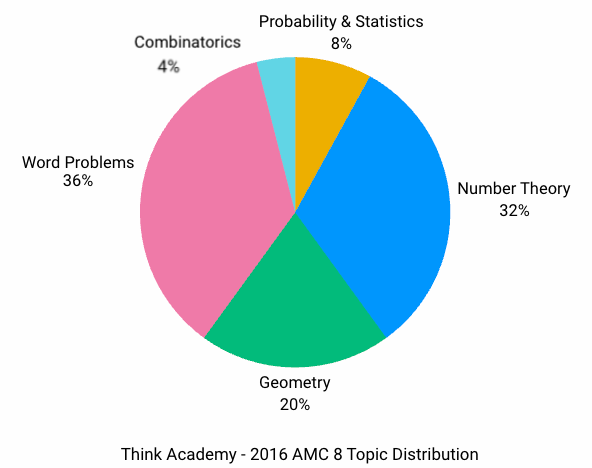
- A concise topic distribution (with a pie chart)
- The core concepts typically tested in each module
- A module-to-question mapping table for the 2016 AMC 8
- Five representative real questions with solutions and common mistakes
- Best resources to prepare for AMC 8
2016 AMC 8 Topic Distribution
The 2016 AMC 8 contains 25 multiple-choice questions completed in 40 minutes, emphasizing logical reasoning and conceptual understanding.
Detailed Module Analysis
| Module | Question Numbers | What It Tests (Brief) |
|---|---|---|
| Geometry | 2, 11, 16, 22, 25 | rectangle midpoint triangle area, diagonal tile count, racing geometry elimination, composite area, semicircle in isosceles triangle |
| Word Problems / Arithmetic | 1, 3, 4, 12, 14, 17, 20, 23, 24 | conversion / unit time, average remaining score, rate comparison, proportional reasoning, tank mileage, percent faster lap problem, LCM day pattern, digit divisibility building number |
| Number Theory / Algebra | 5, 7, 8, 10, 13, 15, 19, 21 | modular arithmetic, perfect square exponent check, telescoping sum, custom operator, prime divisor sum, largest power divisor, consecutive integer constraints, password count with restriction |
| Combinatorics & Logic | 18 | elimination tournament race logic reasoning |
| Probability & Statistics | 6, 9 | median graph statistics; chip drawing probability order |
Real Questions and Solutions Explained
Geometry Example – Problem 22
Question:
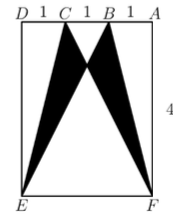
Rectangle DEFA below is a 3 × 4 rectangle with DC = CB = BA = 1. The area of the "bat wings" (shaded area) is:
(A) 2 (B) 2(\frac{1}{2}) (C) 3 (D) 3(\frac{1}{2}) (E) 5
Solution:
Consider trapezoid (𝑪𝑩𝑭𝑬) with parallel bases (𝑪𝑩=1) and (𝑭𝑬=3) and height (4).
[
\text{Area}(𝑪𝑩𝑭𝑬)=\frac{1+3}{2}\cdot4=8.
]
The two white isosceles triangles are similar in a height ratio (3:1) (AA similarity: alternate interior and vertical angles).
Hence their heights are 3 and 1, so their areas are
[
\frac{1}{2}\quad \text{and}\quad \frac{9}{2}.
]
Subtracting from the trapezoid gives the shaded area:
[
8-\frac{1}{2}-\frac{9}{2}=8-5=3.
]
Answer: (C)
Common Mistakes:
- Using rectangle base 4 instead of trapezoid average base ((1+3)/2)
- Assuming both white triangles have the same height (they are in ratio 3:1)
- Subtracting side lengths instead of areas
Word Problem Example – Problem 1
Question:
The longest professional tennis match ever played lasted a total of 11 hours and 5 minutes. How many minutes was this?
(A) 605 (B) 655 (C) 665 (D) 1005 (E) 1105
Solution:
11 hours is (11\times60=660) minutes, and (660+5=665).
Answer: (C)
Common Mistakes:
- Multiplying (11\times60) incorrectly.
- Forgetting to add the extra 5 minutes.
- Turning 5 minutes into a decimal of an hour and rounding.
Number Theory Example – Problem 15
Question:
What is the largest power of 2 that is a divisor of (13^{4}-11^{4})?
(A) 8 (B) 16 (C) 32 (D) 64 (E) 128
Solution:
Use difference of squares twice:
[
13^{4}-11^{4}=(13^{2}-11^{2})(13^{2}+11^{2})=(169-121)(169+121)=48\cdot290.
]
Now (48=2^{4}\cdot3) and (290=2\cdot145). Hence
[
48\cdot290=(2^{4}\cdot3)(2\cdot145)=2^{5}\cdot(3\cdot145),
]
so the greatest power of 2 dividing (13^{4}-11^{4}) is (2^{5}=32).
Answer: (C)
Common Mistakes:
- Stopping after the first factorization step.
- Missing the extra factor 2 inside 290.
- Guessing from parity without factoring.
Combinatorics Example – Problem 18
Question:
In an All-Area track meet, 216 sprinters enter a 100-meter dash competition. The track has 6 lanes, so only 6 sprinters can compete at a time. At the end of each race, the five non-winners are eliminated, and the winner will compete again in a later race. How many races are needed to determine the champion sprinter?
(A) 36 (B) 42 (C) 43 (D) 60 (E) 72
Solution:
Each race eliminates 5 sprinters. To leave exactly one champion from 216 entrants, we must eliminate (216-1=215) sprinters.
Number of races needed is (215\div5=43).
Answer: (C)
Common Mistakes:
- Dividing 216 by 5 directly.
- Double-counting the final race.
- Forgetting that the winner continues to future rounds.
Probability Example – Problem 9
Question:
What is the sum of the distinct prime integer divisors of 2016?
(A) 9 (B) 12 (C) 16 (D) 49 (E) 63
Solution:
Prime factorization: (2016=2^{5}\cdot3^{2}\cdot7).
Distinct primes are 2, 3, 7, and their sum is (2+3+7=12).
Answer: (B)
Common Mistakes:
- Including repeated prime powers in the sum.
- Missing the factor 7 in 2016.
- Adding all divisors instead of distinct primes.
Free Download: 2016 AMC 8 Problems
Recommended Reading
- 2017 AMC 8 Real Questions and Analysis
- How to Prepare for AMC 8 Math Competition
- All About 2026 AMC 8: Dates, Registration, Scores and Prep Tips
- AMC 8 FAQs: The Ultimate Guide for First-Time Test Takers
Try Pengi AI — Smarter Math Practice for Students
Pengi AI supports K–12 learners with personalized math practice, guided explanations, and feedback designed to help them build confidence and improve steadily.