Pengi Editor's Note
This article breaks down the 2017 AMC 10A with a full topic distribution chart, module-to-question mapping, and four representative problems spanning algebra, number theory, geometry, and combinatorics — each with a complete solution and a list of common mistakes. Pengi's editorial team selected this piece as a high-value reference for students aiming to improve their AMC 10 scores; the answer key and topic breakdown are especially useful for identifying weak areas.
Source: Think Academy Blog
2017 AMC 10A Real Questions and Analysis
In this article, you'll find:
- Representative real questions from each module with detailed solutions.
- The complete 2017 AMC 10A Answer Key.
- The best resources to prepare effectively for the AMC 10.
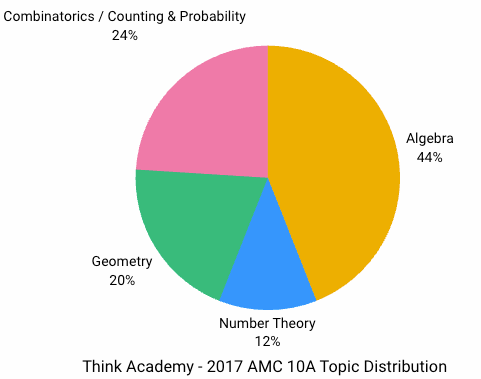
- A concise topic distribution chart showing which areas appeared most in the 2017 AMC 10A.
- A module-to-question mapping table highlighting the core concepts tested in each module for the 2017 AMC 10A.
Real Question and Solutions Explained
Algebra Example – Problem 2
Question:
Pablo buys popsicles for his friends. The store sells single popsicles for $1 each, 3–popsicle boxes for $2 each, and 5–popsicle boxes for $3. What is the greatest number of popsicles that Pablo can buy with $8?
(A) 8 (B) 11 (C) 12 (D) 13 (E) 15
Solution:
Best value per dollar is the 5–pack ( \left( \frac{5}{3} \right) ), then the 3–pack ( \left( \frac{3}{2} \right) ), then singles ( \left( \frac{1}{1} \right) ).
Use as many 5–packs as possible: with $8 take two 5–packs ($6) and one 3–pack ($2).
Popsicles: ( 5 \cdot 2 + 3 = 13 ).
Any other combination gives at most 12 (e.g., four 3–packs, or one 5–pack + two 3–packs + one single).
Answer (D)
Common Mistakes:
- Forgetting that you must spend at most $8 exactly; some mixes leave unused money.
- Comparing packs by price instead of value per dollar.
Number Theory Example – Problem 16
Question:
There are 10 horses named Horse (k) that take exactly (k) minutes per lap. Starting together, the least time (S>0) when all 10 are simultaneously back at the start is (S=2520). Let (T>0) be the least time such that at least 5 of the horses are again at the starting point together. What is the sum of the digits of (T)?
(A) 2 (B) 3 (C) 4 (D) 5 (E) 6
Solution:
At time (t), Horse (k) is at the start iff (k\mid t). We want the smallest (t>0) with at least 5 distinct (k\in{1,\dots,10}) dividing (t).
Check minimal (t):
- (t=10\Rightarrow {1,2,5,10}) → 4 horses.
- (t=12\Rightarrow {1,2,3,4,6}) → 5 horses (works).
No smaller (t\le 11) has 5 divisors from ({1,\dots,10}).
Thus (T=12). Sum of digits: (1+2=3).
Answer (B)
Common Mistakes:
- Looking for 5 distinct lap times without divisor nesting (e.g., (1,2,3,4,6) all dividing 12).
- Thinking (T) must be one of the existing lap times.
Geometry Example – Problem 3
Question:
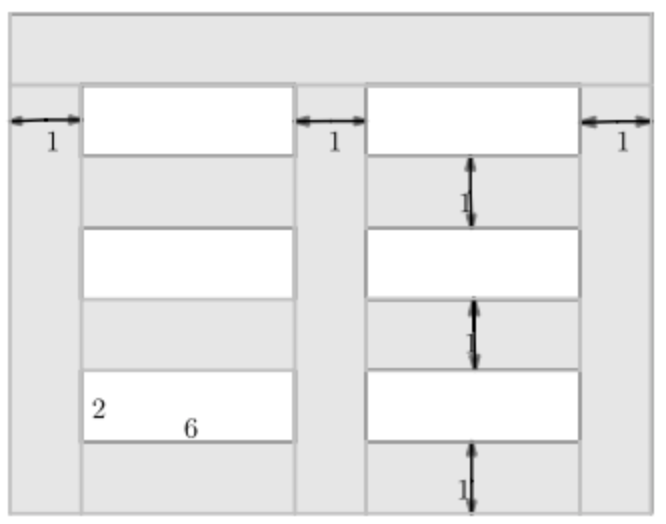
Tamara has three rows of two (6)-ft by (2)-ft flower beds. The beds are separated and surrounded by (1)-ft–wide walkways as shown. What is the total area of the walkways, in square feet?
(A) 72 (B) 78 (C) 90 (D) 120 (E) 150
Solution:
Overall outer rectangle: width (=1+6+1+6+1=15) ft; height (=1+2+1+2+1+2+1=10) ft.
Total outer area (=15\times 10 = 150).
There are (6) beds, each (6\times 2 = 12) sq ft, so total bed area (=6\times 12 = 72).
Walkway area (=150 – 72 = 78).
Answer (B)
Common Mistakes:
- Missing one of the outer/between (1)-ft strips.
- Treating (6\times 2) as orientation–independent without counting rows/columns.
Combinatorics Example – Problem 8
Question:
At a gathering of 30 people, 20 all know each other and 10 know no one. People who know each other hug; people who do not know each other shake hands. How many handshakes occur?
(A) 240 (B) 245 (C) 290 (D) 480 (E) 490
Solution:
The 20 mutual acquaintances produce 0 handshakes (they hug).
Each of the 10 who know no one shakes with all 20: (10\cdot 20=200).
Among those 10, none know each other, so they also shake with each other:
[ \text{within the 10} = \frac{10!}{2!,8!} = 45. ]
Total handshakes (=200 + 45 = 245).
Answer (B)
Common Mistakes:
- Double–counting handshakes or mixing hugs with handshakes.
- Assuming the 10 "know no one" except among themselves.
2017 AMC 10A Answer Key
| Question | Answer |
|---|---|
| 1 | C |
| 2 | D |
| 3 | B |
| 4 | B |
| 5 | C |
| 6 | B |
| 7 | A |
| 8 | B |
| 9 | C |
| 10 | B |
| 11 | D |
| 12 | E |
| 13 | D |
| 14 | D |
| 15 | C |
| 16 | B |
| 17 | D |
| 18 | D |
| 19 | C |
| 20 | D |
| 21 | D |
| 22 | E |
| 23 | B |
| 24 | C |
| 25 | A |
Free Download: 2017 AMC 10A Problems & Solution
Download 2017 AMC 10A Problems
Download 2017 AMC 10A Solution
2017 AMC 10A Topic Distribution
The 2017 AMC 10A featured 25 questions to be completed in 75 minutes, emphasizing advanced problem-solving and proof-based reasoning skills.
Detailed Module Analysis
| Module | Question Numbers | What It Tests (Brief) |
|---|---|---|
| Algebra | 1–5, 7, 9, 12, 13, 14, 17, 24 | Basic operations, functions, coordinate geometry |
| Number Theory | 16, 20, 25 | GCD/LCM, divisibility |
| Geometry | 3, 10, 11, 21, 22 | Polygons, solids, circles |
| Combinatorics / Probability | 6, 8, 15, 18, 19, 23 | Counting and probability |
Try Pengi AI — Smarter Math Practice for Students
Pengi AI supports K–12 learners with personalized math practice, guided explanations, and feedback designed to help them build confidence and improve steadily.