Pengi Editor's Note
This article analyzes the 2017 AMC 10B with a topic distribution chart, module-to-question mapping table, and four representative problems — each worked out in full with clearly labeled common mistakes. Pengi's editorial team selected this piece because the problem walkthroughs cover a strong cross-section of AMC 10B difficulty levels and are directly useful for students doing targeted exam prep.
Source: Think Academy Blog
2017 AMC 10B Real Questions and Analysis
In this article, you'll find:
- Representative real questions from each module with detailed solutions.
- The complete 2017 AMC 10B Answer Key.
- The best resources to prepare effectively for the AMC 10.
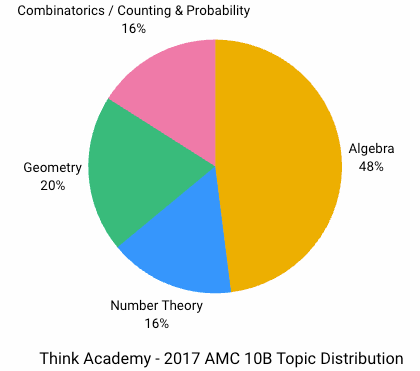
- A concise topic distribution chart showing which areas appeared most in the 2017 AMC 10B.
- A module-to-question mapping table highlighting the core concepts tested in each module for the 2017 AMC 10B.
Real Question and Solutions Explained
Algebra Example – Problem 2
Question:
Sofia ran 5 laps around the 400–meter track at her school. For each lap, she ran the first 100 meters at an average speed of 4 meters per second and the remaining 300 meters at an average speed of 5 meters per second. How much time did Sofia take running the 5 laps?
(A) 5 minutes and 35 seconds (B) 6 minutes and 40 seconds (C) 7 minutes and 5 seconds (D) 7 minutes and 25 seconds (E) 8 minutes and 10 seconds
Solution:
Time per lap:
[ \frac{100}{4} + \frac{300}{5} = 25 + 60 = 85\text{ s.} ]
For 5 laps:
[ 5 \times 85 = 425\text{ s.} ]
Convert to minutes:
[ 425\text{ s} = 7\text{ minutes } 5\text{ seconds.} ]
Answer:(C)
Common Mistakes:
- Averaging speeds instead of summing times.
- Mixing meters/seconds with minutes/hours.
- Forgetting the "per lap" structure and multiplying distances incorrectly.
Number Theory Example – Problem 14
Question:
An integer ( N ) is selected at random in the range ( 1 \le N \le 2020 ). What is the probability that the remainder when ( N^{16} ) is divided by 5 is 1?
(A) ( \frac{1}{5} ) (B) ( \frac{2}{5} ) (C) ( \frac{3}{5} ) (D) ( \frac{4}{5} ) (E) 1
Solution:
If 5 does not divide ( N ), then by Euler's theorem:
[ N^{\varphi(5)} = N^4 \equiv 1 \pmod{5}. ]
Hence,
[ N^{16} = (N^4)^4 \equiv 1 \pmod{5}. ]
If ( 5 \mid N ), then ( N^{16} \equiv 0 \pmod{5} ).
Therefore, all numbers not divisible by 5 give remainder 1.
Count of multiples of 5 in ( 1..2020 ):
[ \frac{2020}{5} = 404. ]
Favorable outcomes:
[ 2020 – 404 = 1616. ]
Probability:
[ \frac{1616}{2020} = \frac{4}{5}. ]
Answer:(D)
Common Mistakes:
- Checking only small bases (1–4) and assuming uniform distribution.
- Forgetting to exclude multiples of 5.
- Claiming ( N^{16} \equiv 1 ) for all ( N ).
Geometry Example – Problem 15
Question:
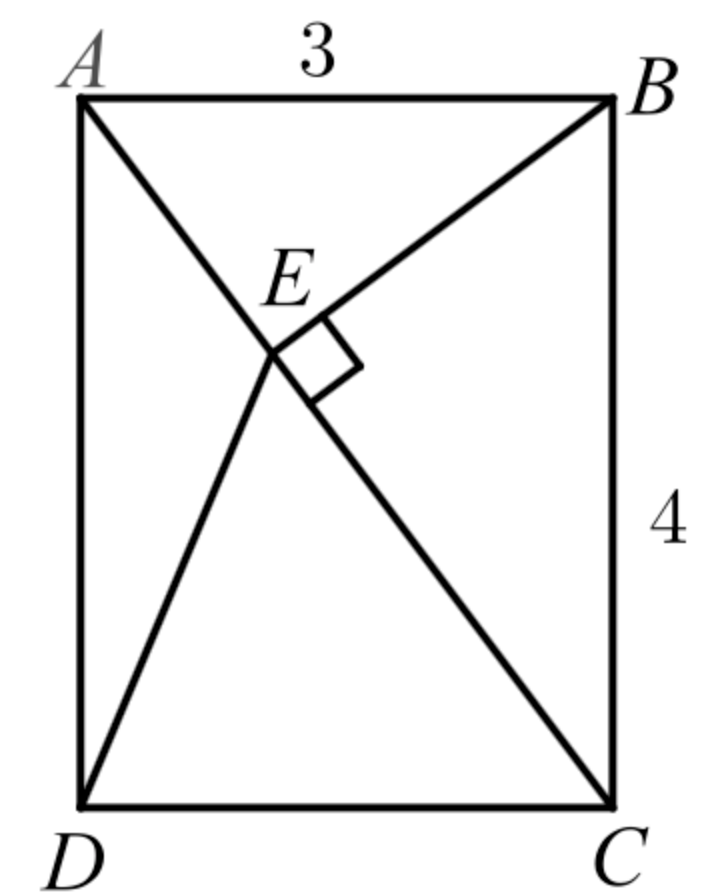
Rectangle (ABCD) has (AB = 3) and (BC = 4). Point (E) is the foot of the perpendicular from (B) to diagonal (\overline{AC}).
What is the area of (\triangle AED)?
(A) 1 (B) ( \frac{42}{25} ) (C) ( \frac{28}{15} ) (D) 2 (E) ( \frac{54}{25} )
Solution:
Place ( A(0,4),\ B(3,4),\ C(3,0),\ D(0,0) ).
Vector along diagonal ( AC ):
[
\vec{v} = (3, -4).
]
From ( B ), foot of perpendicular onto ( AC ):
[
t = \frac{(B – A) \cdot \vec{v}}{\vec{v} \cdot \vec{v}} = \frac{9}{25},
\quad
E = A + t \vec{v} = \left( \frac{27}{25}, \frac{64}{25} \right).
]
Triangle ( \triangle AED ) has base ( AD = 4 ) (vertical) and height equal to the horizontal distance from ( E ) to ( AD ), which is ( \frac{27}{25} ).
Area:
[ \text{Area} = \frac{1}{2} \times 4 \times \frac{27}{25} = \frac{54}{25}. ]
Answer: (E)
Common Mistakes:
- Computing via slope–angle formulas instead of projection.
- Using distance from (E) to (AB) or (BC) instead of (AD).
- Arithmetic mistakes when calculating (t).
Combinatorics Example – Problem 9
Question:
A radio program has a quiz consisting of 3 multiple–choice questions, each with 3 choices. A contestant wins if he or she gets 2 or more of the questions right. The contestant answers randomly to each question. What is the probability of winning?
(A) ( \frac{1}{27} ) (B) ( \frac{1}{9} ) (C) ( \frac{2}{9} ) (D) ( \frac{7}{27} ) (E) ( \frac{1}{2} )
Solution:
Let ( p = \frac{1}{3} ) be the probability of answering a question correctly.
[ P(\text{win}) = P(\text{exactly 2 correct}) + P(\text{exactly 3 correct}) ]
There are 3 ways to get exactly 2 correct out of 3 questions,
so number of combinations ( = \frac{3!}{2!(3-2)!} = 3. )
[ P(\text{win}) = 3 \cdot p^2 (1 – p) + p^3 = 3 \cdot \frac{1}{9} \cdot \frac{2}{3} + \frac{1}{27} = \frac{6}{27} + \frac{1}{27} = \frac{7}{27}. ]
Answer:(D)
Common Mistakes:
- Counting only the "all 3 correct" case.
- Using ( p = \frac{1}{2} ) instead of ( \frac{1}{3} ).
- Forgetting the binomial coefficient for "exactly 2."
2017 AMC 10B Answer Key
| Question | Answer |
|---|---|
| 1 | B |
| 2 | C |
| 3 | E |
| 4 | D |
| 5 | D |
| 6 | B |
| 7 | C |
| 8 | C |
| 9 | D |
| 10 | E |
| 11 | D |
| 12 | A |
| 13 | C |
| 14 | D |
| 15 | E |
| 16 | A |
| 17 | B |
| 18 | D |
| 19 | E |
| 20 | B |
| 21 | D |
| 22 | D |
| 23 | C |
| 24 | C |
| 25 | E |
Free Download: 2017 AMC 10B Problems & Solution
Download 2017 AMC 10B Problems
Download 2017 AMC 10B Solution
2017 AMC 10B Topic Distribution
The 2017 AMC 10B featured 25 questions to be completed in 75 minutes, emphasizing advanced problem-solving and proof-based reasoning skills.
Detailed Module Analysis
| Module | Question Numbers | What It Tests (Brief) |
|---|---|---|
| Algebra | 1–5, 7, 8, 10–13, 17, 24 | Equations, ratios, coordinate geometry |
| Number Theory | 14, 20, 23, 25 | Congruence, divisibility |
| Geometry | 6, 15, 19, 21, 22 | Triangles, solids |
| Combinatorics / Probability | 9, 16, 17, 18 | Counting and probability |
Try Pengi AI — Smarter Math Practice for Students
Pengi AI supports K–12 learners with personalized math practice, guided explanations, and feedback designed to help them build confidence and improve steadily.