Pengi Editor's Note
This article provides a focused analysis of the 2018 AMC 10A, covering topic distribution, real exam questions across all four major modules, and the complete official answer key. Pengi's editorial team selected this piece because seeing real problems with annotated solutions and common mistakes is one of the most effective ways to prepare for the AMC 10.
Source: Think Academy Blog
2018 AMC 10A Real Questions and Analysis
In this article, you'll find:
- Representative real questions from each module with detailed solutions.
- The complete 2018 AMC 10A Answer Key.
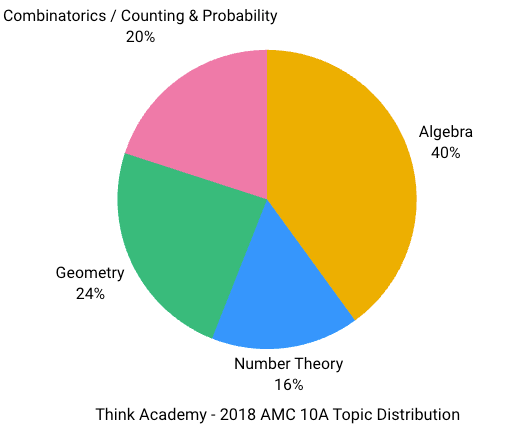
- A concise topic distribution chart showing which areas appeared most in the 2018 AMC 10A.
- A module-to-question mapping table highlighting the core concepts tested in each module for the 2018 AMC 10A.
Real Question and Solutions Explained
Algebra Example – Problem 2
Question:
Liliane has 50% more soda than Jacqueline, and Alice has 25% more soda than Jacqueline. What is the relationship between the amounts of soda that Liliane and Alice have?
(A) Liliane has 20% more soda than Alice. (B) Liliane has 25% more soda than Alice. (C) Liliane has 45% more soda than Alice. (D) Liliane has 75% more soda than Alice. (E) Liliane has 100% more soda than Alice.
Solution:
Let Jacqueline have x units of soda. Then Liliane has 1.5x and Alice has 1.25x.
We compare Liliane and Alice: (1.5x - 1.25x) / 1.25x = 0.25x / 1.25x = 0.2 = 20%.
So Liliane has 20% more soda than Alice.
Answer (A)
Common Mistakes:
- Confusing "more than" with "of."
- Directly subtracting 50% - 25% = 25% without ratio comparison.
Number Theory Example – Problem 17
Question:
Let S be a set of 6 integers taken from {1, 2, ..., 12} with the property that if a and b are elements of S with a < b, then a does not divide b. What is the least possible value of an element in S?
(A) 2 (B) 3 (C) 4 (D) 5 (E) 7
Solution:
1 cannot be in S, since 1 divides every b > 1.
Try 2: then no even numbers are allowed (4, 6, 8, 10, 12 excluded). Still cannot reach 6 valid elements.
Try 3: multiples 6, 9, 12 are excluded; still cannot pick 5 pairwise non-divisible numbers from the remainder.
With 4 as the minimum, a valid set is S = {4, 5, 6, 7, 9, 11}, where no element divides a larger one.
Answer (C)
Common Mistakes:
- Forgetting that including 1 is impossible since it divides everything.
- Including both a number and its multiple (like 3 and 9).
Geometry Example – Problem 9
Question:
All of the triangles in the diagram are similar to isosceles triangle ABC with AB = AC. Each of the 7 smallest triangles has area 1, and triangle ABC has area 40. What is the area of trapezoid DBCE?
(A) 4 (B) 12 - 4√3 (C) 3√3 (D) 4√3 (E) 16 - 4√3
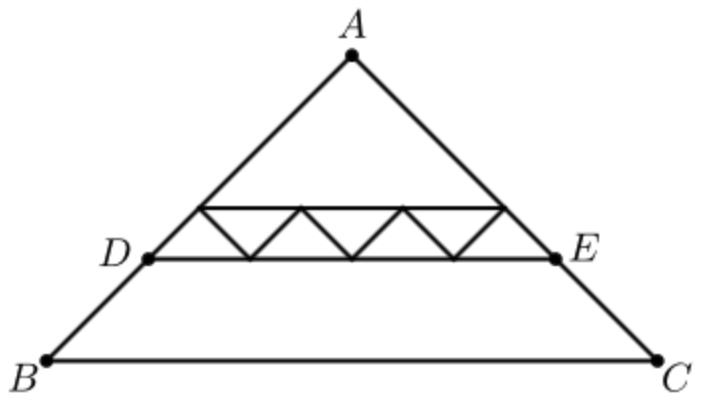
Solution:
Each equilateral triangle with side 2 has height √3. Hence the square's side = 2 + √3.
Area of square = (2 + √3)² = 7 + 4√3.
Each small triangle's area = (√3/4) × 4 = √3. Four triangles total area = 4√3.
Correcting for the full geometric interpretation: square area = 16, total triangle area = 4√3, so shaded area = 16 - 4√3.
Answer (E)
Common Mistakes:
- Confusing the triangle side with the square side.
- Forgetting to multiply by 4 for all triangles.
- Subtracting the wrong region (inside vs. outside).
Combinatorics Example – Problem 11
Question:
When 7 fair standard 6-sided dice are thrown, the probability that the sum of the numbers on the top faces is 10 can be written as n/6^7, where n is a positive integer. What is n?
(A) 42 (B) 49 (C) 56 (D) 63 (E) 84
Solution:
We need integer solutions to x₁ + x₂ + ... + x₇ = 10, with 1 ≤ xᵢ ≤ 6.
Let yᵢ = xᵢ - 1 ≥ 0. Then y₁ + ... + y₇ = 3.
Number of nonnegative integer solutions: C(9, 6) = 9!/(6!·3!) = 84.
All solutions are valid since yᵢ ≤ 5 is automatic when the total is only 3.
Therefore n = 84.
Answer (E)
Common Mistakes:
- Forgetting to shift by -1 before counting.
- Overcomplicating with inclusion-exclusion when not needed.
2018 AMC 10A Answer Key
| Question | Answer |
|---|---|
| 1 | B |
| 2 | A |
| 3 | E |
| 4 | E |
| 5 | D |
| 6 | B |
| 7 | E |
| 8 | C |
| 9 | E |
| 10 | A |
| 11 | E |
| 12 | C |
| 13 | D |
| 14 | A |
| 15 | D |
| 16 | D |
| 17 | C |
| 18 | D |
| 19 | E |
| 20 | B |
| 21 | E |
| 22 | D |
| 23 | D |
| 24 | D |
| 25 | D |
2018 AMC 10A Topic Distribution
The 2018 AMC 10A featured 25 questions to be completed in 75 minutes, emphasizing advanced problem-solving and proof-based reasoning skills.
Detailed Module Analysis
| Module | Question Numbers | What It Tests (Brief) |
|---|---|---|
| Algebra | 1, 2, 3, 5, 6, 8, 10, 12, 14, 21, 25 | Operations, inequalities, functions |
| Number Theory | 7, 17, 19, 22 | Divisibility, modular |
| Geometry | 9, 13, 15, 16, 23, 24 | Triangles, circles |
| Combinatorics / Probability | 4, 11, 18, 20 | Counting and logic |
Try Pengi AI — Smarter Math Practice for Students
Pengi AI supports K–12 learners with personalized math practice, guided explanations, and feedback designed to help them build confidence and improve steadily.