Pengi Editor's Note
This article covers the 2018 AMC 10B exam, presenting four fully worked problems in Algebra, Number Theory, Geometry, and Combinatorics/Probability, each with a solution and common mistake callout. The complete 25-question answer key and module breakdown table are also included. Pengi's editorial team curated this for students in grades 9–10 building toward AMC 10 readiness.
Source: Think Academy Blog
2018 AMC 10B Real Questions and Analysis
In this article, you'll find:
- Representative real questions from each module with detailed solutions.
- The complete 2018 AMC 10B Answer Key.
- The best resources to prepare effectively for the AMC 10.
- A concise topic distribution chart showing which areas appeared most in the 2018 AMC 10B.
- A module-to-question mapping table highlighting the core concepts tested in each module for the 2018 AMC 10B.
Real Question and Solutions Explained
Algebra Example – Problem 2
Question:
Sam drove 96 miles in 90 minutes. His average speed during the first 30 minutes was 60 mph, and his average speed during the second 30 minutes was 65 mph. What was his average speed, in mph, during the last 30 minutes?
(A) 64 (B) 65 (C) 66 (D) 67 (E) 68
Solution:
First 30 minutes = 0.5 hours → distance = ( 0.5 \times 60 = 30 ) miles.
Second 30 minutes = 0.5 hours → distance = ( 0.5 \times 65 = 32.5 ) miles.
Remaining distance = ( 96 – (30 + 32.5) = 33.5 ) miles.
During the last 0.5 hour:
[
v = \frac{33.5}{0.5} = 67 \text{ mph.}
]
Answer:(D)
Common Mistakes:
- Taking the average of the three speeds instead of using distance.
- Mixing minutes and hours.
- Subtracting time instead of distance.
Number Theory Example – Problem 5
Question:
How many subsets of ( {2,3,4,5,6,7,8,9} ) contain at least one prime number?
(A) 128 (B) 192 (C) 224 (D) 240 (E) 256
Solution:
Total subsets: ( 2^8 = 256 ).
Non-prime elements: ( {4,6,8,9} ) → subsets with no prime numbers = ( 2^4 = 16 ).
Thus, subsets containing at least one prime:
[
256 – 16 = 240.
]
Answer:(D)
Common Mistakes:
- Forgetting the empty set counts among "no-prime" subsets.
- Misclassifying 9 as prime.
- Subtracting ( 2^3 ) instead of ( 2^4 ).
Geometry Example – Problem 4
Question:
A three-dimensional rectangular box with dimensions ( X, Y, Z ) has faces whose surface areas are 24, 24, 48, 48, 72, and 72 square units.
What is ( X + Y + Z )?
(A) 18 (B) 22 (C) 24 (D) 30 (E) 36
Solution:
Pair the equal faces:
[
XY = 24, \quad XZ = 48, \quad YZ = 72.
]
Then:
[
X = \sqrt{\frac{(XY)(XZ)}{YZ}} = \sqrt{\frac{24 \times 48}{72}} = \sqrt{16} = 4,
]
[
Y = \sqrt{\frac{(XY)(YZ)}{XZ}} = \sqrt{\frac{24 \times 72}{48}} = \sqrt{36} = 6,
]
[
Z = \sqrt{\frac{(XZ)(YZ)}{XY}} = \sqrt{\frac{48 \times 72}{24}} = \sqrt{144} = 12.
]
So:
[
X + Y + Z = 4 + 6 + 12 = 22.
]
Answer: (B)
Common Mistakes:
- Adding face areas instead of working with their products.
- Pairing the wrong faces.
- Forgetting to take square roots after dividing products.
Combinatorics Example – Problem 6
Question:
A box contains chips numbered 1, 2, 3, 4, 5. Chips are drawn uniformly at random without replacement until the sum of the values drawn exceeds 4. What is the probability that 3 draws are required?
(A) ( \frac{1}{15} ) (B) ( \frac{1}{10} ) (C) ( \frac{1}{6} ) (D) ( \frac{1}{5} ) (E) ( \frac{1}{4} )
Solution:
To require 3 draws:
- After two draws, the sum ( \le 4 );
- After the third, it becomes ( > 4 ).
Possible first-two-draw pairs with ( \text{sum} \le 4 ):
( (1,2), (2,1), (1,3), (3,1) ).
For ( (1,2) ): sum = 3 → third chip can be from ( {3,4,5} ), 3 choices.
For ( (1,3) ): sum = 4 → third chip can be from ( {2,4,5} ), 3 choices.
[
4 \text{ valid ordered pairs} \times 3 \text{ third choices} = 12 \text{ favorable sequences.}
]
Total ordered triples (without replacement): ( 5 \times 4 \times 3 = 60. )
Therefore:
[
P = \frac{12}{60} = \frac{1}{5}.
]
Answer:(D)
Common Mistakes:
- Using combinations instead of ordered sequences.
- Allowing repetition of chips.
- Misreading "exceeds 4" as "( \ge 4 )".
2018 AMC 10B Answer Key
| Question | Answer |
|---|---|
| 1 | A |
| 2 | D |
| 3 | B |
| 4 | B |
| 5 | D |
| 6 | D |
| 7 | D |
| 8 | C |
| 9 | D |
| 10 | E |
| 11 | C |
| 12 | C |
| 13 | C |
| 14 | D |
| 15 | A |
| 16 | E |
| 17 | B |
| 18 | D |
| 19 | E |
| 20 | B |
| 21 | C |
| 22 | C |
| 23 | B |
| 24 | C |
| 25 | C |
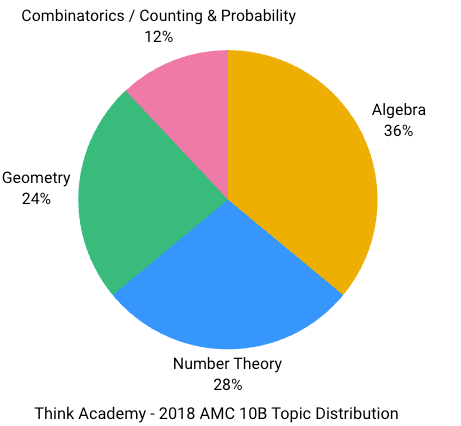
2018 AMC 10B Topic Distribution
The 2018 AMC 10B featured 25 questions to be completed in 75 minutes, emphasizing advanced problem-solving and proof-based reasoning skills.
Detailed Module Analysis
| Module | Question Numbers | What It Tests (Brief) |
|---|---|---|
| Algebra | 1, 2, 3, 8, 10, 14, 20, 22, 25 | Linear, quadratic, inequalities |
| Number Theory | 5, 11, 13, 16, 19, 21, 23 | Primes, divisibility |
| Geometry | 4, 7, 12, 15, 17, 24 | Solids, polygons |
| Combinatorics / Probability | 6, 9, 18 | Counting, probability |
Try Pengi AI — Smarter Math Practice for Students
Pengi AI supports K–12 learners with personalized math practice, guided explanations, and feedback designed to help them build confidence and improve steadily.