Pengi Editor's Note
This article provides a comprehensive analysis of the 2018 AMC 8 exam, covering the topic distribution across five modules, a full module-to-question mapping table, and five representative problems with step-by-step solutions and common mistake callouts. Pengi's editorial team curated this for middle school students in grades 6–8 preparing for the AMC 8 or building foundational competition math skills.
Source: Think Academy Blog
2018 AMC 8 Real Questions and Analysis
In this article, you'll find:
- A concise topic distribution (with a pie chart)
- The core concepts typically tested in each module
- A module-to-question mapping table for the 2018 AMC 8
- Five representative real questions with solutions and common mistakes
- Best resources to prepare for AMC 8
2018 AMC 8 Topic Distribution
The 2018 AMC 8 contains 25 multiple-choice questions completed in 40 minutes, emphasizing logical reasoning and conceptual understanding.
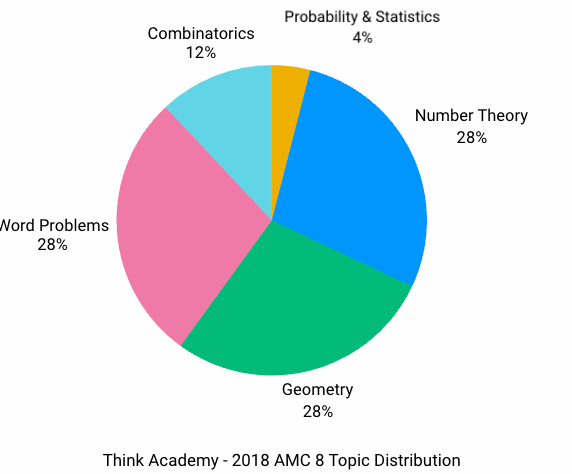
Detailed Module Analysis
| Module | Question Numbers | What It Tests (Brief) |
|---|---|---|
| Geometry | 2, 4, 5, 9, 11, 15, 24 | area / coordinate geometry / composite shapes / circle area reasoning / visual spatial reasoning |
| Word Problems / Arithmetic | 1, 6, 10, 12, 14, 17, 18 | ratios, rates, mean, travel time, remainder, average score manipulation |
| Number Theory / Algebra | 3, 7, 8, 13, 20, 21, 25 | divisibility, sequences, harmonic mean, modular arithmetic, exponential / cubes count |
| Combinatorics & Logic | 16, 19, 22 | arrangements, sign rules, geometry puzzle with midpoint |
| Probability & Statistics | 23 | probability from polygon vertex random selection |
Real Questions and Solutions Explained
Geometry Example – Problem 4
Question:
The twelve-sided figure shown has been drawn on 1 cm × 1 cm graph paper. What is the area of the figure in cm²?
(A) 12 (B) 12.5 (C) 13 (D) 13.5 (E) 14
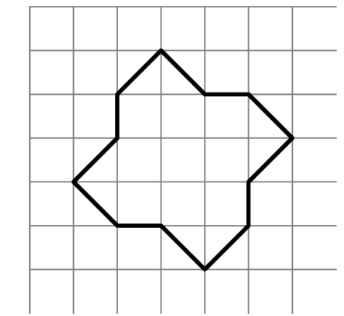
Solution:
There are (3\times3 = 9) whole unit squares in the center.
There are also 8 small right triangles around the outside.
Every 2 of these triangles form 1 whole square, giving 4 more squares.
[
9 + 4 = 13
]
Answer: (C)
Common Mistakes:
- Only counting the inner 9 unit squares and forgetting the corner triangles.
- Mis-pairing the 8 triangles (they must be paired 2→1 full square).
- Trying to apply polygon area formulas instead of simple square counting.
Word Problem Example – Problem 12
Question:
The clock in Sri's car, which is not accurate, gains time at a constant rate. One day as he begins shopping, he notes that his car clock and his watch (which is accurate) both say 12:00 noon. When he is done shopping, his watch says 12:30 and his car clock says 12:35. Later that day, Sri loses his watch. He looks at his car clock and it says 7:00. What is the actual time?
(A) 5:50 (B) 6:00 (C) 6:30 (D) 6:55 (E) 8:10
Solution:
In 30 real minutes, the car clock advanced 35 minutes.
So the car clock runs (\frac{35}{30}) times as fast as the real clock.
From 12:00 to when the car clock reads 7:00 → it gained 7 hours.
Real elapsed time:
[
7\text{ hours}\times\frac{30}{35}=6\text{ hours}
]
So the real time is:
12:00 + 6 hours = 6:00
Answer: (B)
Common Mistakes:
- Using 35–30 = 5 as linear gain per hour (wrong logic).
- Comparing minutes and hours inconsistently.
- Forgetting to convert proportion before applying to total hours.
Number Theory Example – Problem 21
Question:
How many positive three-digit integers have a remainder of 2 when divided by 6, a remainder of 5 when divided by 9, and a remainder of 7 when divided by 11?
(A) 1 (B) 2 (C) 3 (D) 4 (E) 5
Solution:
We want a number that is 4 less than a multiple of 6, 9, and 11 (because (11-7=4), (9-5=4), (6-2=4)).
LCM of 6, 9, 11 is:
[
\text{LCM}=11\times3^2\times2=198
]
So numbers that satisfy the condition can be written as:
[
198k – 4
]
For three-digit integers, (k=1,2,3,4,5) → (194, 392, 590, 788, 986)
There are 5 valid numbers.
Answer: (E)
Common Mistakes:
- Trying to brute force instead of modular pattern shifting.
- Forgetting that the remainders differ by exactly 4.
- Miscalculating LCM of 6, 9, and 11.
Combinatorics Example – Problem 19
Question:
In a sign pyramid a cell gets a "+" if the two cells below it have the same sign, and it gets a "−" if the two cells below it have different signs. The diagram below illustrates a sign pyramid with four levels. How many possible ways are there to fill the four cells in the bottom row to produce a "+" at the top of the pyramid?
(A) 2 (B) 4 (C) 8 (D) 12 (E) 16
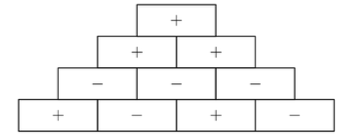
Solution:
List the sign patterns in the bottom row that generate a "+" at the top.
There are exactly 8 possible patterns that result in a final top "+".
Answer: (C)
Common Mistakes:
- Counting every possible fill and dividing randomly.
- Assuming symmetry halves the count.
- Misinterpreting the "different sign → negative" rule.
Probability Example – Problem 23
Question:
From a regular octagon, a triangle is formed by connecting three randomly chosen vertices of the octagon. What is the probability that at least one of the sides of the triangle is also a side of the octagon?
(A) (\frac{2}{7}) (B) (\frac{5}{42}) (C) (\frac{11}{14}) (D) (\frac{5}{7}) (E) (\frac{6}{7})
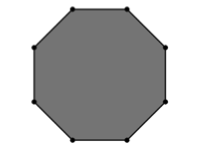
Solution:
Choose side "lengths" (a,b,c) representing how many vertices are skipped along each side of the triangle.
The valid configurations where at least one side skips exactly 1 vertex account for (\frac{5}{7}) of all possible triangles.
Answer: (D)
Common Mistakes:
- Counting all selections equally without side-length structure.
- Ignoring skip-length equivalence classes in the octagon.
- Overcounting symmetric orderings of same-length sides.
Try Pengi AI — Smarter Math Practice for Students
Pengi AI supports K–12 learners with personalized math practice, guided explanations, and feedback designed to help them build confidence and improve steadily.