Pengi Editor's Note
This article covers the 2018 Math Kangaroo competition for Levels 1–2 and 3–4, walking through real exam problems in geometry, reasoning, word problems, and number sense with full solutions and annotated common mistakes. Pengi's editorial team selected this piece because understanding what the exam actually tests — question by question — is the most direct path to effective preparation. The complete official answer key for all levels is included.
Source: Think Academy Blog
2018 Math Kangaroo Real Questions and Analysis
In this article, you'll find:
- A topic distribution chart for the 2018 Math Kangaroo Levels 1–4
- Key concepts tested in each topic
- A question–module mapping table
- Four real 2018 questions with solutions and common mistakes
- Study tips and resources to prepare effectively for Math Kangaroo
2018 Math Kangaroo Overview
The Math Kangaroo competition consists of a single 75-minute multiple-choice test with five answer options per question. Students can participate either online or on paper.
Scoring Structure
- Grades 1–4: 24 questions, maximum score of 96 points
- Grades 5–12: 30 questions, maximum score of 120 points
Levels 1-2 Analysis
Topic Distribution
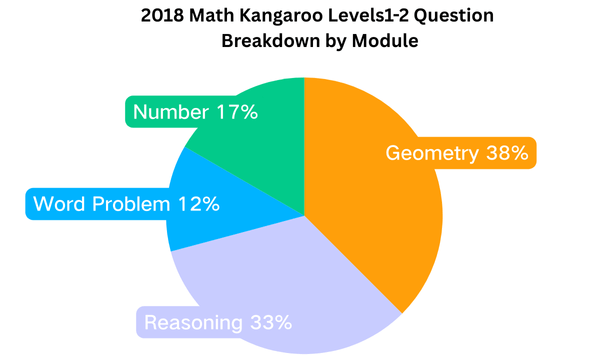
The 2018 Math Kangaroo Levels 1–2 exam emphasizes geometry (38%) and reasoning (33%), with number sense (17%) and word problems (12%) completing the mix—showing a test built around visual-spatial thinking, logical step-by-step reasoning, and foundational arithmetic understanding.
Detailed Module Summary
| Module | Question Numbers | What It Tests (Brief) |
|---|---|---|
| Geometry | Q2, Q3, Q4, Q8, Q9, Q10, Q12, Q16, Q22 | Lines; shapes; dividing shapes; parts of whole; three views; identify positions; rotation; puzzles; equal segments; overlapping; length |
| Reasoning | Q1, Q7, Q11, Q13, Q14, Q15, Q23, Q24 | Visual transformations; shape patterns; positional reasoning; equivalent substitution; map reasoning |
| Word Problem | Q17, Q18, Q20, | Multiple-step problems; budget & cost problems |
| Number | Q5, Q6, Q19, Q21 | Equal quantity; counting; forming numbers; digits; cutting papers |
Real Questions and Solutions Explained
Geometry Example – Problem 9
Question:
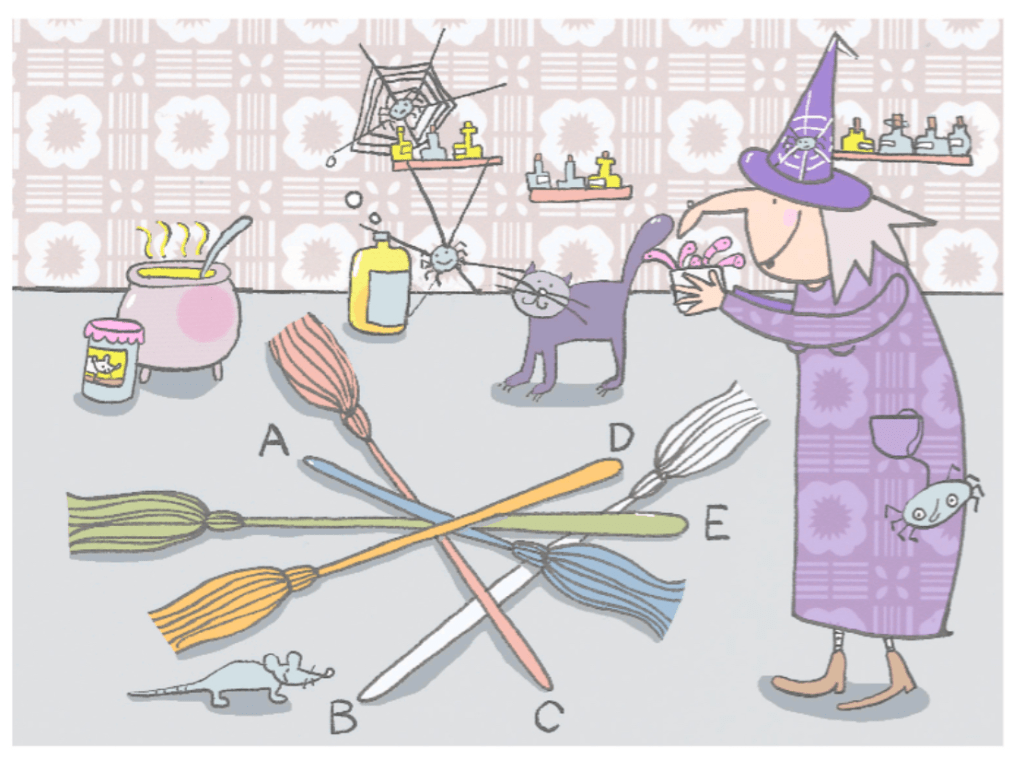
Juana, the friendly witch, has 5 broomsticks in her garage. Each broomstick is marked with a letter at the end of its handle. Juana removes the broomsticks one by one without moving the others. Which broomstick will she remove last?
(A) A (B) B (C) C (D) D (E) E
Solution:
Juana can only remove the broomstick that is on top of the pile without disturbing the others. She must remove the broomsticks in the only possible order that follows this rule.
By observing the picture: First, broomstick D is on top and is removed. Then broomstick A is next and removed. Followed by broomstick E. Then C. Finally, broomstick B is at the bottom and is removed last.
Answer: B
Common Mistakes:
- Assuming the last broomstick is whichever is visually on top in the image.
- Not checking how each broomstick overlaps with the others.
Reasoning Example – Problem 23
Question:
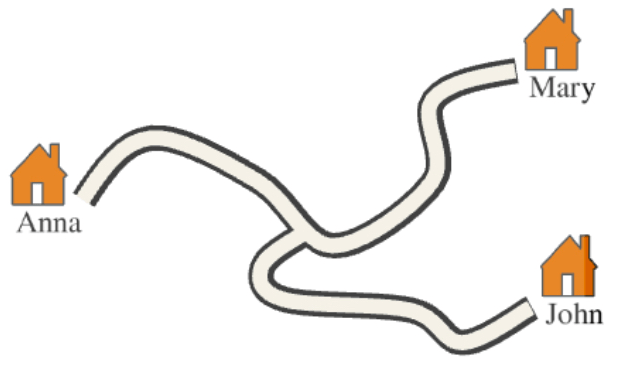
The road from Anna's house to Mary's house is 16 km long. The road from Mary's house to John's house is 20 km long and the road from the crossroad to Mary's house is 9 km long. How long is the road from Anna's house to John's house?
(A) 7 km (B) 9 km (C) 11 km (D) 16 km (E) 18 km
Solution:
To find the total distance from Anna's house to John's house:
From the diagram and information, the road from the crossroad to Mary's house is 9 km. The road from Mary to John is 20 km, so the crossroad to John must be: 20 – 9 = 11 km. Similarly, the road from Anna to Mary is 16 km, so the crossroad to Anna is: 16 – 9 = 7 km. Now, the total from Anna to John (via the crossroad) is: 7 + 11 = 18 km.
Answer: E
Common Mistakes:
- Adding 16 and 20 directly without using the crossroad
- Subtracting incorrectly or from the wrong points
- Forgetting the shared segment between houses and crossroad
Word Problem Example – Problem 18
Question:
1 ice-cream cone costs 1 dollar. There is a sale so you can buy 6 ice-cream cones for 5 dollars. How many ice-cream cones at most can you buy with 36 dollars?
(A) 36 (B) 30 (C) 42 (D) 43 (E) 45
Solution:
To get the most ice-cream cones, use the sale as much as possible. Each sale gives 6 cones for $5.
36 ÷ 5 = 7 groups with $1 left. 7 sale deals × 6 cones = 42 cones. $1 left buys 1 more cone at full price. So, total: 42 + 1 = 43 cones
Answer: D
Common Mistakes:
- Buying all cones at regular price
- Thinking only 6 cones can be bought with $5, without checking how many times it fits into 36
- Forgetting to use leftover money for an extra cone
Number Example – Problem 5
Question:
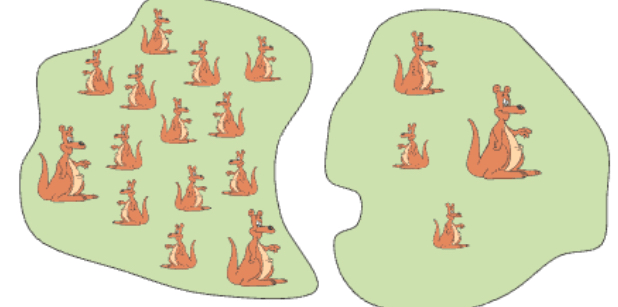
How many kangaroos must be moved from one park to the other in order to get the same number of kangaroos in each park?
(A) 4 (B) 5 (C) 6 (D) 8 (E) 9
Solution:
There are 14 kangaroos in the park on the left and 4 kangaroos in the park on the right.
Moving 5 kangaroos from the left park to the right park will result in each park having the same number of kangaroos — 9 in each.
Answer: B
Common Mistakes:
- Counting the kangaroos incorrectly
- Forgetting to subtract from one park and add to the other
Levels 3-4 Analysis
Topic Distribution
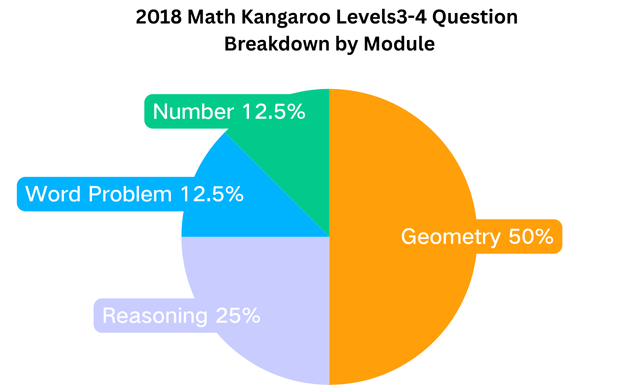
The 2018 Math Kangaroo Levels 3–4 exam places a strong emphasis on geometry (50%), supported by reasoning tasks (25%) and a smaller share of number and word problems (each 12.5%), highlighting a clear shift toward spatial visualization and shape-based problem solving.
Detailed Module Summary
| Module | Question Numbers | What It Tests (Brief) |
|---|---|---|
| Geometry | Q2, Q4, Q5, Q6, Q9, Q11, Q12, Q14, Q16, Q19, Q21, Q22 | Rotation; parallel lines; relative positions; lengths; folding and cutting paper; dividing shapes; coloring cubes; perimeters; measurement; areas |
| Reasoning | Q8, Q10, Q17, Q18, Q23, Q24 | Positional reasoning; shape patterns; map reasoning; logic reasoning; inverse problems |
| Word Problem | Q3, Q13, Q15 | Age problems; inverse problems; multiples problems |
| Number | Q1, Q7, Q20 | Digits; equivalent substitution; new operations |
Real Questions and Solutions Explained
Geometry Example – Problem 11
Question:
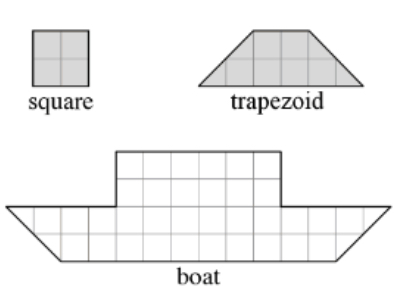
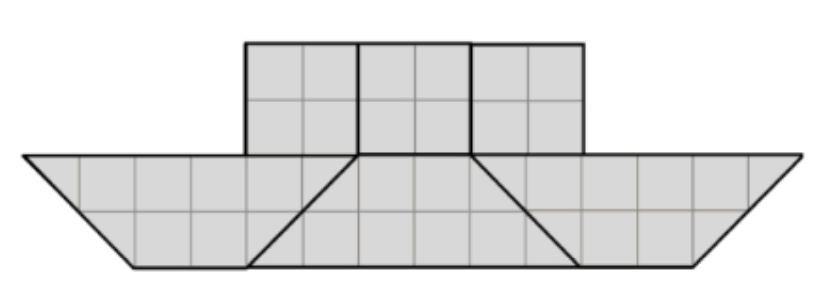
Tom cuts two kinds of shapes out of grid paper as shown to the left. What is the smallest number of shapes that Tom needs in order to exactly cover the boat in the picture?
(A) 5 (B) 6 (C) 7 (D) 8 (E) 9
Solution:
Tom uses squares to fill the top part of the boat because they have right angles. There are 3 squares in the top section. To build the bottom of the boat, Tom uses 3 trapezoids. The middle trapezoid stays upright, while the two side trapezoids are flipped to fit the shape of the boat. So in total, Tom needs 3 squares + 3 trapezoids = 6 shapes.
Answer: B
Common Mistakes:
- Miscounting the number of squares or trapezoids needed
- Using all shapes without flipping the trapezoids
- Not matching the exact angles and positions in the boat outline
- Assuming all shapes must stay in their original orientation
Reasoning Example – Problem 24
Question:
To defeat a dragon, Matthias has to cut off all the dragon's heads. If he can cut off 3 of the dragon's heads, one new head immediately grows. Matthias defeats the dragon by cutting off 13 heads in total. How many heads did the dragon have at the beginning?
(A) 8 (B) 9 (C) 10 (D) 11 (E) 12
Solution:
Work backward. Every time Matthias cuts off 3 heads, 1 grows back — so he only really removes 2 heads per set of 3. This happens 3 times (9 heads cut, 3 grow back). That's 9 + 3 = 12 heads. The 13th head he cuts doesn't grow back — it's the final one. So, he had 9 heads at the beginning.
Answer: B
Common Mistakes:
- Forgetting that some heads grow back
- Not working backwards from the last cut
- Miscounting the number of new heads added
Word Problem Example – Problem 3
Question:
Susan is 6 years old. Her sister is one year younger and her brother is one year older. What is the sum of the ages of the three siblings?
(A) 10 (B) 15 (C) 18 (D) 21 (E) 30
Solution:
Susan is 6 years old. Her sister is one year younger, so she is 5 years old. Her brother is one year older, so he is 7 years old. Add the three ages: 6 (Susan) + 5 (sister) + 7 (brother) = 18.
Answer: C
Common Mistakes:
- Forgetting to adjust ages by ±1
- Adding only Susan's age three times
- Thinking it's a trick question and overcomplicating it
Number Example – Problem 1
Question:
Lena has 10 rubber stamps. Each stamp has one of the digits: 0, 1, 2, 3, 4, 5, 6, 7, 8, and 9. She stamps the date of the Kangaroo contest:

How many of the stamps does she use?
(A) 5 (B) 6 (C) 7 (D) 9 (E) 10
Solution:
Each stamp has only one digit. If a digit appears more than once, Lena uses the same stamp again. The digits used in 03152018 are: 0, 3, 1, 5, 2, 0, 1, 8. Now count only the unique digits: 0, 1, 2, 3, 5, 8 → That's 6 different digits. So, Lena uses 6 stamps.
Answer: B
Common Mistakes:
- Counting all digits, not just the different ones
- Forgetting repeated digits only need one stamp
2018 Math Kangaroo Answer Key
| Question | Level 1 & 2 | Level 3 & 4 |
|---|---|---|
| 1 | E | B |
| 2 | D | E |
| 3 | D | C |
| 4 | D | E |
| 5 | B | D |
| 6 | B | D |
| 7 | E | D |
| 8 | C | A |
| 9 | B | D |
| 10 | A | A |
| 11 | D | B |
| 12 | A | E |
| 13 | C | E |
| 14 | C | C |
| 15 | C | C |
| 16 | B | D |
| 17 | A | D |
| 18 | D | C |
| 19 | A | B |
| 20 | C | A |
| 21 | D | B |
| 22 | B | D |
| 23 | E | E |
| 24 | E | B |
Try Pengi AI — Smarter Math Practice for Students
Pengi AI supports K–12 learners with personalized math practice, guided explanations, and feedback designed to help them build confidence and improve steadily.