Pengi Editor's Note
This article analyzes the 2019 AMC 10A exam, presenting four representative problems in Algebra, Number Theory, Geometry, and Combinatorics with full solutions and common mistake breakdowns. The complete 25-question answer key and a topic distribution chart are also included. Pengi's editorial team curated this as a focused study resource for students in grades 9–10 preparing for the AMC 10.
Source: Think Academy Blog
2019 AMC 10A Real Questions and Analysis
In this article, you'll find:
- Representative real questions from each module with detailed solutions.
- The complete 2019 AMC 10A Answer Key.
- The best resources to prepare effectively for the AMC 10.
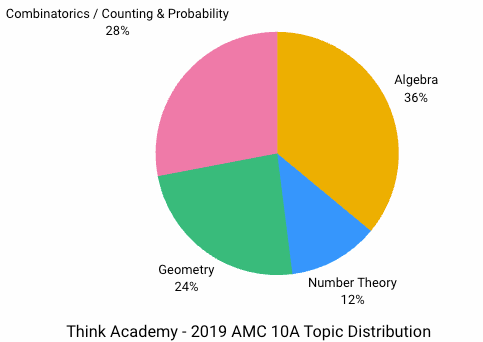
- A concise topic distribution chart showing which areas appeared most in the 2019 AMC 10A.
- A module-to-question mapping table highlighting the core concepts tested in each module for the 2019 AMC 10A.
Real Question and Solutions Explained
Algebra Example – Problem 2
Question:
What is the hundreds digit of ( 20! – 15! )?
(A) 0 (B) 1 (C) 2 (D) 4 (E) 5
Solution:
[
20! – 15! = 15!(20 \times 19 \times 18 \times 17 \times 16 – 1).
]
Note that ( 15! ) ends with at least three zeros (since ( 15! ) contains multiple factors of 5 and 2).
So, we only need the last three digits of
[
20 \times 19 \times 18 \times 17 \times 16 – 1.
]
Compute:
( 20 \times 19 \times 18 \times 17 \times 16 = 1,860,480. )
Then subtract 1 → 1,860,479. The last three digits are 479.
Now multiply by ( 15! ), which contributes at least three trailing zeros.
Thus the last three digits of ( 20! – 15! ) are 000, so the hundreds digit is 0.
Answer (A)
Common Mistakes:
- Forgetting that ( 15! ) adds trailing zeros.
- Trying to compute full factorial values.
- Confusing the last nonzero digit with the hundreds digit.
Number Theory Example – Problem 9
Question:
What is the greatest three-digit positive integer ( n ) for which the sum of the first ( n ) positive integers is not a divisor of the product of the first ( n ) positive integers?
(A) 995 (B) 996 (C) 997 (D) 998 (E) 999
Solution:
Sum of first ( n ) integers:
[
S = \frac{n(n+1)}{2}.
]
Product of first ( n ) integers:
[
P = n!.
]
We want ( S ∤ P ).
If ( n ) is even:
[
S = \frac{n}{2}(n+1).
]
Since ( \frac{n}{2} ) and ( n+1 ) are coprime, both divide ( n! ).
This is true because ( n+1 \le n! ) for ( n \ge 2 ).
Hence for even ( n ), ( S \mid n! ).
If ( n ) is odd:
[
S = \frac{n(n+1)}{2} = (n+1)\cdot \frac{n}{2}.
]
We need to check whether ( \frac{n+1}{2} ) divides ( n! ).
For odd ( n ), if ( \frac{n+1}{2} ) is prime and greater than ( \frac{n}{2} ), then it will not divide ( n! ).
Thus we seek the largest ( n ) with ( \frac{n+1}{2} ) prime.
Try from the top:
- ( n = 999 \Rightarrow \frac{1000}{2} = 500 ) (not prime)
- ( n = 998 \Rightarrow \frac{999}{2} = 499.5 ) (not integer)
- ( n = 997 \Rightarrow \frac{998}{2} = 499 ) (prime)
Therefore, for ( n = 997 ), ( S ∤ P ).
Answer (C)
Common Mistakes:
- Forgetting parity difference between even and odd ( n ).
- Checking divisibility for small examples instead of general reasoning.
- Misidentifying when ( \frac{n + 1}{2} ) divides ( n! ).
Geometry Example – Problem 8
Question:
The figure below shows line ( \ell ) with a regular, infinite, recurring pattern of squares and line segments. How many of the following rigid motions, other than the identity, will transform the figure into itself?
- Some rotation around a point of line ( \ell )
- Some translation in the direction parallel to line ( \ell )
- The reflection across line ( \ell )
- Some reflection across a line perpendicular to line ( \ell )
(A) 0 (B) 1 (C) 2 (D) 3 (E) 4

Solution:
The pattern repeats regularly along the line, so translation along ( \ell ) works.
Rotation: not possible because orientation of squares alternates above and below.
Reflection across ( \ell ): swaps top and bottom squares → not identical.
Reflection perpendicular to ( \ell ): aligns repeating pattern → yes.
Thus, two valid transformations: translation and reflection perpendicular to ( \ell ).
Answer (C)
Common Mistakes:
- Counting rotation as valid (it changes orientation).
- Ignoring pattern symmetry along direction of line.
- Assuming reflection over ( \ell ) preserves figure.
Combinatorics Example – Problem 12
Question:
Melanie computes the mean ( \mu ), the median ( M ), and the modes of the 365 values that are the dates in the months of 2019. Thus her data consist of: twelve 1s, twelve 2s, …, twelve 28s, eleven 29s, eleven 30s, and seven 31s. Let ( d ) be the median of the modes. Which of the following statements is true?
(A) ( \mu < d < M ) (B) ( M < d < \mu ) (C) ( d = M = \mu ) (D) ( d < M < \mu ) (E) ( d < \mu < M )
Solution:
Modes: 1–28 (appear 12 times each).
Median of modes = median of 1–28 = 14.5 ⇒ ( d = 14.5. )
Median ( M ): with 365 total values, the 183rd value.
After ( 12 \times 28 = 336 ) values (through 28), next are 29s.
So ( M = 29. )
Mean ( \mu ): average of all day numbers weighted by month counts.
[
\mu = \frac{12(1 + 2 + \dots + 28) + 11(29 + 30) + 7(31)}{365}.
]
Using ( \sum_{1}^{28} = 406, )
[
\mu \approx \frac{12 \times 406 + 11(59) + 217}{365}
= \frac{4872 + 649 + 217}{365}
= \frac{5738}{365} \approx 15.7.
]
So ( \mu \approx 15.7, ; d = 14.5, ; M = 29. )
Therefore ( \mu < d < M. )
Answer (A)
Common Mistakes:
- Forgetting to weight by month count.
- Misidentifying "median of the modes" as the mode itself.
- Assuming symmetry when days stop at 31.
2019 AMC 10A Answer Key
| Question | Answer |
|---|---|
| 1 | C |
| 2 | A |
| 3 | D |
| 4 | B |
| 5 | D |
| 6 | C |
| 7 | C |
| 8 | C |
| 9 | B |
| 10 | C |
| 11 | C |
| 12 | E |
| 13 | D |
| 14 | D |
| 15 | E |
| 16 | A |
| 17 | D |
| 18 | D |
| 19 | B |
| 20 | B |
| 21 | D |
| 22 | B |
| 23 | C |
| 24 | B |
| 25 | D |
2019 AMC 10A Topic Distribution
The 2019 AMC 10A featured 25 questions to be completed in 75 minutes, emphasizing advanced problem-solving and proof-based reasoning skills.
Detailed Module Analysis
| Module | Question Numbers | What It Tests (Brief) |
|---|---|---|
| Algebra | 1, 2, 3, 4, 5, 7, 15, 19, 24 | Algebraic expressions, functions |
| Number Theory | 9, 11, 18 | Divisibility, bases |
| Geometry | 6, 8, 10, 13, 16, 21 | Triangles, circles |
| Combinatorics / Probability | 12, 14, 17, 20, 22, 23, 25 | Counting, probability |
Try Pengi AI — Smarter Math Practice for Students
Pengi AI supports K–12 learners with personalized math practice, guided explanations, and feedback designed to help them build confidence and improve steadily.