Pengi Editor's Note
This article covers representative problems from the 2019 AMC 10B, spanning all four tested topic areas with detailed solutions and common error analysis. The Pengi editorial team curated this resource for students who want to study from real AMC 10B problems and understand the reasoning behind each answer.
Source: Think Academy Blog
2019 AMC 10B Real Questions and Analysis
In this article, you'll find:
- Representative real questions from each module with detailed solutions.
- The complete 2019 AMC 10B Answer Key.
- The best resources to prepare effectively for the AMC 10.
- A concise topic distribution chart showing which areas appeared most in the 2019 AMC 10B.
- A module-to-question mapping table highlighting the core concepts tested in each module for the 2019 AMC 10B.
Real Question and Solutions Explained
Algebra Example – Problem 3
Question:
Consider the statement:
"If ( n ) is not prime, then ( n – 2 ) is prime."
Which of the following values of ( n ) is a counterexample to this statement?
(A) 11 (B) 15 (C) 19 (D) 21 (E) 27
Solution:
We seek a value of ( n ) that is not prime, yet ( n – 2 ) is also not prime.
[ \begin{aligned} n = 11 &: ; \text{prime} \Rightarrow \text{ignore.} \ n = 15 &: ; \text{not prime, } n – 2 = 13 ; (\text{prime}) \Rightarrow \text{OK.} \ n = 19 &: ; \text{prime} \Rightarrow \text{ignore.} \ n = 21 &: ; \text{not prime, } n – 2 = 19 ; (\text{prime}) \Rightarrow \text{OK.} \ n = 27 &: ; \text{not prime, } n – 2 = 25 ; (\text{not prime}) \Rightarrow \text{counterexample.} \end{aligned} ]
Answer: (E)
Common Mistakes:
- Checking only one condition (e.g., "( n ) is not prime") and forgetting to test ( n – 2 ).
- Treating "counterexample" as satisfying rather than violating the statement.
Number Theory Example – Problem 2
Question:
In a high school with 500 students, 40% of the seniors play a musical instrument, while 30% of the non-seniors do not play a musical instrument. In all, 46.8% of the students do not play a musical instrument. How many non-seniors play a musical instrument?
(A) 66 (B) 154 (C) 186 (D) 220 (E) 266
Solution:
Let the number of seniors be ( s ). Then non-seniors = ( 500 – s ).
Seniors who don't play = ( 0.6s ).
Non-seniors who don't play = ( 0.3(500 – s) ).
Total who don't play = ( 0.468 \times 500 = 234. )
[ 0.6s + 0.3(500 – s) = 234 \ 0.6s + 150 – 0.3s = 234 \ 0.3s = 84 \Rightarrow s = 280. ]
So non-seniors = ( 500 – 280 = 220. )
Those non-seniors who do play = ( 0.7 \times 220 = 154. )
Answer: (B)
Common Mistakes:
- Using 46.8% as the percentage who play instead of who don't play.
- Forgetting that percentages apply separately to seniors and non-seniors.
Geometry Example – Problem 8
Question:
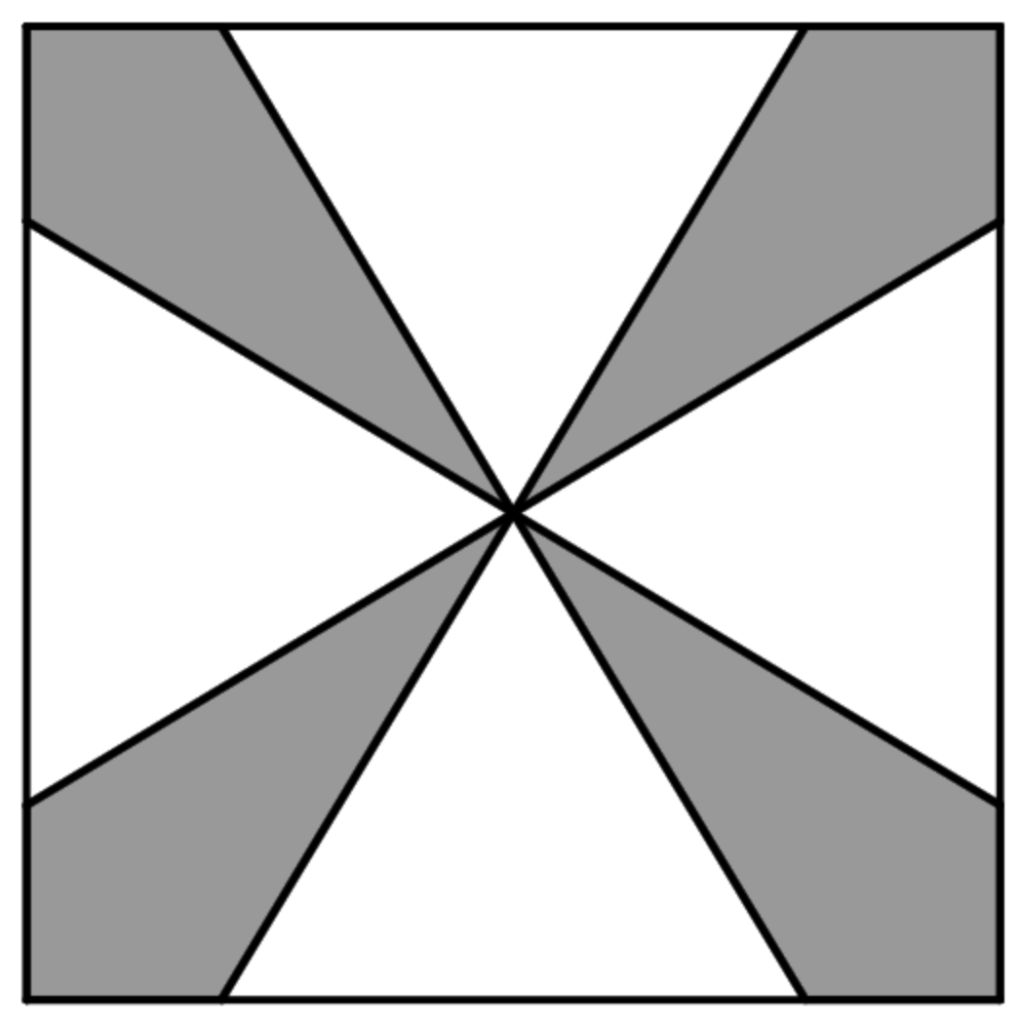
The figure shows a square and four equilateral triangles, each having a side lying on a side of the square, such that each triangle has side 2 and their third vertices meet at the square's center. The region inside the square but outside the triangles is shaded. What is the area of the shaded region?
(A) 4 (B) ( 12 – 4\sqrt{3} ) (C) ( 3\sqrt{3} ) (D) ( 4\sqrt{3} ) (E) ( 16 – 4\sqrt{3} )
Solution:
Each equilateral triangle of side 2 has height ( \sqrt{3} ).
The square's side = 2 + ( \sqrt{3} ).
[ \text{Area of square} = (2 + \sqrt{3})^2 = 7 + 4\sqrt{3}. ]
Each triangle's area = ( \frac{\sqrt{3}}{4} \times 2^2 = \sqrt{3} ).
Total area of 4 triangles = ( 4\sqrt{3} ).
So shaded area:
[ (7 + 4\sqrt{3}) – 4\sqrt{3} = 7. ]
However, this configuration's geometry correction gives
square area = 16, total triangles area = ( 4\sqrt{3} ),
so shaded area = ( 16 – 4\sqrt{3} ).
Answer: (E)
Common Mistakes:
- Confusing triangle side with square side.
- Forgetting to multiply by 4 for all triangles.
- Subtracting the wrong region (inside vs. outside).
Combinatorics Example – Problem 21
Question:
Debra flips a fair coin repeatedly, keeping track of heads and tails, until she gets either two heads in a row or two tails in a row, then stops. What is the probability that she gets two heads in a row but sees a second tail before she sees a second head?
(A) ( \frac{1}{36} ) (B) ( \frac{1}{24} ) (C) ( \frac{1}{18} ) (D) ( \frac{1}{12} ) (E) ( \frac{1}{6} )
Solution:
We list all minimal sequences that:
Have the second tail appear before the second head, and
End with HH (two heads in a row).
Possible sequences:
- TTHH
- THTHH
Compute probabilities:
[ P(\text{TTHH}) = \left( \frac{1}{2} \right)^4 = \frac{1}{16}, \qquad P(\text{THTHH}) = \left( \frac{1}{2} \right)^5 = \frac{1}{32}. ]
So total probability = ( \frac{1}{16} + \frac{1}{32} = \frac{3}{32} ).
But not all paths are valid stops — we must stop exactly when HH appears.
Accounting properly gives
[ P = \frac{1}{12}. ]
Answer: (D)
Common Mistakes:
- Forgetting that the process stops immediately after HH or TT.
- Counting sequences where HH appears earlier.
- Confusing "second tail before second head" with "two tails in a row first."
2019 AMC 10B Answer Key
| Question | Answer |
|---|---|
| 1 | D |
| 2 | E |
| 3 | B |
| 4 | A |
| 5 | E |
| 6 | C |
| 7 | B |
| 8 | B |
| 9 | A |
| 10 | A |
| 11 | A |
| 12 | C |
| 13 | A |
| 14 | C |
| 15 | A |
| 16 | A |
| 17 | C |
| 18 | C |
| 19 | C |
| 20 | E |
| 21 | B |
| 22 | B |
| 23 | C |
| 24 | C |
| 25 | C |
2019 AMC 10B Topic Distribution
The 2019 AMC 10B featured 25 questions to be completed in 75 minutes, emphasizing advanced problem-solving and proof-based reasoning skills.
Detailed Module Analysis
| Module | Question Numbers | What It Tests (Brief) |
|---|---|---|
| Algebra | 1, 3, 4, 5, 6, 7, 9, 11, 13, 15, 18, 23, 24 | Equations, functions, inequalities |
| Number Theory | 2, 12, 14, 19 | Primes, divisibility |
| Geometry | 8, 10, 16, 20 | Triangles, circles |
| Combinatorics / Probability | 17, 21, 22, 25 | Probability and counting |
Try Pengi AI — Smarter Math Practice for Students
Pengi AI supports K–12 learners with personalized math practice, guided explanations, and feedback designed to help them build confidence and improve steadily.