Pengi Editor's Note
This article breaks down the 2019 AMC 8 with five carefully selected problems spanning all major topic areas, each accompanied by a full solution and common pitfalls. The Pengi editorial team recommends this resource for middle school students beginning their AMC 8 preparation or reviewing past exam material.
Source: Think Academy Blog
2019 AMC 8 Real Questions and Analysis
In this article, you'll find:
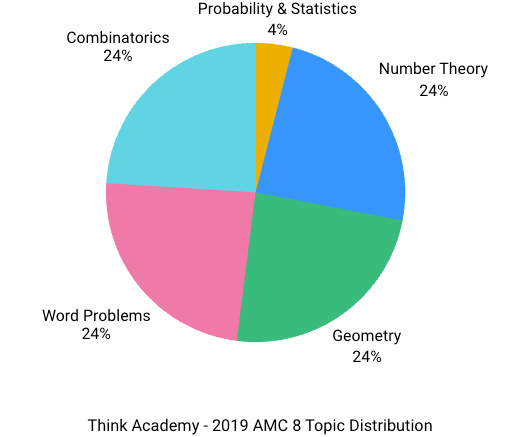
- A concise topic distribution (with a pie chart)
- The core concepts typically tested in each module
- A module-to-question mapping table for the 2019 AMC 8
- Five representative real questions with solutions and common mistakes
- Best resources to prepare for AMC 8
2019 AMC 8 Topic Distribution
The 2019 AMC 8 contains 25 multiple-choice questions completed in 40 minutes, emphasizing logical reasoning and conceptual understanding.
Detailed Module Analysis
| Module | Question Numbers | What It Tests (Brief) |
|---|---|---|
| Geometry | 2, 4, 9, 12, 21, 24 | Area & perimeter, angles in rhombus and triangle, solid geometry, coordinate graphs |
| Word Problems / Arithmetic | 1, 7, 8, 14, 16, 22 | Proportions, rates, percent change, averages |
| Number Theory / Algebra | 3, 11, 17, 19, 20, 23 | Ordering fractions, products and patterns, algebraic equations |
| Combinatorics & Logic | 5, 10, 13, 15, 18, 25 | Counting, arrangements, logic puzzles, probability reasoning |
| Probability & Statistics | 6 | Grid symmetry probability |
Real Questions and Solutions Explained
Geometry Example – Problem 4
Question:
Quadrilateral ABCD is a rhombus with perimeter 52 meters. The length of diagonal AC is 24 meters. What is the area in square meters of rhombus ABCD?
(A) 60 (B) 90 (C) 105 (D) 120 (E) 144
Solution:
All sides of a rhombus are equal. From the perimeter, each side is
[
s = \frac{52}{4} = 13.
]
Diagonals of a rhombus are perpendicular bisectors. Let BD = 2x.
Then the half–diagonals form a right triangle with legs 12 and x and hypotenuse 13:
[
12^{2} + x^{2} = 13^{2} \Rightarrow x^{2} = 169 – 144 = 25 \Rightarrow x = 5,
]
so
[
BD = 2x = 10.
]
Area of a rhombus equals one-half the product of the diagonals:
[
[ABCD] = \frac{AC \times BD}{2} = \frac{24 \times 10}{2} = 120.
]
Answer: (D)
Common Mistakes:
- Using (\text{area} = s^{2}) (that's for a square, not a general rhombus).
- Forgetting diagonals are perpendicular bisectors; not halving AC when forming the right triangle.
- Using 24 and 13 directly in (a^{2}+b^{2}=c^{2}) instead of the half-diagonals and side.
Word Problem Example – Problem 1
Question:
Ike and Mike go into a sandwich shop with a total of $30.00 to spend. Sandwiches cost $4.50 each and soft drinks cost $1.00 each. Ike and Mike plan to buy as many sandwiches as they can, and use any remaining money to buy soft drinks. Counting both sandwiches and soft drinks, how many items will they buy?
(A) 6 (B) 7 (C) 8 (D) 9 (E) 10
Solution:
Each sandwich costs $4.50.
The number of sandwiches they can buy is
[
\frac{30}{4.5} = 6 \text{ sandwiches (since } 6 \times 4.5 = 27).
]
They spend $27 on sandwiches and have
[
30 – 27 = 3
]
dollars left to buy 3 soft drinks.
Total items:
[
6 + 3 = 9
]
Answer: (D)
Common Mistakes:
- Forgetting to use only the remaining money for soft drinks.
- Rounding $4.50 incorrectly and getting 7 sandwiches.
- Misinterpreting "total items" as sandwiches only.
Number Theory Example – Problem 17
Question:
What is the value of the product
[
\left(\frac{1 \cdot 3}{2 \cdot 2}\right)
\left(\frac{2 \cdot 4}{3 \cdot 3}\right)
\left(\frac{3 \cdot 5}{4 \cdot 4}\right)
\cdots
\left(\frac{97 \cdot 99}{98 \cdot 98}\right)
\left(\frac{98 \cdot 100}{99 \cdot 99}\right)?
]
(A) (\frac{1}{2}) (B) (\frac{50}{99}) (C) (\frac{9800}{9801}) (D) (\frac{100}{99}) (E) 50
Solution:
Each term has the pattern
[
\frac{n(n+2)}{(n+1)^{2}}.
]
We can rewrite this as
[
\frac{n}{n+1} \times \frac{n+2}{n+1}.
]
When we multiply all the terms together, many factors cancel:
[
\left(\frac{1}{2} \times \frac{3}{2}\right)
\left(\frac{2}{3} \times \frac{4}{3}\right)
\left(\frac{3}{4} \times \frac{5}{4}\right)
\cdots
\left(\frac{98}{99} \times \frac{100}{99}\right).
]
After cancellation, all middle terms disappear, leaving
[
\frac{1 \times 100}{2 \times 99} = \frac{100}{198} = \frac{50}{99}.
]
Answer: (B)
Common Mistakes:
- Forgetting to recognize the telescoping pattern.
- Multiplying all terms directly instead of noticing cancellations.
- Simplifying only one part (e.g., the numerators) without pairing with denominators.
Combinatorics Example – Problem 18
Question:
The faces of each of two fair dice are numbered 1, 2, 3, 5, 7, and 8. When the two dice are tossed, what is the probability that their sum will be an even number?
(A) (\frac{4}{9}) (B) (\frac{1}{2}) (C) (\frac{5}{9}) (D) (\frac{3}{5}) (E) (\frac{2}{3})
Solution:
For a sum to be even, both dice must show either even + even or odd + odd.
From the set ({1, 2, 3, 5, 7, 8}):
- Even numbers: ({2, 8}) → 2 even faces
- Odd numbers: ({1, 3, 5, 7}) → 4 odd faces
Each die has 6 faces, so the total number of outcomes is
[
6 \times 6 = 36.
]
Even + Even:
[
2 \times 2 = 4 \text{ outcomes.}
]
Odd + Odd:
[
4 \times 4 = 16 \text{ outcomes.}
]
Total even-sum outcomes:
[
4 + 16 = 20.
]
Therefore, the probability is
[
\frac{20}{36} = \frac{5}{9}.
]
Answer: (C)
Common Mistakes:
- Forgetting that both even–even and odd–odd combinations give even sums.
- Counting only one type of pair (even + even).
- Using (\frac{1}{2}) without checking the distribution of even and odd faces.
Probability Example – Problem 6
Question:
There are 81 grid points (uniformly spaced) in the square shown in the diagram below, including the points on the edges. Point P is in the center of the square. Given that point Q is randomly chosen among the other 80 points, what is the probability that the line PQ is a line of symmetry for the square?
(A) (\frac{1}{5}) (B) (\frac{1}{4}) (C) (\frac{2}{5}) (D) (\frac{9}{20}) (E) (\frac{1}{2})
Solution:
There are 9 equally spaced points along each side of the square, forming a (9 \times 9) grid.
Thus, there are
[
9 \times 9 = 81
]
points in total. Point P is the center (the 5th row and 5th column).
The square has 4 lines of symmetry that pass through its center:
- Vertical axis
- Horizontal axis
- Diagonal (top-left to bottom-right)
- Diagonal (top-right to bottom-left)
Each such symmetry line includes 9 points (since there are 9 points along each row, column, or diagonal).
But one of those points is P itself, so each line contributes
[
9 – 1 = 8
]
possible choices for Q.
Since there are 4 symmetry lines:
[
4 \times 8 = 32
]
points make PQ a symmetry line.
There are 80 possible choices for Q in total, so the probability is
[
\frac{32}{80} = \frac{2}{5}.
]
Answer: (C)
Common Mistakes:
- Forgetting to exclude the center point P from the count.
- Counting 8 symmetry lines instead of 4 (each line already represents both directions).
- Miscounting the number of points on diagonals versus edges.
Try Pengi AI — Smarter Math Practice for Students
Pengi AI supports K–12 learners with personalized math practice, guided explanations, and feedback designed to help them build confidence and improve steadily.