Pengi Editor's Note
The Pengi editorial team selected this in-depth 2020 AMC 10B breakdown from Think Academy's archives. It walks through representative problems across Algebra, Number Theory, Geometry, and Combinatorics — exactly the kind of targeted, module-by-module analysis that helps AMC 10 competitors identify their weak spots. A must-read for students targeting the AMC 10 Honor Roll.
Source: Think Academy Blog
2020 AMC 10B Real Questions and Analysis
In this article, you’ll find:
- Representative real questions from each module with detailed solutions.
- The complete 2020 AMC 10B Answer Key.
- The best resources to prepare effectively for the AMC 10.
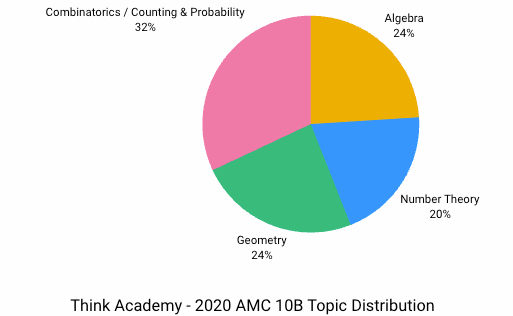
- A concise topic distribution chart showing which areas appeared most in the 2020 AMC 10B.
- A module-to-question mapping table highlighting the core concepts tested in each module for the 2020 AMC 10B.
Real Question and Solutions Explained
Algebra Example – Problem 3
Question:
The ratio of 𝑤 to 𝑥 is 4 : 3, the ratio of 𝑦 to 𝑧 is 3 : 2, and the ratio of 𝑧 to 𝑥 is 1 : 6. What is the ratio of 𝑤 to 𝑦?
(A) 4 : 3 (B) 3 : 2 (C) 8 : 3 (D) 4 : 1 (E) 16 : 3
Solution:
Let \( 𝑥 = 6𝑘 \) and \( 𝑧 = 𝑘 \) from \( 𝑧 : 𝑥 = 1 : 6. \)
From \( 𝑦 : 𝑧 = 3 : 2, \) we get
\[
𝑦 = \frac{3}{2}𝑘.
\]
From \( 𝑤 : 𝑥 = 4 : 3, \) we get
\[
𝑤 = \frac{4}{3} \cdot 6𝑘 = 8𝑘.
\]
Then
\[
𝑤 : 𝑦 = 8𝑘 : \frac{3}{2}𝑘 = 8 : 1.5 = 16 : 3.
\]
Answer:(E)
Common Mistakes:
- Mixing which variable is in the numerator of each ratio.
- Not linking all three ratios through a common parameter (𝑘).
- Reducing \( 8 : 1.5 \) incorrectly.
Number Theory Example – Problem 4
Question:
The acute angles of a right triangle are \( 𝑎^\circ \) and \( 𝑏^\circ, \) where \( 𝑎 > 𝑏 \) and both \( 𝑎 \) and \( 𝑏 \) are prime numbers. What is the least possible value of \( 𝑏? \)
(A) 2 (B) 3 (C) 5 (D) 7 (E) 11
Solution:
In a right triangle, \( 𝑎 + 𝑏 = 90. \)
Since 90 is even, either one angle is \( 2^\circ \) and the other \( 88^\circ \) (not prime), or both are odd primes.
To minimize \( 𝑏, \) maximize \( 𝑎 < 90 \) while keeping \( 𝑏 = 90 – 𝑎 \) prime.
Testing large primes below 90:
\( 𝑎 = 89 \Rightarrow 𝑏 = 1 \) (not prime)
\( 𝑎 = 83 \Rightarrow 𝑏 = 7 \) (prime)
Thus, the smallest possible \( 𝑏 \) is 7.
Answer:(D)
Common Mistakes:
- Trying \( 𝑏 = 2 \) (forces \( 𝑎 = 88, \) not prime).
- Forgetting both must be primes.
- Not checking valid prime pairs summing to 90.
Geometry Example – Problem 8
Question:
Points 𝑃 and 𝑄 lie in a plane with \( 𝑃𝑄 = 8. \) How many locations for point 𝑅 in this plane are there such that \( △𝑃𝑄𝑅 \) is a right triangle with area 12 square units?
(A) 2 (B) 4 (C) 6 (D) 8 (E) 12
Solution:
If \( △𝑃𝑄𝑅 \) is right at 𝑅, then 𝑃𝑄 is the hypotenuse (by Thales’ theorem).
Let the legs be 𝑃𝑅 = 𝑎 and 𝑄𝑅 = 𝑏, so
\[
𝑎^2 + 𝑏^2 = 8^2 = 64, \qquad \frac{1}{2}𝑎𝑏 = 12 \Rightarrow 𝑎𝑏 = 24.
\]
Then
\[
(𝑎 + 𝑏)^2 = 𝑎^2 + 𝑏^2 + 2𝑎𝑏 = 64 + 48 = 112 \Rightarrow 𝑎 + 𝑏 = 4\sqrt{7}.
\]
Solving
\[
𝑡^2 − (𝑎 + 𝑏)𝑡 + 𝑎𝑏 = 0 \Rightarrow 𝑡^2 − 4\sqrt{7}𝑡 + 24 = 0
\]
gives two distinct roots \( 𝑡 = 2(\sqrt{7} ± 1), \) so \( 𝑎 ≠ 𝑏. \)
For each ordered pair \( (𝑎, 𝑏), \) the circles \( 𝑃𝑅 = 𝑎 \) and \( 𝑄𝑅 = 𝑏 \) intersect in 2 points (mirror images across line 𝑃𝑄).
Swapping \( (𝑎, 𝑏) \) and \( (𝑏, 𝑎) \) gives another 2 points.
Total = 4.
Answer: (B)
Common Mistakes:
- Forgetting the right angle is at 𝑅 (so 𝑃𝑄 must be the hypotenuse).
- Counting only one side of line 𝑃𝑄.
- Assuming \( 𝑎 = 𝑏 \) (not true here).
Combinatorics Example – Problem 11
Question:
Ms. Carr asks her students to read any 5 of the 10 books on a reading list. Harold randomly selects 5 books from this list, and Betty does the same. What is the probability that there are exactly 2 books that they both select?
(A) \( \frac{1}{8} \) (B) \( \frac{5}{36} \) (C) \( \frac{14}{45} \) (D) \( \frac{25}{63} \) (E) \( \frac{1}{2} \)
Solution:
Fix Harold’s chosen set of 5 books.
Betty must choose exactly 2 of Harold’s 5 and 3 of the remaining 5.
Number of favorable outcomes:
\[
\frac{5!}{2!(5−2)!} \times \frac{5!}{3!(5−3)!} = 10 \times 10 = 100.
\]
Total possible selections for Betty:
\[
\frac{10!}{5!(10−5)!} = 252.
\]
Therefore,
\[
P = \frac{100}{252} = \frac{25}{63}.
\]
Answer:(D)
Common Mistakes:
- Multiplying by \( 2! \) unnecessarily (order doesn’t matter).
- Using \( \frac{10!}{2!(10−2)!} \times \frac{8!}{3!(8−3)!} \), which double-counts since Harold’s set is fixed.
- Forgetting to divide by the total \( \frac{10!}{5!(10−5)!} \).
2020 AMC 10B Answer Key
| Question | Answer |
|---|---|
| 1 | D |
| 2 | E |
| 3 | E |
| 4 | D |
| 5 | B |
| 6 | B |
| 7 | A |
| 8 | D |
| 9 | D |
| 10 | C |
| 11 | D |
| 12 | D |
| 13 | B |
| 14 | D |
| 15 | D |
| 16 | A |
| 17 | C |
| 18 | B |
| 19 | A |
| 20 | B |
| 21 | B |
| 22 | D |
| 23 | C |
| 24 | C |
| 25 | A |
Last 10 Years AMC 10 Real Questions and Analysis
Think Academy provides in-depth breakdowns of the past decade of AMC 10 exams. Click below to explore:
- Year-by-year topic trend insights and concept distributions
- Real AMC 10 exams from the last 10 years
- Official answer keys
- Representative questions, detailed solutions, and common mistakes
| AMC 10A | AMC 10B |
|---|---|
| 2024 AMC 10A | 2024 AMC10B |
| 2023 AMC 10A | 2023 AMC10B |
| 2022 AMC 10A | 2022 AMC10B |
| 2021 AMC 10A | 2021 AMC10B |
| 2020 AMC 10A | 2020 AMC10B |
| 2019 AMC 10A | 2019 AMC10B |
| 2018 AMC 10A | 2018 AMC10B |
| 2017 AMC 10A | 2017 AMC10B |
| 2016 AMC 10A | 2016 AMC10B |
2020 AMC 10B Topic Distribution
The 2020 AMC 10B featured 25 questions to be completed in 75 minutes, emphasizing advanced problem-solving and proof-based reasoning skills.
Learn more about AMC 10 Format and Scoring Here: AMC 10 FAQ and Resources: Your Ultimate Guide
Detailed Module Analysis
| Module | Question Numbers | What It Tests (Brief) |
|---|---|---|
| Algebra | 1, 3, 12, 13, 15, 22 | Algebraic operations, coordinate geometry |
| Number Theory | 4, 6, 9, 19, 24 | Congruence, factorization |
| Geometry | 2, 8, 10, 14, 20, 21 | Solids, triangles, polygons |
| Combinatorics / Probability | 5, 7, 11, 16, 17, 18, 23, 25 | Counting, logic, probability |
Try Pengi AI — Smarter Math Practice for Students
Pengi AI supports K–12 learners with personalized math practice, guided explanations, and feedback designed to help them build confidence and improve steadily.