Pengi Editor's Note
The Pengi editorial team curated this Think Academy breakdown of the 2020 AMC 8 exam. It includes representative problems with full explanations across all tested modules — a practical resource for students aiming to improve their AMC 8 scores and build a foundation for AMC 10.
Source: Think Academy Blog
2020 AMC 8 Real Questions and Analysis
In this article, you’ll find:
- A concise topic distribution (with a pie chart)
- The core concepts typically tested in each module
- A module-to-question mapping table for the 2020 AMC 8
- Five representative real questions with solutions and common mistakes
- Best resources to prepare for AMC 8
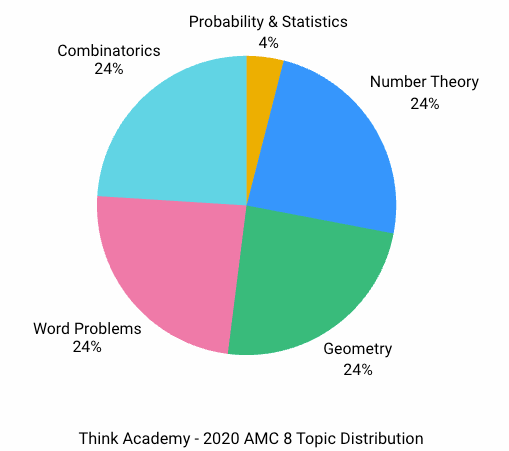
2020 AMC 8 Topic Distribution
The 2020 AMC 8 contains 25 multiple-choice questions completed in 40 minutes, emphasizing logical reasoning and conceptual understanding.
Learn more about AMC 8 Format and Scoring Here: AMC 8 FAQs: The Ultimate Guide for First-Time Test Takers
Detailed Module Analysis
| Module | Question Numbers | What It Tests (Brief) |
|---|---|---|
| Geometry | 9, 16, 18, 21, 24, 25 | 3-D solids, surface area, coordinate geometry, similar figures, ratios of areas |
| Word Problems / Arithmetic | 1, 2, 3, 5, 11, 20 | Multi-step arithmetic, rates, averages, mixtures, work and distance |
| Number Theory / Algebra | 7, 8, 12, 15, 17, 22 | Integers, divisibility, factorials, ratios, remainder patterns, functional rules |
| Combinatorics & Logic | 4, 6, 10, 13, 19, 23 | Counting, arrangements, logical deduction, puzzle reasoning |
| Probability & Statistics | 14 | Graph reading, approximation, data interpretation |
Real Questions and Solutions Explained
Geometry Example – Problem 18
Question:
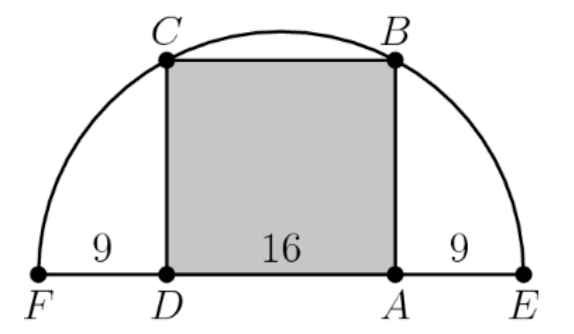
Rectangle ABCD is inscribed in a semicircle with diameter FE, as shown in the figure. Let DA = 16, and let FD = AE = 9. What is the area of ABCD?
(A) 240 (B) 248 (C) 256 (D) 264 (E) 272
Solution:
FE is the diameter and equals the sum of the three collinear segments:
\[
FE = FD + DA + AE = 9 + 16 + 9 = 34.
\]
Hence the radius is
\[
r = \frac{FE}{2} = 17.
\]
Let O be the midpoint of FE. The rectangle’s vertical sides are at D and A, whose horizontal distances from O are both
\[
|OD_x| = |OA_x| = 17 – 9 = 8.
\]
Points C and B lie on the semicircle, so the rectangle’s height h satisfies
\[
h = \sqrt{r^{2} – 8^{2}} = \sqrt{17^{2} – 8^{2}} = \sqrt{289 – 64} = \sqrt{225} = 15.
\]
Therefore the area is
\[
[ABCD] = \text{base} \times \text{height} = 16 \times 15 = 240.
\]
Answer: (A)
Common Mistakes:
- Using 16 as the diameter or radius instead of part of the chord.
- Forgetting to divide FE by 2 to find the radius.
Word Problem Example – Problem 1
Question:
Luka is making lemonade to sell at a school fundraiser. His recipe requires 4 times as much water as sugar and twice as much sugar as lemon juice. He uses 3 cups of lemon juice. How many cups of water does he need?
(A) 6 (B) 8 (C) 12 (D) 18 (E) 24
Solution:
Let the amount of lemon juice be 3 cups.
Then sugar is twice that amount:
\[
\text{sugar} = 2 \times 3 = 6
\]
Water is 4 times as much as sugar:
\[
\text{water} = 4 \times 6 = 24
\]
So Luka needs 24 cups of water.
Answer: (E)
Common Mistakes:
- Multiplying by 4 before finding the amount of sugar.
- Confusing “twice as much sugar as lemon juice” with “half as much.”
- Forgetting that “4 times as much water as sugar” means multiply by 4, not add 4.
Number Theory Example – Problem 12
Question:
For a positive integer n, the factorial notation n! represents the product of the integers from n to 1.
What value of N satisfies the following equation?
\[
5! \cdot 9! = 12 \cdot N!
\]
(A) 10 (B) 11 (C) 12 (D) 13 (E) 14
Solution:
We start by expanding the factorials:
\[
9! = 9 \times 8 \times 7 \times 6 \times 5!
\]
Substitute this into the given equation:
\[
5! \cdot 9! = 5! \cdot (9 \times 8 \times 7 \times 6 \times 5!) = (5!)^{2} \times 3024
\]
Now divide both sides by 12 to isolate N!:
\[
N! = \frac{5! \cdot 9!}{12} = \frac{(5!)^{2} \times 3024}{12}
\]
Simplify:
\[
N! = 5! \times \frac{9 \times 8 \times 7 \times 6 \times 5!}{12}
\]
Compute the ratio step by step or notice that
\[
5! \cdot 9! = 12 \cdot 11!
\]
Therefore,
\[
N = 11
\]
Answer: (B)
Common Mistakes:
- Forgetting to cancel out the factorial terms before solving.
- Assuming (N = 9) or (N = 10) by comparing only single factorial values.
- Misinterpreting the equation as addition instead of multiplication.
Combinatorics Example – Problem 10
Question:
Zara has a collection of 4 marbles: an Aggie, a Bumblebee, a Steelie, and a Tiger. She wants to display them in a row on a shelf, but does not want to put the Steelie and the Tiger next to one another. In how many ways can she do this?
(A) 6 (B) 8 (C) 12 (D) 18 (E) 24
Solution:
Without restriction, the 4 marbles can be arranged in
\[
4! = 24 \text{ ways.}
\]
Now treat the Steelie and Tiger as one single “block.”
Together with the other two marbles, there are
\[
3! = 6 \text{ ways to arrange these 3 units.}
\]
Inside the block, the Steelie and Tiger can switch positions in
\[
2! = 2 \text{ ways.}
\]
Hence the number of arrangements where the Steelie and Tiger are together is
\[
6 \times 2 = 12.
\]
Subtract from the total:
\[
24 – 12 = 12.
\]
Answer: (C)
Common Mistakes:
- Forgetting to multiply by 2! for the order inside the Steelie–Tiger pair.
- Counting only the disallowed cases instead of subtracting from total.
- Assuming the two marbles are identical rather than distinct.
Probability Example – Problem 14
Question:
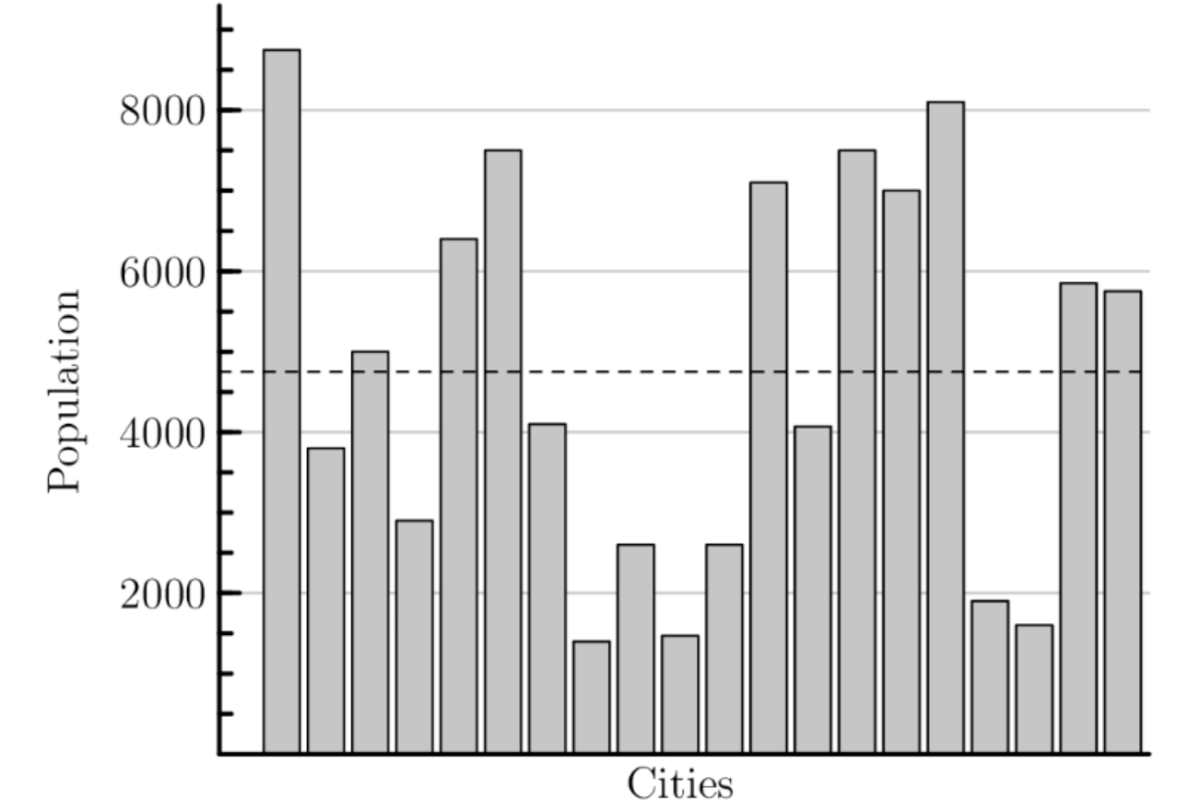
There are 20 cities in the County of Newton. Their populations are shown in the bar chart below. The average population of all the cities is indicated by the horizontal dashed line. Which of the following is closest to the total population of all 20 cities?
(A) 65,000 (B) 75,000 (C) 85,000 (D) 95,000 (E) 105,000
Solution:
From the bar chart, the horizontal dashed line (average) is located slightly below 5,000.
Estimate the average population per city as about 4,700 to 4,800.
Multiply by the number of cities:
\[
20 \times 4,750 = 95,000
\]
Thus, the total population of all 20 cities is closest to 95,000.
Answer: (D)
Common Mistakes :
- Misreading the horizontal dashed line as 5,000 instead of slightly below it.
- Forgetting that the dashed line represents the average (so multiply by 20 to get total).
- Estimating from one or two bars instead of using the mean value.
Try Pengi AI — Smarter Math Practice for Students
Pengi AI supports K–12 learners with personalized math practice, guided explanations, and feedback designed to help them build confidence and improve steadily.