Pengi Editor's Note
The Pengi editorial team curated this Think Academy analysis of the 2021 AMC 10A. The module-by-module breakdown with representative problems and common mistakes is particularly valuable for students building systematic AMC 10 preparation strategies.
Source: Think Academy Blog
2021 AMC 10A Real Questions and Analysis
In this article, you’ll find:
- Representative real questions from each module with detailed solutions.
- The complete 2021 AMC 10A Answer Key.
- The best resources to prepare effectively for the AMC 10.
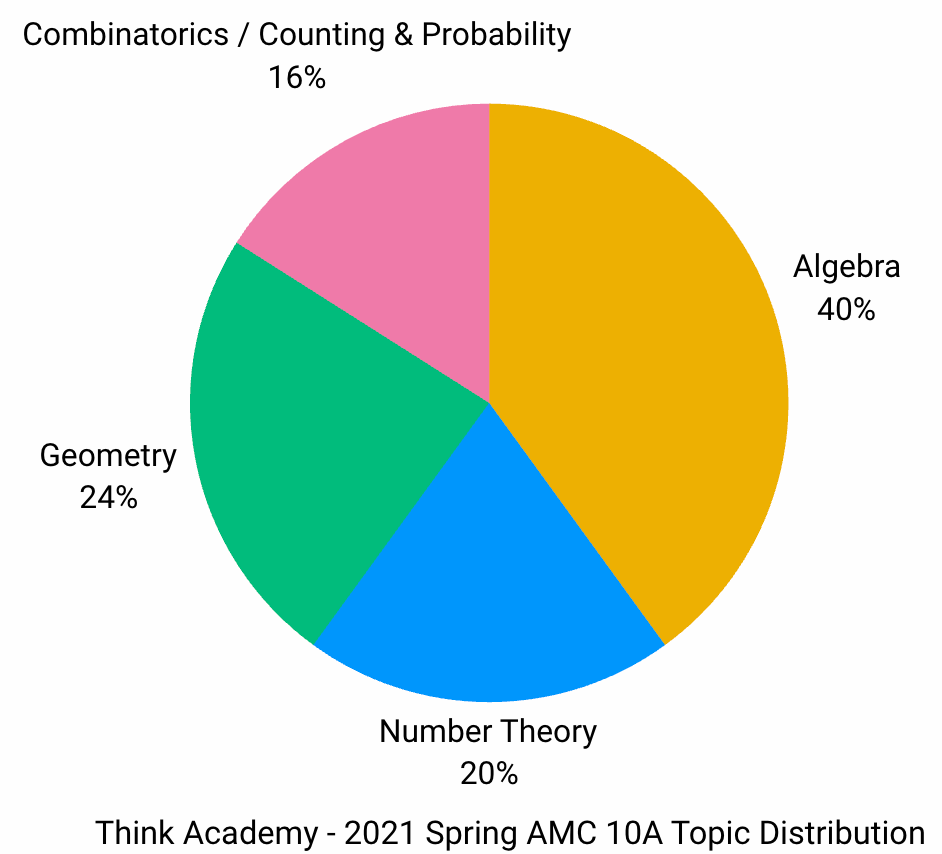
- A concise topic distribution chart showing which areas appeared most in the 2021 AMC 10A.
- A module-to-question mapping table highlighting the core concepts tested in each module for the 2021 AMC 10A.
Real Question and Solutions Explained – Spring
Algebra Example – Problem 2
Question:
Portia’s high school has 3 times as many students as Lara’s high school. The two high schools have a total of 2600 students. How many students does Portia’s high school have?
(A) 600 (B) 650 (C) 1950 (D) 2000 (E) 2050
Solution:
Let Lara’s high school have \(x\) students, so Portia’s has \(3x.\)
Write the equation \(x+3x=2600\Rightarrow4x=2600\Rightarrow x=650.\)
Portia’s school has \(3x=1950.\)
Answer (C)
Common Mistakes:
- Dividing by 3 instead of 4.
- Assigning \(x\) to the wrong school.
Number Theory Example – Problem 3
Question:
The sum of two natural numbers is 17,402. One of the two numbers is divisible by 10. If the units digit of that number is erased, the other number is obtained. What is the difference of these two numbers?
(A) 10,272 (B) 11,700 (C) 13,362 (D) 14,238 (E) 15,426
Solution:
Let the number divisible by 10 be \(10a.\) Removing its zero gives \(a.\)
Their sum is \(10a+a=17,402\Rightarrow11a=17,402\Rightarrow a=1582.\)
The two numbers are 15,820 and 1,582. Their difference is \(15,820-1,582=14,238.\)
Answer (D)
Common Mistakes:
- Forgetting that removing the zero divides the number by 10.
- Reversing which number corresponds to \(a\).
Geometry Example – Problem 12
Question:
Two right circular cones with vertices facing down as shown in the figure below contain the same amount of liquid. The radii of the tops of the liquid surfaces are 3 cm and 6 cm. Into each cone is dropped a spherical marble of radius 1 cm, which sinks to the bottom and is completely submerged without spilling any liquid. What is the ratio of the rise of the liquid level in the narrow cone to the rise of the liquid level in the wide cone?
(A) 1 : 1 (B) 47 : 43 (C) 2 : 1 (D) 40 : 13 (E) 4 : 1
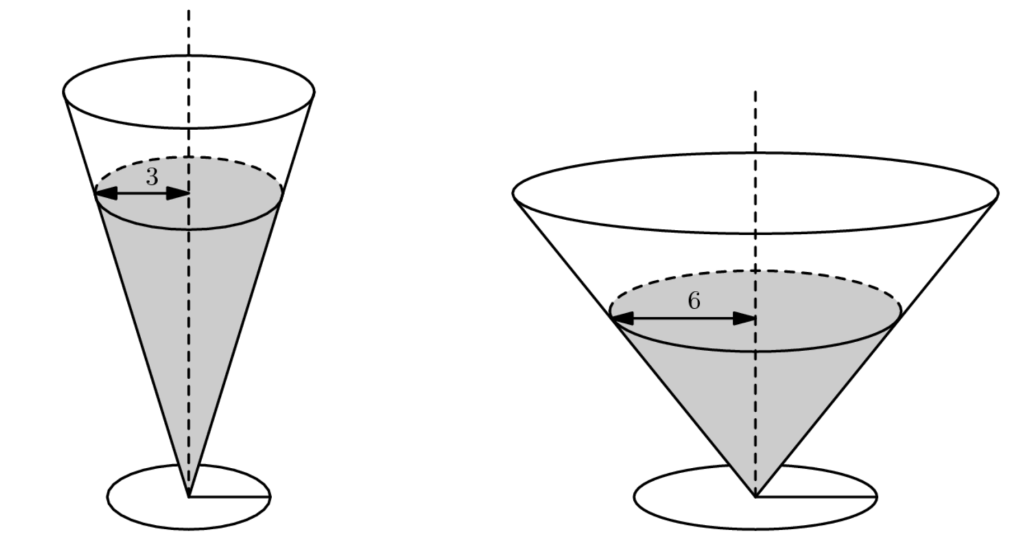
Solution:
The marble displaces the same volume of liquid in both cones.
Since the cross-sectional area is proportional to \(r^2\), the rise of liquid height \(h\propto\frac{1}{r^2}.\)
The ratio of rises is \(\frac{h_1}{h_2}=\frac{r_2^2}{r_1^2}=\frac{6^2}{3^2}=\frac{36}{9}=4.\)
Hence the ratio is 4 : 1.
Answer (E)
Common Mistakes:
- Forgetting that rise ∝ 1/area, not 1/r.
- Assuming the displaced height is the same in both cones.
Combinatorics Example – Problem 7
Question:
Tom has a collection of 13 snakes, 4 of which are purple and 5 of which are happy. He observes that
– all of his happy snakes can add,
– none of his purple snakes can subtract, and
– all of his snakes that can’t subtract also can’t add.
Which of these conclusions can be drawn about Tom’s snakes?
(A) Purple snakes can add.
(B) Purple snakes are happy.
(C) Snakes that can add are purple.
(D) Happy snakes are not purple.
(E) Happy snakes can’t subtract.
Solution:
From the second condition, purple snakes can’t subtract.
From the third, if a snake can’t subtract, it also can’t add → purple snakes can’t add.
From the first, happy snakes can add.
Therefore, happy snakes cannot be purple.
Answer (D)
Common Mistakes:
- Confusing “can’t subtract” with “can’t add.”
- Assuming “purple snakes” and “happy snakes” overlap.
Real Question and Solutions Explained – Fall
Algebra Example – Problem 1
Question:
What is the value of \(\frac{(2112-2021)^2}{169}?\)
(A) 7 (B) 21 (C) 49 (D) 64 (E) 91
Solution:
Compute \(2112-2021=91.\)
Factorize \(91=7\times13.\)
Substitute into the expression: \(\frac{(91)^2}{13^2}=\frac{8281}{169}=49.\)
Answer (C)
Common Mistakes:
- Forgetting to square both numerator and denominator.
- Miscomputing \(2112-2021\).
Number Theory Example – Problem 5
Question:
The six-digit number \(20210A\) is prime for only one digit \(A\). What is \(A\)?
(A) 1 (B) 3 (C) 5 (D) 7 (E) 9
Solution:
Test even digits → divisible by 2.
Test A = 5 → divisible by 5.
Test A = 9 → 202109 ÷ 7 ≈ 28873 → prime.
Other digits yield composites.
Answer (E)
Common Mistakes:
- Not checking divisibility by 3, 7, or 11 properly.
- Forgetting that “only one digit A” satisfies primality.
Geometry Example – Problem 3
Question:
What is the maximum number of balls of clay of radius 2 that can completely fit inside a cube of side length 6 assuming the balls can be reshaped but not compressed before they are packed in the cube?
(A) 3 (B) 4 (C) 5 (D) 6 (E) 7
Solution:
Each sphere has volume \(\frac{4}{3}\pi(2^3)=\frac{32}{3}\pi.\)
The cube has volume \(6^3=216.\)
Maximum count = \(\frac{216}{\frac{32}{3}\pi}\approx6.46\Rightarrow6.\)
Answer (D)
Common Mistakes:
- Forgetting spheres can be reshaped (not rigid packing).
- Using sphere packing efficiency instead of volume ratio.
Combinatorics Example – Problem 9
Question:
When a certain unfair die is rolled, an even number is 3 times as likely to appear as an odd number. The die is rolled twice. What is the probability that the sum of the numbers rolled is even?
(A) \(\frac{3}{8}\) (B) \(\frac{4}{9}\) (C) \(\frac{5}{9}\) (D) \(\frac{9}{16}\) (E) \(\frac{5}{8}\)
Solution:
Let total weight = \(3+1=4\). Probability of even = \(\frac{3}{4}\); odd = \(\frac{1}{4}.\)
Sum is even if both rolls are even or both odd: \((\frac{3}{4})^2+(\frac{1}{4})^2=\frac{9}{16}+\frac{1}{16}=\frac{10}{16}=\frac{5}{8}.\)
Answer (E)
Common Mistakes:
- Adding instead of squaring probabilities.
- Forgetting two independent rolls must both be even or both odd.
2021 AMC 10A Answer Key
| Question | Answer – Spring | Answer – Fall |
|---|---|---|
| 1 | D | C |
| 2 | C | E |
| 3 | D | D |
| 4 | D | B |
| 5 | B | E |
| 6 | A | B |
| 7 | D | D |
| 8 | E | B |
| 9 | D | E |
| 10 | C | B |
| 11 | E | A |
| 12 | E | D |
| 13 | C | D |
| 14 | A | D |
| 15 | C | C |
| 16 | C | D |
| 17 | D | D |
| 18 | E | C |
| 19 | E | A |
| 20 | D | B |
| 21 | C | E |
| 22 | B | B |
| 23 | D | D |
| 24 | D | E |
| 25 | E | A |
Last 10 Years AMC 10 Real Questions and Analysis
Think Academy provides in-depth breakdowns of the past decade of AMC 10 exams. Click below to explore:
- Year-by-year topic trend insights and concept distributions
- Real AMC 10 exams from the last 10 years
- Official answer keys
- Representative questions, detailed solutions, and common mistakes
| AMC 10A | AMC 10B |
|---|---|
| 2024 AMC 10A | 2024 AMC10B |
| 2023 AMC 10A | 2023 AMC10B |
| 2022 AMC 10A | 2022 AMC10B |
| 2021 AMC 10A | 2021 AMC10B |
| 2020 AMC 10A | 2020 AMC10B |
| 2019 AMC 10A | 2019 AMC10B |
| 2018 AMC 10A | 2018 AMC10B |
| 2017 AMC 10A | 2017 AMC10B |
| 2016 AMC 10A | 2016 AMC10B |
2021 Spring AMC 10A Topic Distribution
The 2021 Spring AMC 10A featured 25 questions to be completed in 75 minutes, emphasizing advanced problem-solving and proof-based reasoning skills.
Learn more about AMC 10 Format and Scoring Here: AMC 10 FAQ and Resources: Your Ultimate Guide
| Module | Question Numbers | What It Tests (Brief) |
|---|---|---|
| Algebra (+ arithmetic reasoning) | 2, 4, 5, 6, 9, 10, 14, 16, 18, 19 | Operations, equations, functions, factoring, quadratics, averages |
| Number Theory | 1, 3, 8, 11, 22 | Divisibility, place value, modular arithmetic, prime factorization |
| Geometry | 12, 13, 17, 21, 24 | 2-D and 3-D geometry, similarity, area/volume, circles, trapezoids |
| Combinatorics / Counting & Probability | 7, 15, 20, 23, 25 | Counting, logical reasoning, probability, arrangements |
2021 Fall AMC 10A Topic Distribution
The 2021 Fall AMC 10A featured 25 questions to be completed in 75 minutes, emphasizing advanced problem-solving and proof-based reasoning skills.
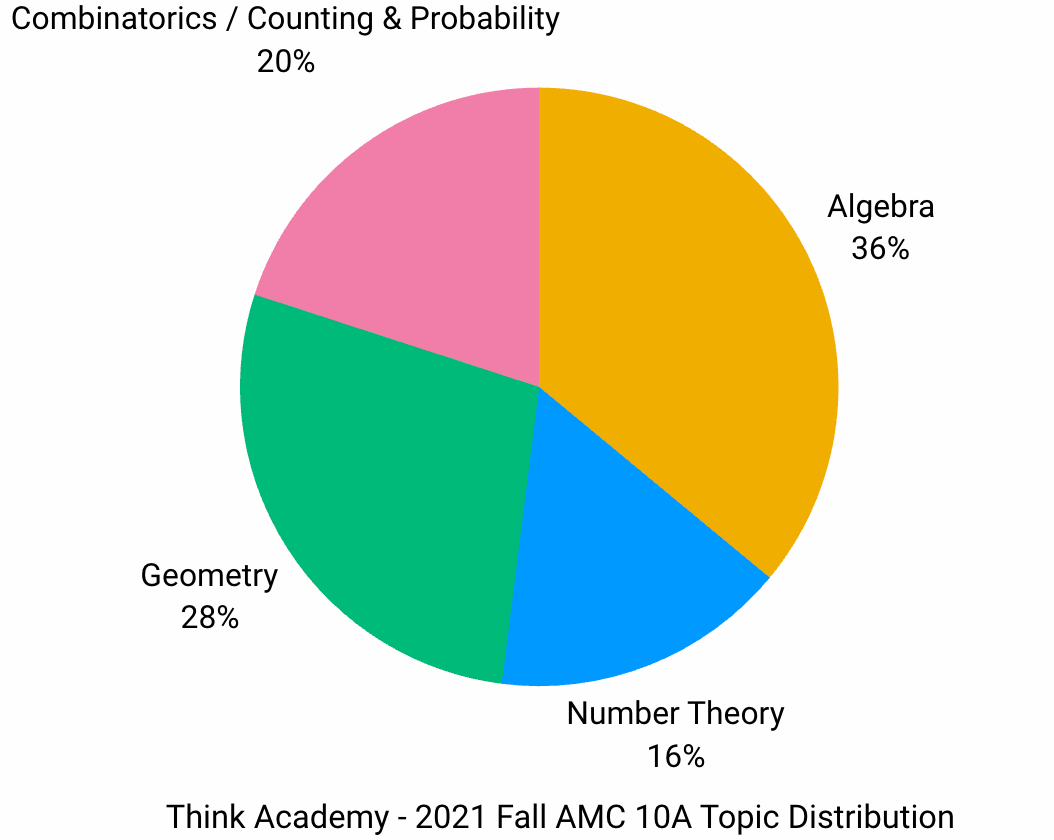
| Module | Question Numbers | What It Tests (Brief) |
|---|---|---|
| Algebra (+ arithmetic reasoning) | 1, 4, 6, 10, 11, 14, 16, 20, 25 | Applications, symmetry, polynomials, expressions, functional reasoning |
| Number Theory | 5, 8, 12, 23 | Divisibility, primes, bases, modular arithmetic |
| Geometry | 2, 3, 7, 15, 17, 19, 22 | Areas, angles, coordinate and 3-D solids |
| Combinatorics / Counting & Probability | 9, 13, 18, 21, 24 | Counting, arrangements, probability, logical reasoning |
Try Pengi AI — Smarter Math Practice for Students
Pengi AI supports K–12 learners with personalized math practice, guided explanations, and feedback designed to help them build confidence and improve steadily.