Pengi Editor's Note
The Pengi editorial team curated this Think Academy 2022 AMC 10A breakdown. The representative problems with full solutions and error analysis provide exactly the kind of structured review that separates strong AMC 10 competitors from the rest.
Source: Think Academy Blog
2022 AMC 10A Real Questions and Analysis
In this article, you’ll find:
- Representative real questions from each module with detailed solutions.
- The complete 2022 AMC 10A Answer Key.
- The best resources to prepare effectively for the AMC 10.
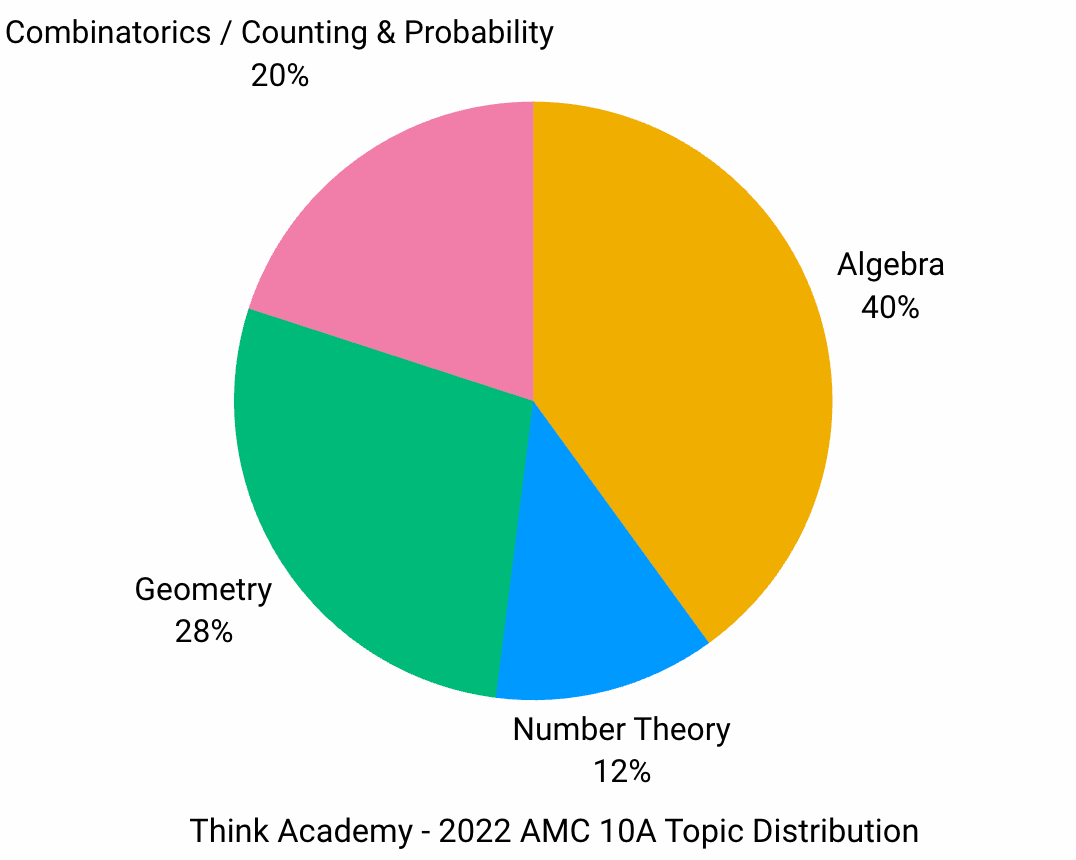
- A concise topic distribution chart showing which areas appeared most in the 2022 AMC 10A.
- A module-to-question mapping table highlighting the core concepts tested in each module for the 2022 AMC 10A.
Real Question and Solutions Explained
Algebra Example – Problem 3
Question:
The sum of three numbers is 96. The first number is 6 times the third number, and the third number is 40 less than the second number. What is the absolute value of the difference between the first and second numbers?
(A) 1 (B) 2 (C) 3 (D) 4 (E) 5
Solution:
Let the three numbers be 𝑎, 𝑏, and 𝑐.
We have \(a+b+c=96,\ a=6c,\ c=b-40.\)
Substitute \(a=6c\) and \(b=c+40:\) \(6c+(c+40)+c=96 \Rightarrow 8c+40=96 \Rightarrow c=7.\)
Then \(a=42\) and \(b=47.\)
The absolute difference is \(|a-b|=|42-47|=5.\)
Answer (E)
Common Mistakes:
- Forgetting that “40 less than” means subtract 40, not add 40.
- Failing to apply all three equations consistently.
- Taking the difference without absolute value.
Number Theory Example – Problem 7
Question:
The least common multiple (LCM) of a positive integer 𝑛 and 18 is 180, and the greatest common divisor (GCD) of 𝑛 and 45 is 15. What is the sum of the digits of 𝑛?
(A) 3 (B) 6 (C) 8 (D) 9 (E) 12
Solution:
Prime factorizations: \(18=2\times3^2,\ 45=3^2\times5,\ 180=2^2\times3^2\times5.\)
Let \(n=2^a3^b5^c.\)
From LCM condition, \(\max(a,1)=2,\ \max(b,2)=2,\ \max(c,0)=1\Rightarrow a\ge2,\ b\ge2,\ c=1.\)
From GCD condition, \(\min(b,2)=1,\ \min(c,1)=1\Rightarrow b=1,\ c=1,\ a=2.\)
Hence \(n=2^2\times3^1\times5^1=60,\) and the digit sum is \(6+0=6.\)
Answer (B)
Common Mistakes:
- Confusing the roles of \(\min\) and \(\max\) for GCD vs. LCM.
- Checking only one of the two conditions.
- Mishandling prime exponents (especially missing the factor 2).
Geometry Example – Problem 5
Question:
Square 𝐴𝐵𝐶𝐷 has side 1. Points 𝑃, 𝑄, 𝑅, 𝑆 each lie on a side of 𝐴𝐵𝐶𝐷 so that 𝐴𝑃𝑄𝐶𝑅𝑆 forms an equilateral convex hexagon with side 𝑠. What is 𝑠?
(A) \(\frac{2\sqrt{3}}{3}\) (B) \(\frac{1}{2}\) (C) \(2-\sqrt{2}\) (D) \(1-\frac{\sqrt{2}}{4}\) (E) \(\frac{2\sqrt{2}}{3}\)
Solution:
Place the square as \(A(0,0),\ B(1,0),\ C(1,1),\ D(0,1).\)
By symmetry, the six equal edges of the equilateral hexagon align with 45° directions from mid-sides; coordinate or vector relations give \(s=1-\frac{\sqrt{2}}{4}.\)
Answer (D)
Common Mistakes:
- Placing 𝑃, 𝑄, 𝑅, 𝑆 asymmetrically so the hexagon is not equilateral.
- Forgetting edges partly lie inside the square, not only along sides.
- Relying on rough measurement instead of coordinate equations.
Combinatorics Example – Problem 9
Question:
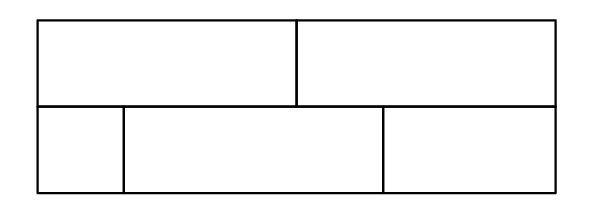
A rectangle is partitioned into 5 regions as shown. Each region is to be painted one of five colors — red, orange, yellow, blue, or green — so that touching regions are painted different colors. Colors may be reused. How many different colorings are possible?
(A) 120 (B) 270 (C) 360 (D) 540 (E) 720
Solution:
Model the picture as a graph with 5 vertices (regions) and edges for shared borders (corner-touching does not count).
One region has degree 3, two have degree 2, and the remaining fit accordingly; counting sequentially yields \(5\times4\times3\times3\times2=360.\)
Answer (C)
Common Mistakes:
- Treating regions that meet only at a corner as adjacent.
- Assuming the order of colors matters beyond adjacency constraints.
- Forgetting colors may be reused on non-adjacent regions.
2022 AMC 10A Answer Key
| Question | Answer |
|---|---|
| 1 | D |
| 2 | B |
| 3 | E |
| 4 | E |
| 5 | C |
| 6 | A |
| 7 | B |
| 8 | D |
| 9 | D |
| 10 | E |
| 11 | C |
| 12 | A |
| 13 | C |
| 14 | E |
| 15 | D |
| 16 | D |
| 17 | D |
| 18 | A |
| 19 | C |
| 20 | E |
| 21 | B |
| 22 | D |
| 23 | B |
| 24 | E |
| 25 | B |
Last 10 Years AMC 10 Real Questions and Analysis
Think Academy provides in-depth breakdowns of the past decade of AMC 10 exams. Click below to explore:
- Year-by-year topic trend insights and concept distributions
- Real AMC 10 exams from the last 10 years
- Official answer keys
- Representative questions, detailed solutions, and common mistakes
| AMC 10A | AMC 10B |
|---|---|
| 2024 AMC 10A | 2024 AMC10B |
| 2023 AMC 10A | 2023 AMC10B |
| 2022 AMC 10A | 2022 AMC10B |
| 2021 AMC 10A | 2021 AMC10B |
| 2020 AMC 10A | 2020 AMC10B |
| 2019 AMC 10A | 2019 AMC10B |
| 2018 AMC 10A | 2018 AMC10B |
| 2017 AMC 10A | 2017 AMC10B |
| 2016 AMC 10A | 2016 AMC10B |
2022 AMC 10A Topic Distribution
The 2022 AMC 10A featured 25 questions to be completed in 75 minutes, emphasizing advanced problem-solving and proof-based reasoning skills.
Learn more about AMC 10 Format and Scoring Here: AMC 10 FAQ and Resources: Your Ultimate Guide
Detailed Module Analysis
| Module | Question Numbers | What It Tests (Brief) |
|---|---|---|
| Algebra (+ arithmetic reasoning) | 1, 2, 3, 4, 6, 8, 11, 16, 17, 20 | Ratios, equations, averages, arithmetic and geometric sequences, Vieta’s formulas, and Diophantine reasoning |
| Number Theory | 7, 19, 25 | Greatest common divisor (GCD), least common multiple (LCM), remainders, and modular reasoning |
| Geometry | 5, 10, 13, 15, 18, 21, 23 | Triangles and polygons, angle bisectors and parallel lines, circles, coordinate and solid geometry, rotations and transformations, and lattice-point area reasoning |
| Combinatorics / Counting & Probability | 9, 12, 14, 22, 24 | Counting methods, logical reasoning, casework and complementary counting, permutations and subsets |
Try Pengi AI — Smarter Math Practice for Students
Pengi AI supports K–12 learners with personalized math practice, guided explanations, and feedback designed to help them build confidence and improve steadily.