Pengi Editor's Note
The Pengi editorial team curated this Think Academy 2023 AMC 10A breakdown. The module-level problem walkthroughs, common mistake highlights, and answer key give students a complete study package for one of the most important recent AMC 10 exams.
Source: Think Academy Blog
2023 AMC 10A Real Questions and Analysis
In this article, you’ll find:
- Representative real questions from each module with detailed solutions.
- The complete 2023 AMC 10A Answer Key.
- The best resources to prepare effectively for the AMC 10.
- A concise topic distribution chart showing which areas appeared most in the 2023 AMC 10A.
- A module-to-question mapping table highlighting the core concepts tested in each module for the 2023 AMC 10A.
Real Question and Solutions Explained
Algebra Example – Problem 8
Question:
Barb the baker has developed a new temperature scale for her bakery called the Breadus scale, which is a linear function of the Fahrenheit scale. Bread rises at 110 degrees Fahrenheit, which is 0 degrees on the Breadus scale. Bread is baked at 350 degrees Fahrenheit, which is 100 degrees on the Breadus scale. Bread is done when its internal temperature is 200 degrees Fahrenheit. What is this in degrees on the Breadus scale?
(A) 33 (B) 34.5 (C) 36 (D) 37.5 (E) 39
Solution:
Let the conversion be \( B = aF + b \).
Using the two calibration points \((F,B) = (110,0)\) and \((350,100)\):
\[ a = \frac{100 – 0}{350 – 110} = \frac{100}{240} = \frac{5}{12}, \quad b = 0 – \frac{5}{12} \times 110 = -\frac{275}{6} \]
At \( F = 200 \):
\[ B = \frac{5}{12} \times 200 – \frac{275}{6} = \frac{250}{3} – \frac{275}{6} = \frac{225}{6} = 37.5 \]
Therefore, the Breadus temperature is 37.5°.
Answer (D)
Common Mistakes:
- Assuming a direct proportion \( B = kF \) (forgetting the intercept).
- Mixing the two reference points when computing the slope.
- Converting \( 200^{\circ} \) after rounding \( a \) or \( b \).
Number Theory Example – Problem 12
Question:
How many three-digit positive integers \( N \) satisfy the following?
- The number formed by reversing the digits of \( N \) is divisible by 5.
- \( N \) is divisible by 7.
(A) 13 (B) 14 (C) 15 (D) 16 (E) 17
Solution:
A number is divisible by 5 if and only if its last digit is 0 or 5. The reverse of \(N\) ends with the hundreds digit of \(N\), so that hundreds digit must be 0 or 5. For a three-digit \(N\), it cannot start with 0; hence the hundreds digit is 5.
Thus \(N \in \{500, 501, \dots, 599\}\) and \(7 \mid N\).
The smallest multiple of 7 in this range is \(7 \times 72 = 504\), and the largest is \(7 \times 85 = 595\).
Hence the valid multiples are \(7 \times 72, 7 \times 73, \dots, 7 \times 85\), giving
\[ 85 – 72 + 1 = 14 \text{ numbers.} \]
Answer (B)
Common Mistakes:
- Requiring the units digit of \(N\) to be 0 or 5 (it’s the reverse that must be).
- Forgetting that the hundreds digit cannot be 0.
- Off-by-one errors when counting multiples within an interval.
Geometry Example – Problem 22
Question:
Circles \( C_1 \) and \( C_2 \) each have radius 1, and the distance between their centers is \( \frac{1}{2} \). Circle \( C_3 \) is the largest circle internally tangent to both \( C_1 \) and \( C_2 \). Circle \( C_4 \) is internally tangent to both \( C_1 \) and \( C_2 \), and externally tangent to \( C_3 \).
What is the radius of \( C_4 \)?
(A) \( \frac{1}{14} \) (B) \( \frac{1}{12} \) (C) \( \frac{1}{10} \) (D) \( \frac{3}{28} \) (E) \( \frac{1}{9} \)
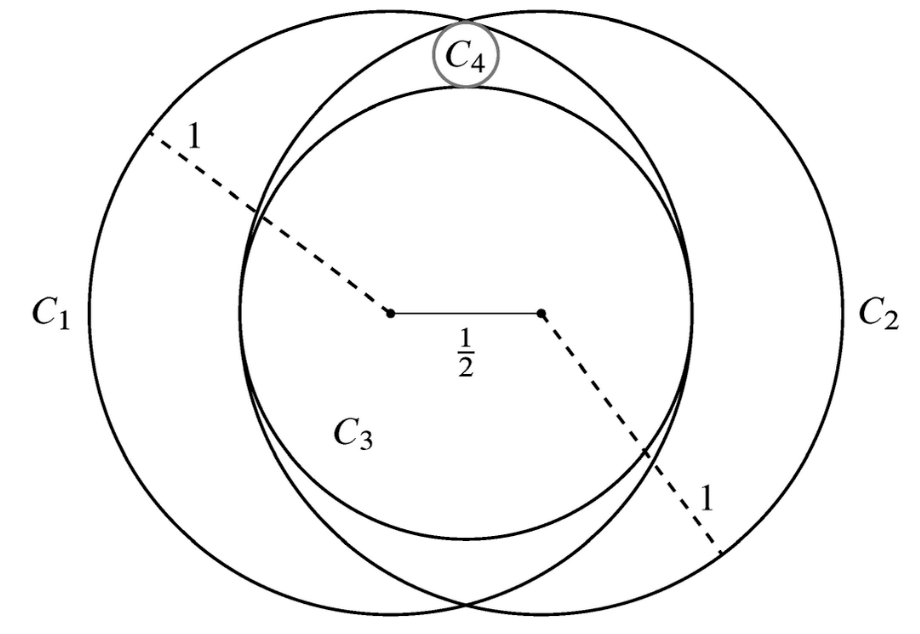
Solution:
Let the centers of the two unit circles be \((\pm \frac{1}{4}, 0)\), so their distance is \( \frac{1}{2} \).
The center of \( C_3 \) lies on the perpendicular bisector (the y-axis).
For internal tangency to each unit circle, the distance from its center \((0, y)\) to either unit circle center must be \( 1 – r \).
This is minimized when \( y = 0 \), giving
\[ r_3 = 1 – \frac{1}{4} = \frac{3}{4} \]
Let \( C_4 \) have center \((0, x)\) (with \( x > 0 \)) and radius \( r \).
Internal tangency to each unit circle gives
\[ \sqrt{\Big( \frac{1}{4} \Big)^2 + x^2} = 1 – r \tag{1} \]
External tangency to \( C_3 \) (center at the origin) gives
\[ x = r_3 + r = \frac{3}{4} + r \tag{2} \]
Substitute (2) into (1):
\[ \Big( \frac{3}{4} + r \Big)^2 + \frac{1}{16} = (1 – r)^2 \]
Simplify:
\[ \frac{5}{8} + \frac{3}{2}r = 1 – 2r \Rightarrow \frac{7}{2}r = \frac{3}{8} \Rightarrow r = \frac{3}{28} \]
Therefore, the radius of \( C_4 \) is \( \frac{3}{28} \).
Answer (D)
Common Mistakes:
- Placing the small-circle center at the midpoint (implies impossible concentric tangency).
- Using \(x = |r_3 – r|\) instead of \(x = r_3 + r\).
- Forgetting both distances to the unit centers must be equal.
Combinatorics Example – Problem 7
Question:
Janet rolls a standard 6-sided die 4 times and keeps a running total of the numbers she rolls. What is the probability that at some point, her running total will equal 3?
(A) \( \frac{2}{9} \) (B) \( \frac{49}{216} \) (C) \( \frac{25}{108} \) (D) \( \frac{17}{72} \) (E) \( \frac{13}{54} \)
Solution:
Total outcomes: \(6^4=1296\). Count the complement = sequences whose partial sums never equal 3.
- First roll = 3 → already hits 3 (not in complement).
- First roll \(\ge 4\): already exceeds 3 and can never come back → \(3\cdot6^3=648\) sequences in the complement.
- First roll = 1: the second roll cannot be 2.
- If second = 1, sum = 2; third cannot be 1, so 5 choices for the third and 6 for the fourth → \(5\cdot6=30\).
- If second \in\{3,4,5,6\}, sum \(\ge 4\); remaining two rolls free → \(4\cdot6^2=144\).
Total for first = 1: \(174\). - First roll = 2: the second roll cannot be 1.
- If second = 2, sum = 4; remaining free → \(6^2=36\).
- If second \in\{3,4,5,6\}, sum \(\ge 5\); remaining free → \(4\cdot6^2=144\).
Total for first = 2: \(180\).
Complement total: \(648+174+180=1002\). Hence desired count
\[1296-1002=294\]
and probability
\[\frac{294}{1296} = \frac{49}{216}.\]
Answer (B)
Common Mistakes:
- Forgetting that a first roll of 3 already satisfies the condition (should not be part of the complement).
- Overcounting by continuing to restrict later rolls after the running total has already exceeded 3.
- Using \(6^3\) instead of \(6^4\) for the total number of possible outcomes.
2023 AMC 10A Answer Key
| Question | Answer |
|---|---|
| 1 | E |
| 2 | A |
| 3 | A |
| 4 | D |
| 5 | E |
| 6 | D |
| 7 | B |
| 8 | D |
| 9 | E |
| 10 | D |
| 11 | C |
| 12 | B |
| 13 | C |
| 14 | B |
| 15 | E |
| 16 | B |
| 17 | A |
| 18 | D |
| 19 | E |
| 20 | D |
| 21 | D |
| 22 | D |
| 23 | C |
| 24 | C |
| 25 | A |
Last 10 Years AMC 10 Real Questions and Analysis
Think Academy provides in-depth breakdowns of the past decade of AMC 10 exams. Click below to explore:
- Year-by-year topic trend insights and concept distributions
- Real AMC 10 exams from the last 10 years
- Official answer keys
- Representative questions, detailed solutions, and common mistakes
| AMC 10A | AMC 10B |
|---|---|
| 2024 AMC 10A | 2024 AMC10B |
| 2023 AMC 10A | 2023 AMC10B |
| 2022 AMC 10A | 2022 AMC10B |
| 2021 AMC 10A | 2021 AMC10B |
| 2020 AMC 10A | 2020 AMC10B |
| 2019 AMC 10A | 2019 AMC10B |
| 2018 AMC 10A | 2018 AMC10B |
| 2017 AMC 10A | 2017 AMC10B |
| 2016 AMC 10A | 2016 AMC10B |
2023 AMC 10A Topic Distribution
The 2023 AMC 10A featured 25 questions to be completed in 75 minutes, emphasizing advanced problem-solving and proof-based reasoning skills.
Learn more about AMC 10 Format and Scoring Here: AMC 10 FAQ and Resources: Your Ultimate Guide
Learn more about 2023 AMC 10A Strategies Here: 2023 AMC 10A Exam Analysis: Difficulty, Structure, and Strategies
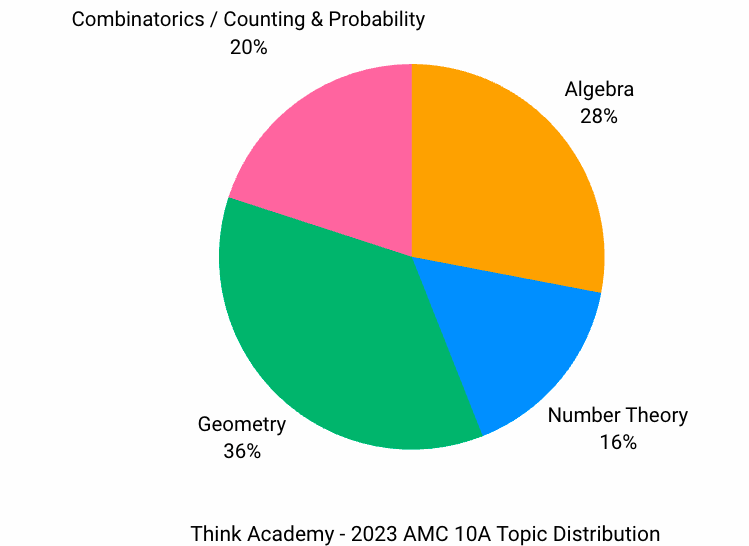
Detailed Module Analysis
| Module | Question Numbers | What It Tests (Brief) |
|---|---|---|
| Algebra (+ arithmetic reasoning) | 1, 2, 6, 8, 10, 16, 21 | Ratios, fractions, means, linear equations, functions, and polynomial transformations |
| Number Theory | 3, 5, 12, 23 | Primes, factors, divisibility, and digit properties |
| Geometry | 4, 11, 13, 15, 17, 18, 19, 22, 24 | Perimeter, area, triangles, circles, 3D solids, rotations, tangents, and similarity |
| Combinatorics / Counting & Probability | 7, 9, 14, 20, 25 | Counting, casework, logic, and probability on solids |
Try Pengi AI — Smarter Math Practice for Students
Pengi AI supports K–12 learners with personalized math practice, guided explanations, and feedback designed to help them build confidence and improve steadily.