Pengi Editor's Note
The Pengi editorial team selected this Think Academy 2023 Math Kangaroo analysis. Real problem walkthroughs with clear explanations make it an efficient prep resource for Math Kangaroo participants at every level.
Source: Think Academy Blog
2023 Math Kangaroo Real Questions and Analysis
In this article, you’ll find:
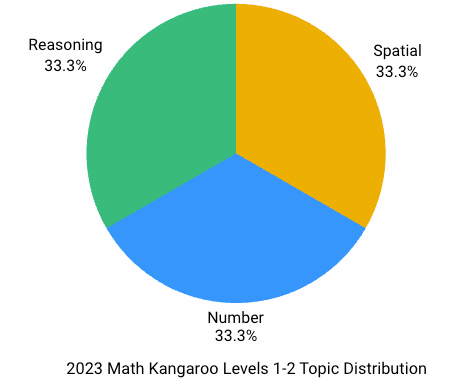
- A topic distribution chart for the 2023 Math Kangaroo Levels 1–4
- Key concepts tested in each topic
- A question–module mapping table
- Four real 2023 questions with solutions and common mistakes
- Study tips and resources to prepare effectively for Math Kangaroo
2023 Math Kangaroo Overview
The Math Kangaroo competition consists of a single 75-minute multiple-choice test with five answer options per question. Students can participate either online or on paper.
Scoring Structure
- Grades 1–4: 24 questions, maximum score of 96 points
- Grades 5–12: 30 questions, maximum score of 120 points
Learn more about Math Kangaroo Format and Scoring Here: Math Kangaroo FAQ and Resources: Your Ultimate Guide
Levels 1-2 Analysis
Topic Distribution
Detailed Module Summary
| Module | Question Numbers | What It Tests (Brief) |
|---|---|---|
| Spatial | 2, 4, 9, 13, 14, 15, 16, 20 | Understanding 2D and 3D shapes, symmetry, visual-spatial reasoning, and geometric transformations |
| Number | 3, 5, 6, 7, 10, 11, 21, 22 | Arithmetic operations, counting, number relationships, and numerical logic |
| Reasoning | 1, 8, 12, 17, 18, 19, 23, 24 | Logical deduction, multi-step reasoning, pattern recognition, sequencing, and situational logic |
Spatial Example – Problem 13
Question:
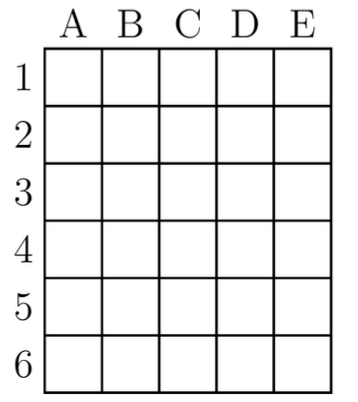
The table has 30 boxes. After painting the boxes in row 3, row 6, column C, and column D, how many boxes will not be painted?
(A) 8 (B) 10 (C) 12 (D) 18 (E) 22
Solution:
There are \(6 \times 5 = 30\) boxes in total.
Painting row 3 and row 6 → \(2 \times 5 = 10\) boxes painted.
Painting column C and column D → \(2 \times 6 = 12\) boxes painted.
However, 4 boxes (where rows 3 or 6 intersect columns C or D) were double-counted.
Total painted = \(10 + 12 – 4 = 18.\)
Unpainted = \(30 – 18 = 12.\)
Answer (C)
Common Mistakes:
- Adding \(10 + 12 = 22\) without subtracting overlapping boxes.
- Assuming intersections are counted once but not actually adjusting for double-counts.
Number Example – Problem 10
Question:
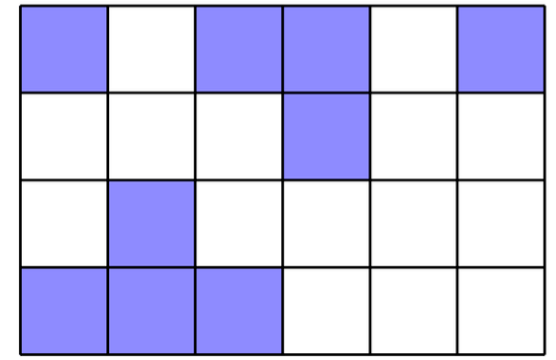
There are 24 squares in the picture. Suchit has coloured some of them. How many more squares need to be coloured so that half of the squares are coloured?
(A) 1 (B) 2 (C) 3 (D) 4 (E) 5
Solution:
There are \(6 \times 4 = 24\) squares in total.
Currently, 9 squares are coloured.
Half of 24 is \(12\), so \(12 – 9 = 3\) more squares must be coloured.
Answer (C)
Common Mistakes:
- Miscounting the grid (thinking there are 20 or 25 squares).
- Misinterpreting “so that half are coloured” as “colour another half of what’s left.”
Reasoning Example – Problem 17
Question:
Elvis has 6 identical triangles like this.
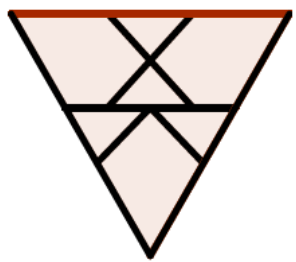
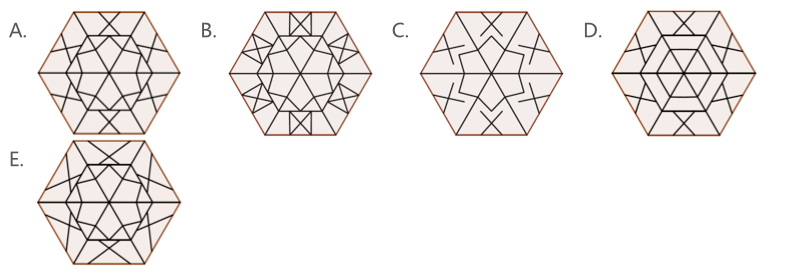
Which of the following pictures can he make?
Solution:
By arranging six equilateral triangles around a common center, they fit perfectly to form a regular hexagon (A).
Other options show misaligned edges or overlapping angles, which are impossible with six identical equilateral triangles.
Answer (A)
Common Mistakes:
- Choosing complex-looking figures instead of checking geometric fit.
- Ignoring “identical triangles” and “shared edges,” leading to visual misjudgment.
Levels 3-4 Analysis
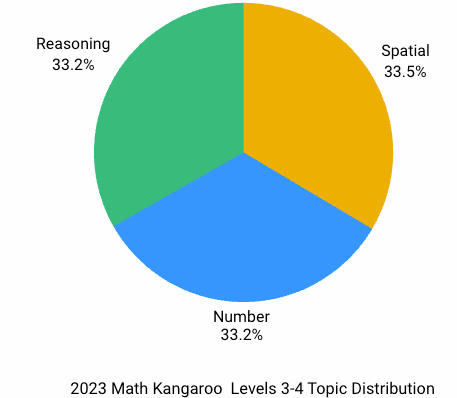
Topic Distribution
Detailed Module Summary
| Module | Question Numbers | What It Tests (Brief) |
|---|---|---|
| Spatial | 4, 6, 8, 9, 11, 14, 18, 22 | Spatial visualization, pattern folding, geometric reasoning, mirror/reflection symmetry, and 3D logic |
| Number | 2, 5, 7, 10, 13, 15, 17, 19 | Arithmetic, counting, combinatorics, parity/odd-even reasoning, and structured numerical relationships |
| Reasoning | 1, 3, 12, 16, 20, 21, 23, 24 | Logical deduction, sequencing, constraint satisfaction, conditional reasoning, and elimination puzzles |
Real Questions and Solutions Explained
Spatial Example – Problem 14
Question:
The Metro line has 6 stations, A, B, C, D, E, and F. The train stops at every station. When it reaches one of the two end stations, it changes direction. The train driver started driving at station B and her first stop was station C. Which station will be her 96th stop?
(A) A (B) B (C) C (D) D (E) E

Solution:
The train moves as follows:
B → C → D → E → F → E → D → C → B → A → B → C → …
This pattern repeats every 10 stops.
Divide 96 by 10: \(96 \div 10 = 9\) remainder \(6\).
The 96th stop corresponds to the 6th term in the pattern:
B(1), C(2), D(3), E(4), F(5), D(6).
Answer (D)
Common Mistakes:
- Ignoring direction change at the ends, treating it as one-way A→F.
- Subtracting \(96 – 6\) or miscounting instead of using the 10-stop repeating pattern.
Number Example – Problem 10
Question:
There are six weights of 1, 2, 3, 4, 5 and 6 kg. Rossitza puts five of them on the scales and puts one weight aside. The scales balance. Which weight did she put aside?
(A) 1 (B) 2 (C) 3 (D) 4 (E) We can’t be sure

Solution:
The total of all weights is \(1 + 2 + 3 + 4 + 5 + 6 = 21\) kg.
If one weight \(w\) is put aside, the remaining total \(21 – w\) must be even for equal balance.
Thus \(w\) must be odd: \(w = 1, 3, 5.\)
Now check each case:
Remove 5 → remaining \(16\); two sides of \(8\) kg possible (e.g., \(2 + 6 = 8\) and \(1 + 3 + 4 = 8\)).
Since all three removals can balance the scales, it’s not unique.
Remove 1 → remaining \(20\); two sides of \(10\) kg are possible (e.g., \(4 + 6 = 10\) and \(2 + 3 + 5 = 10\)).
Remove 3 → remaining \(18\); two sides of \(9\) kg possible (e.g., \(4 + 5 = 9\) and \(1 + 2 + 6 = 9\)).
Answer (E)
Common Mistakes:
- Assuming any odd weight automatically works without verifying possible partitions.
- Focusing on equal number of items instead of equal total mass.
Reasoning Example – Problem 24
Question:
Maria has shaded exactly 5 cells in a \(4 \times 4\) grid. She challenges 5 of her friends to guess which cells she has shaded. The grids they have drawn are shown below. Maria looks at them and says: “One of you is right and each of the rest of you has four cells correct.” Which is the correct answer?
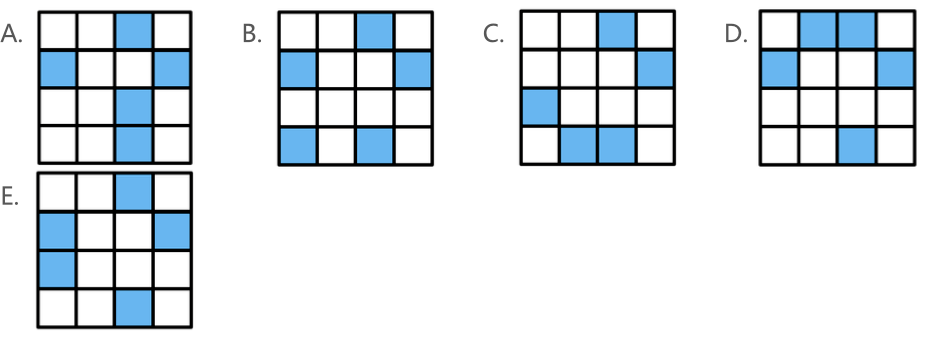
Solution:
By comparing overlaps between grids:
If A were correct → C overlaps in 3 cells → contradiction.
If B were correct → C overlaps in 3 cells → contradiction.
If C were correct → A overlaps in 3 cells → contradiction.
If D were correct → C overlaps in 3 cells → contradiction.
If E is correct → A, B, C, D each overlap with E in exactly 4 shaded cells, satisfying all conditions.
Answer (E)
Common Mistakes:
- Counting total overlaps instead of ensuring “exactly four correct cells.”
- Interpreting “one of you is right” as “one has the most correct cells” rather than being entirely correct.
2023 Math Kangaroo Answer Key
| Question | Level 1 & 2 | Level 3 & 4 |
|---|---|---|
| 1 | D | D |
| 2 | B | C |
| 3 | A | B |
| 4 | A | C |
| 5 | E | C |
| 6 | C | E |
| 7 | B | C |
| 8 | D | E |
| 9 | D | A |
| 10 | C | A |
| 11 | C | E |
| 12 | E | A |
| 13 | C | D |
| 14 | B | D |
| 15 | D | B |
| 16 | A | A |
| 17 | A | C |
| 18 | C | B |
| 19 | A | B |
| 20 | B | D |
| 21 | D | B |
| 22 | E | B |
| 23 | B | D |
| 24 | C | E |
Best Resources to Prepare for Math Kangaroo
MK Past Papers & 100 Questions Pack
Get instant access to real MK past papers and 100 carefully selected questions — perfect for focused prep!
Math Kangaroo Resource Pack
Free Download: Levels 1–2 & 3–4
Past Exams (2023–2025) & 100-Question Practice Collection
Zip Code *
Student’s Grade *
Recommended Reading
- 2024 Math Kangaroo Real Questions and Analysis
- Math Kangaroo 2025 Results: Scores, Awards & Rankings
- Math Kangaroo: Solutions for 2025 and Preparation for 2026
Try Pengi AI — Smarter Math Practice for Students
Pengi AI supports K–12 learners with personalized math practice, guided explanations, and feedback designed to help them build confidence and improve steadily.