Pengi Editor's Note
The Pengi editorial team curated this Think Academy 2024 AMC 10A breakdown. As one of the most recent AMC 10 exams available, studying these real problems with detailed solutions is one of the most efficient ways to prepare for upcoming competitions.
Source: Think Academy Blog
2024 AMC 10A Real Questions and Analysis
In this article, you’ll find:
- Representative real questions from each module with detailed solutions.
- The complete 2024 AMC 10A Answer Key.
- The best resources to prepare effectively for the AMC 10.
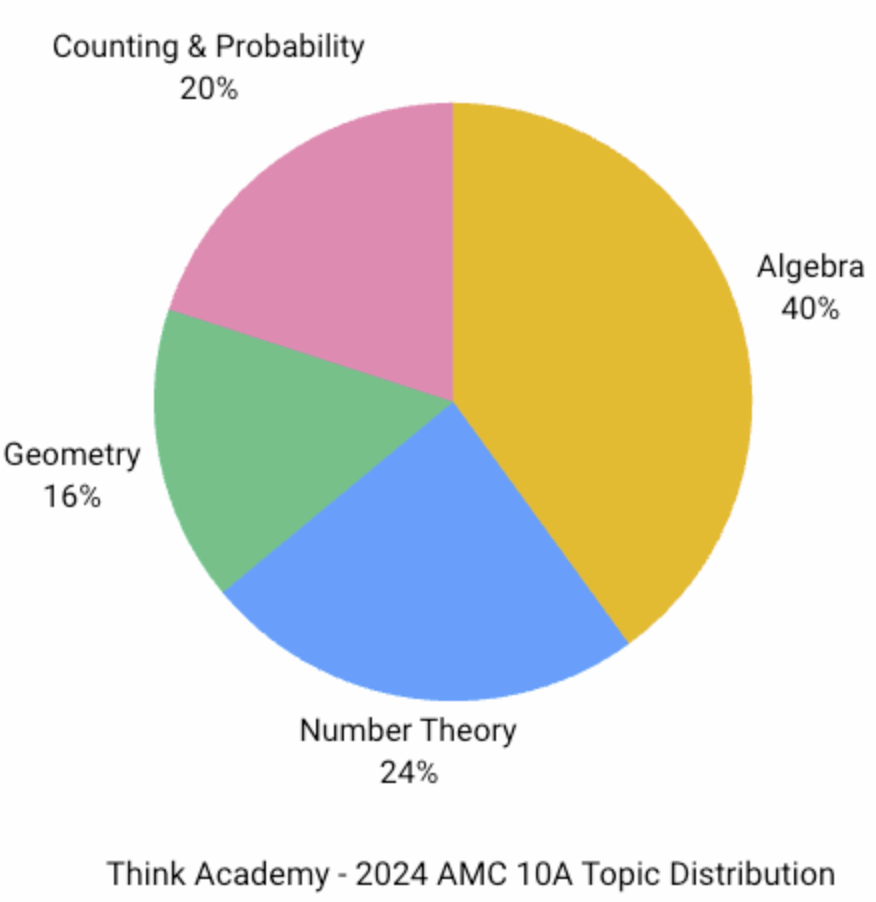
- A concise topic distribution chart showing which areas appeared most in the 2024 AMC 10A.
- A module-to-question mapping table highlighting the core concepts tested in each module for the 2024 AMC 10A.
Real Questions and Solutions Explained
Algebra / Arithmetic Reasoning Example – Problem 8
Question:
Amy, Bomani, Charlie, and Daria work in a chocolate factory. On Monday Amy, Bomani, and Charlie started working at 1:00 PM and were able to pack 4, 3, and 3 packages, respectively, every 3 minutes. At some later time, Daria joined the group and was able to pack 5 packages every 4 minutes. Together, they finished 450 packages at exactly 2:45 PM. At what time did Daria join the group?
(A) 1:25 PM (B) 1:35 PM (C) 1:45 PM (D) 1:55 PM (E) 2:05 PM
Solution:
Total time from 1:00 PM to 2:45 PM is 105 minutes.
Rate of Amy + Bomani + Charlie: \(\frac{4+3+3}{3}=\frac{10}{3}=3.\overline{3}\ \text{packages/min.}\)
Rate of Daria: \(\frac{5}{4}=1.25\ \text{packages/min.}\)
Let \(t\) be the number of minutes Daria worked. Then the first \(105-t\) minutes were done by 3 workers, and the last \(t\) minutes by 4 workers: \((105-t)\left(\frac{10}{3}\right)+t\left(\frac{10}{3}+\frac{5}{4}\right)=450.\)
Simplify: \(350-3.33t+4.58t=450\Rightarrow1.25t=100\Rightarrow t=80.\)
Daria worked 80 minutes, so she joined after \(105-80=25\) minutes → 1:25 PM.
Answer (A)
Common Mistakes:
- Forgetting to convert “every 3 min” to “per minute.”
- Assuming all workers started together.
- Arithmetic rounding between fractional and decimal rates.
- Ignoring that total time is 105 min, not 1 hr 45 s.
Number Theory Example – Problem 5
Question:
What is the least value of 𝑛 such that 𝑛! is a multiple of 2024?
(A) 11 (B) 21 (C) 22 (D) 23 (E) 253
Solution:
Ignoring the largest prime factor 23.
Using 22 instead of 23.
Misfactorizing 2024 as \(2^4\times127\).
Answer (D)
Common Mistakes:
- Ignoring the largest prime factor 23.
- Using 22 instead of 23.
- Misfactorizing 2024 as \(2^4\times127\)
Geometry Example – Problem 13
Question:
Two transformations commute if applying them in either order gives the same result.
Consider the four transformations below on the coordinate plane:
- Translation 2 units right
- 90° rotation counterclockwise about the origin
- Reflection across the 𝑥-axis
- Dilation about the origin by scale factor 2
Of the 6 distinct pairs of transformations, how many commute?
(A) 1 (B) 2 (C) 3 (D) 4 (E) 5
Solution:
Translation & Reflection across \(x\)-axis: commute. \(F(T(x,y))=(x+2,-y)=T(F(x,y))\)
Rotation & Dilation: commute (both origin-centered linear maps).
Reflection & Dilation: commute (scaling then reflecting or vice versa).
Others do not commute.
Total = 3 pairs.
Answer (C)
Common Mistakes:
- Thinking all transformations commute.
- Forgetting rotation & translation centers differ.
- Misapplying matrix multiplication order.
Counting & Probability Example – Problem 9
Question:
Six juniors and six seniors form three disjoint teams of four people each, each team having 2 juniors and 2 seniors. How many distinct ways are possible?
(A) 720 (B) 1350 (C) 2700 (D) 3280 (E) 8100
Solution:
Pair the 6 juniors into 3 unordered pairs: \(\frac{6!}{(2!)^3\,3!}=15.\)
Pair the 6 seniors similarly: 15.
Match each junior pair with a senior pair: \(3!=6.\)
Total = \(15\times15\times6=1350.\)
Answer (B)
Common Mistakes:
- Dividing again by \(3!\) (teams already unlabeled).
- Treating teams as ordered.
- Pairing individuals directly instead of pairs, causing overcount.
2024 AMC 10A Answer Key
| Question | Number |
|---|---|
| 1 | A |
| 2 | B |
| 3 | B |
| 4 | B |
| 5 | D |
| 6 | D |
| 7 | B |
| 8 | A |
| 9 | B |
| 10 | C |
| 11 | D |
| 12 | E |
| 13 | C |
| 14 | D |
| 15 | E |
| 16 | D |
| 17 | E |
| 18 | D |
| 19 | E |
| 20 | C |
| 21 | C |
| 22 | B |
| 23 | D |
| 24 | B |
| 25 | C |
Last 10 Years AMC 10 Real Questions and Analysis
Think Academy provides in-depth breakdowns of the past decade of AMC 10 exams. Click below to explore:
- Year-by-year topic trend insights and concept distributions
- Real AMC 10 exams from the last 10 years
- Official answer keys
- Representative questions, detailed solutions, and common mistakes
| AMC 10A | AMC 10B |
|---|---|
| 2024 AMC 10A | 2024 AMC10B |
| 2023 AMC 10A | 2023 AMC10B |
| 2022 AMC 10A | 2022 AMC10B |
| 2021 AMC 10A | 2021 AMC10B |
| 2020 AMC 10A | 2020 AMC10B |
| 2019 AMC 10A | 2019 AMC10B |
| 2018 AMC 10A | 2018 AMC10B |
| 2017 AMC 10A | 2017 AMC10B |
| 2016 AMC 10A | 2016 AMC10B |
2024 AMC 10A Topic Distribution
The 2024 AMC 10A featured 25 questions to be completed in 75 minutes, emphasizing advanced problem-solving and proof-based reasoning skills.
Learn more about AMC 10 Format and Scoring Here: AMC 10 FAQ and Resources: Your Ultimate Guide
Detailed Module Analysis
| Module | Question Numbers | What It Tests (Brief) |
|---|---|---|
| Algebra (+ Arithmetic Reasoning) | 1, 2, 4, 8, 10, 12, 15, 21 | Linear and quadratic equations, systems, ratios, patterns, word problems, and functional relationships. |
| Number Theory | 3, 5, 7, 11, 18, 19, 23 | Divisibility, remainders, modular arithmetic, prime factorization, Diophantine equations, and integer reasoning. |
| Geometry | 13, 14, 16, 22 | Triangles and similarity, circle tangents, area ratios, and coordinate geometry proofs. |
| Counting & Probability / Combinatorics | 6, 9, 17, 20, 24, 25 | Permutations, combinations, symmetry counting, probability cases, and logical enumeration. |
Try Pengi AI — Smarter Math Practice for Students
Pengi AI supports K–12 learners with personalized math practice, guided explanations, and feedback designed to help them build confidence and improve steadily.