Pengi Editor's Note
The Pengi editorial team selected this Think Academy 2024 AMC 10B breakdown. The combination of representative problems, common mistake analysis, and the complete answer key makes this the essential study companion for the most recent AMC 10B exam.
Source: Think Academy Blog
2024 AMC 10B Real Questions and Analysis
In this article, you’ll find:
- Representative real questions from each module with detailed solutions.
- The complete 2024 AMC 10B Answer Key.
- The best resources to prepare effectively for the AMC 10.
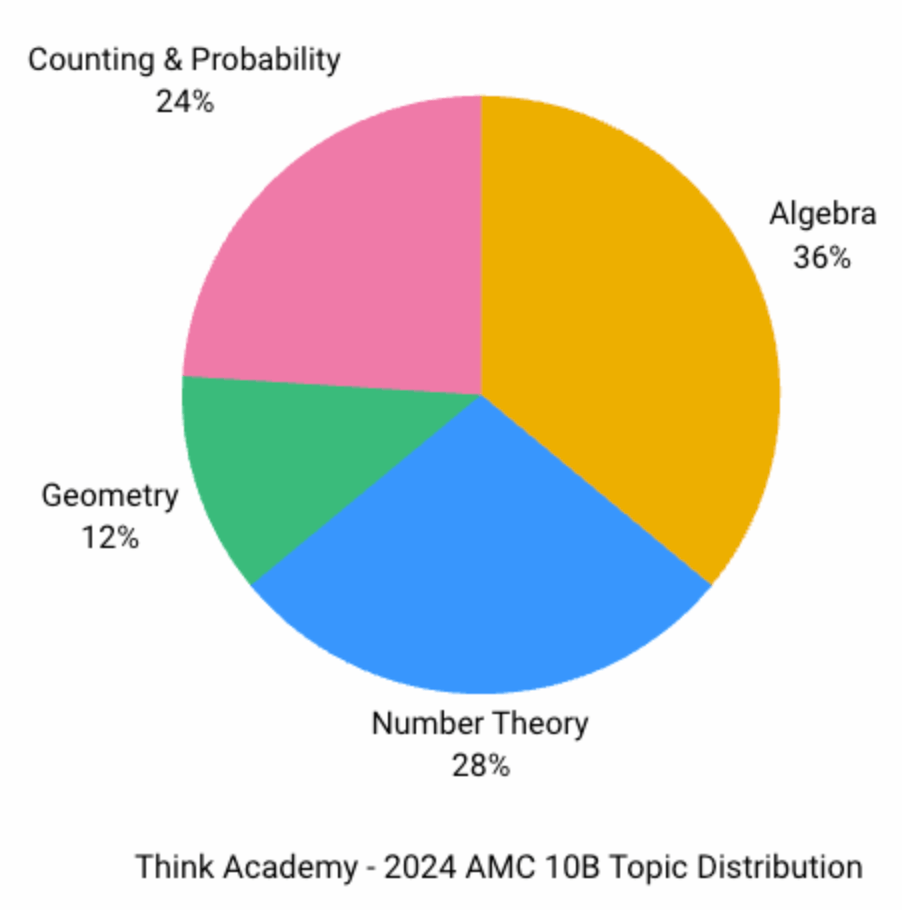
- A concise topic distribution chart showing which areas appeared most in the 2024 AMC 10B.
- A module-to-question mapping table highlighting the core concepts tested in each module for the 2024 AMC 10B.
Real Question and Solutions Explained
Algebra Example – Problem 1
Question:
In a long line of people arranged left to right, the 1013th person from the left is also the 1010th person from the right. How many people are in the line?
(A) 2021 (B) 2022 (C) 2023 (D) 2024 (E) 2025
Solution:
If a person is the \(k\)ᵗʰ from the left and the \(m\)ᵗʰ from the right, then \(N=k+m-1.\)
Substitute \(k=1013\) and \(m=1010:\)
\(N=1013+1010-1=2022.\)
Answer (B)
Common Mistakes:
- Forgetting the “−1,” leading to 2023.
- Mixing up left/right positions.
- Writing two separate equations instead of using \(N=k+m-1.\)
Number Theory Example – Problem 7
Question:
What is the remainder when \(7^{2024}+7^{2025}+7^{2026}\) is divided by 19?
(A) 0 (B) 1 (C) 7 (D) 11 (E) 18
Solution:
Since \(7^3=343\equiv1\pmod{19},\) powers of 7 repeat every 3 modulo 19.
\(2024\equiv2\pmod3\Rightarrow7^{2024}\equiv7^2\equiv49\equiv11\pmod{19}.\)
\(2025\equiv0\pmod3\Rightarrow7^{2025}\equiv7^0\equiv1\pmod{19}.\)
\(2026\equiv1\pmod3\Rightarrow7^{2026}\equiv7\pmod{19}.\)
Sum: \(11+1+7=19\equiv0\pmod{19}.\)
Answer (A)
Common Mistakes:
- Using Euler/Fermat instead of noticing the shorter period 3.
- Errors reducing \(7^2\) or \(7^3\) modulo 19.
- Reporting “19” instead of the remainder 0.
Geometry Example – Problem 10
Question:
Quadrilateral 𝐴𝐵𝐶𝐷 is a parallelogram, and 𝐸 is the midpoint of side 𝐴𝐷. Let 𝐹 be the intersection of lines 𝐸𝐵 and 𝐴𝐶. What is the ratio of the area of quadrilateral 𝐶𝐷𝐸𝐹 to the area of triangle 𝐶𝐹𝐵?
(A) 5:4 (B) 4:3 (C) 3:2 (D) 5:3 (E) 2:1
Solution:
Place coordinates: \(A(0,0),\ B(1,0),\ D(0,1),\ C(1,1)\). Then midpoint \(E=(0,\frac{1}{2})\).
Line AC: \(y=x\). Parametrize EB: \(E+t(B-E)=(t,\frac{1}{2}-\frac{t}{2})\).
Intersect with \(y=x\): \(\frac{1}{2}-\frac{t}{2}=t\Rightarrow t=\frac{1}{3}\), hence \(F(\frac{1}{3},\frac{1}{3})\).
Using coordinate areas (shoelace) or a unit-square partition, we get \(\frac{[CDEF]}{[CFB]}=\frac{5}{4}\).
Answer (A)
Common Mistakes:
- Assuming 𝐹 is the midpoint of 𝐴𝐶.
- Not using coordinates (or vectors) to get the correct intersection point.
- Shoelace formula errors from ordering vertices incorrectly.
Combinatorics Example – Problem 12
Question:
A group of 100 students from different countries meet at a mathematics competition. Each student speaks the same number of languages, and for every pair of students 𝐴 and 𝐵, student 𝐴 speaks some language that student 𝐵 does not speak, and student 𝐵 speaks some language that student 𝐴 does not speak. What is the least possible total number of languages spoken by all the students?
(A) 9 (B) 10 (C) 12 (D) 51 (E) 100
Solution:
Let there be \(n\) total languages and each student speak exactly \(k\) languages. The condition implies the 100 students correspond to 100 distinct \(k\)-subsets of an \(n\)-set. We need at least 100 such subsets, so
\[\frac{n!}{k!(n-k)!} \ge 100\]
To minimize \(n\), choose a middle layer. With \(n=9\):
\[\frac{9!}{4!\,5!} = 126 \ge 100\]
Thus 9 languages suffice.
Answer (A)
Common Mistakes:
- Interpreting the problem as total spoken instances \((100k)\) instead of distinct languages.
- Assuming \(n\) must be large; overlooking that \(\frac{9!}{4!\,5!}=126\) already works.
- Choosing non-central \(k\) values that reduce \(\frac{n!}{k!(n-k)!}\) and force larger \(n\)
2024 AMC 10B Answer Key
| Question | Answer |
|---|---|
| 1 | B |
| 2 | B |
| 3 | E |
| 4 | D |
| 5 | B |
| 6 | B |
| 7 | A |
| 8 | D |
| 9 | A |
| 10 | A |
| 11 | C |
| 12 | A |
| 13 | B |
| 14 | B |
| 15 | C |
| 16 | A |
| 17 | D |
| 18 | B |
| 19 | C |
| 20 | A |
| 21 | C |
| 22 | A |
| 23 | B |
| 24 | E |
| 25 | E |
Last 10 Years AMC 10 Real Questions and Analysis
Think Academy provides in-depth breakdowns of the past decade of AMC 10 exams. Click below to explore:
- Year-by-year topic trend insights and concept distributions
- Real AMC 10 exams from the last 10 years
- Official answer keys
- Representative questions, detailed solutions, and common mistakes
| AMC 10A | AMC 10B |
|---|---|
| 2024 AMC 10A | 2024 AMC10B |
| 2023 AMC 10A | 2023 AMC10B |
| 2022 AMC 10A | 2022 AMC10B |
| 2021 AMC 10A | 2021 AMC10B |
| 2020 AMC 10A | 2020 AMC10B |
| 2019 AMC 10A | 2019 AMC10B |
| 2018 AMC 10A | 2018 AMC10B |
| 2017 AMC 10A | 2017 AMC10B |
| 2016 AMC 10A | 2016 AMC10B |
2024 AMC 10B Topic Distribution
The 2024 AMC 10B featured 25 questions to be completed in 75 minutes, emphasizing advanced problem-solving and proof-based reasoning skills.
Learn more about AMC 10 Format and Scoring Here: AMC 10 FAQ and Resources: Your Ultimate Guide
Detailed Module Analysis
| Module | Question Numbers | What It Tests (Brief) |
|---|---|---|
| Algebra (+ Arithmetic Reasoning) | 1, 2, 4, 5, 9, 15, 19, 25 | Factorials, equations, inequalities, series, means and medians, and pattern reasoning. |
| Number Theory | 6, 7, 8, 13, 16, 18, 24 | Prime factorization, remainders, divisors, mod arithmetic, parity, and Diophantine reasoning. |
| Geometry | 10, 11, 21 | Parallelograms, similar triangles, area ratios, and coordinate geometry. |
| Counting & Probability / Combinatorics | 12, 14, 17, 20, 22, 23 | Subsets, arrangements, geometric probability, casework, permutations, and pattern recognition. |
Try Pengi AI — Smarter Math Practice for Students
Pengi AI supports K–12 learners with personalized math practice, guided explanations, and feedback designed to help them build confidence and improve steadily.