Pengi Editor's Note
The Pengi editorial team selected this Think Academy 2024 AMC 8 analysis. With real problem walkthroughs and the complete answer key, it gives students an accurate picture of what the AMC 8 tests and how to approach it strategically.
Source: Think Academy Blog
2024 AMC 8 Real Questions and Analysis
In this article, you’ll find:
- A concise topic distribution (with a pie chart)
- The core concepts typically tested in each module
- A module-to-question mapping table for the 2024 AMC 8
- Five representative real questions with solutions and common mistakes
- Best resources to prepare for AMC 8
2024 AMC 8 Topic Distribution
The 2024 AMC 8 contains 25 multiple-choice questions completed in 40 minutes, emphasizing logical reasoning and conceptual understanding.
Learn more about AMC 8 Format and Scoring Here: AMC 8 FAQs: The Ultimate Guide for First-Time Test Takers
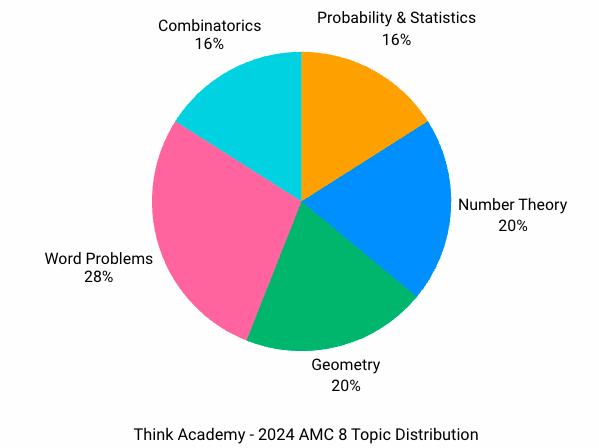
Detailed Module Analysis
| Module | Question Numbers | What It Tests (Brief) |
|---|---|---|
| Geometry | 3, 6, 11, 14, 24 | area/length, triangle & coordinate geometry, shortest paths/geometry reasoning, composite figures |
| Word Problems | 1, 2, 8, 9, 10, 12, 21 | contextual arithmetic & rates, ratios/proportions, sequences in context |
| Number Theory | 4, 15, 16, 19, 23 | divisibility & remainders, digit/cryptarithm logic, prime/CRT style reasoning |
| Combinatorics | 7, 13, 20, 25 | tilings/arrangements, Catalan-style paths, ordering constraints, constructive counting |
| Probability & Statistics | 5, 17, 18, 22 | probability with dice/coins, averages/means, distribution/expected value |
Real Questions and Solutions Explained
Geometry Example – Problem 11
Question:
The coordinates of △ABC are A(5,7), B(11,7), and C(3,𝑦) with 𝑦>7. The area of △ABC is 12. What is the value of 𝑦?
(A) 8 (B) 9 (C) 10 (D) 11 (E) 12
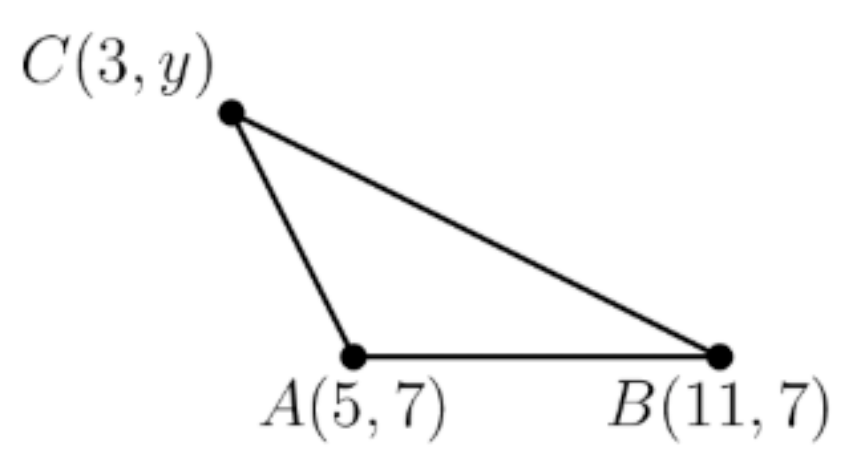
Solution:
Segment AB is horizontal with length 11−5=6, so use AB as the base.
\[ \frac12 \times 6 \times (𝑦-7) = 12 \]
\[ 3(𝑦-7)=12 \Rightarrow 𝑦-7=4 \Rightarrow 𝑦=11 \]
Answer: (D)
Common Mistakes:
- Using 𝑦 as the height directly without subtracting 7.
- Choosing a slanted side as the base and doing unnecessary distance calculations.
- Forgetting the \(\frac{1}{2}\) factor in the triangle area formula .
Word Problem Example – Problem 12
Question:
Rohan keeps a total of 90 guppies in 4 fish tanks.
- There is 1 more guppy in the 2nd tank than the 1st.
- There are 2 more in the 3rd than the 2nd.
- There are 3 more in the 4th than the 3rd.
How many guppies are in the 4th tank?
(A) 20 (B) 21 (C) 23 (D) 24 (E) 26
Solution:
Let the 1st tank have 𝑥. Then the four tanks have 𝑥, 𝑥+1, 𝑥+3, 𝑥+6.
\[4𝑥 + 10 = 90 \Rightarrow 𝑥 = 20\]
Fourth tank: \[𝑥 + 6 = 26\]
Answer: (E)
Common Mistakes:
- Treating the increases as consecutive from the first tank (e.g., 𝑥, 𝑥+1, 𝑥+2, 𝑥+3).
- Solving for 𝑥 correctly but reporting the first tank (𝑥) instead of the fourth (𝑥+6).
Number Theory Example – Problem 4
Question:
When Yunji added all the integers from 111 to 999 she mistakenly left out a number. Her incorrect sum turned out to be a perfect square. Which number did she leave out?
(A) 5 (B) 6 (C) 7 (D) 8 (E) 9
Solution:
The true sum is \[1 + 2 + \cdots + 9 = \frac{9 \times 10}{2} = 45\]
Perfect squares less than 45 are 36 and 25.
If the mistaken sum is 36, the omitted number is \[45 – 36 = 9\] which is valid. (If 25, the omitted number would be 20, which is not in the list.) Therefore, the omitted number is 9.
Answer: (E)
Common Mistakes:
- Forgetting the formula for \(1 + 2 + \cdots + n\).
- Checking 25 and stopping early, or subtracting in the wrong order (36 − 45).
Combinatorics Example – Problem 13
Question:
Buzz Bunny hops one step at a time up or down a set of stairs. In how many ways can Buzz start on the ground, make a sequence of 6 hops, and end up back on the ground? (For example, one sequence of hops is up-up-down-down-up-down.)
(A) 4 (B) 5 (C) 6 (D) 8 (E) 12
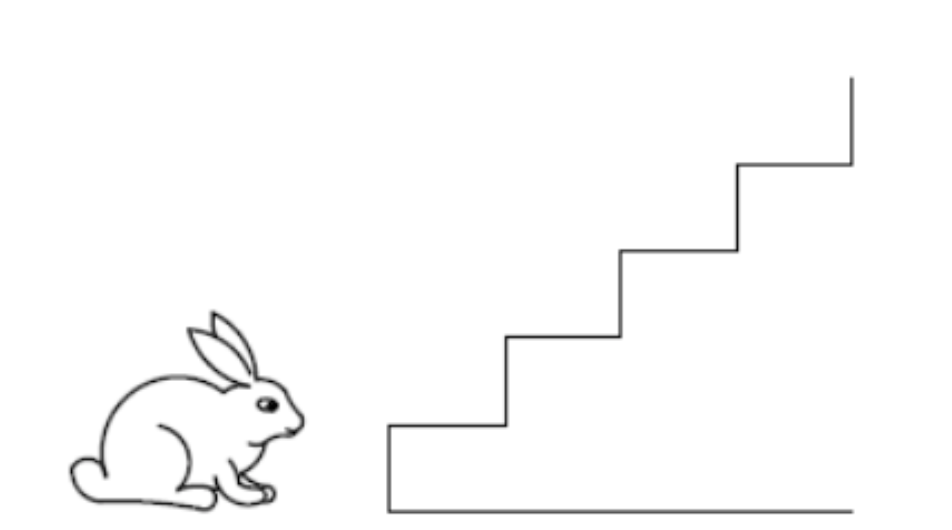
Solution:
To finish at ground after 6 hops, there must be 3 ups and 3 downs. Interpreting “stairs” as not going below ground, we count sequences that never dip below the start and return to ground — i.e., Dyck paths of semilength 3.
The five valid sequences are: UUUDDD, UUDUDD, UUDDUD, UDUDUD, UDUUDD.
The count equals the Catalan number: \[ C_{3} = \frac{1}{4} \times \frac{6!}{3!\,3!} = 5 \] Therefore, the number of ways is 5.
Answer: (B)
Common Mistakes:
- Counting all \( \frac{6!}{3!\,3!} = 20 \) up/down arrangements and ignoring the “no below ground” condition.
- Forgetting the path must start and end on ground.
Probability Example – Problem 5
Question:
Aaliyah rolls two standard 6-sided dice and notices the product is a multiple of 6. Which of the following integers cannot be the sum of the two numbers?
(A) 5 (B) 6 (C) 7 (D) 8 (E) 9
Solution:
“Product is multiple of 6” \(\Rightarrow\) at least one die is even and at least one die is a multiple of 3.
List all pairs satisfying both: (1,6), (2,3), (2,6), (3,6), (4,6), (5,6), (6,6).
Their sums are: 7, 5, 8, 9, 10, 11, 12. Among the given options, 6 never appears.
Answer: (B)
Common Mistakes :
- Requiring both dice to be multiples of 6.
- Missing pairs like (2,3).
- Counting all possible sums (5–12) and ignoring the product condition.
2024 AMC 8 Answer Key
| Question | Answer |
|---|---|
| 1 | B |
| 2 | C |
| 3 | E |
| 4 | E |
| 5 | B |
| 6 | D |
| 7 | E |
| 8 | D |
| 9 | E |
| 10 | B |
| 11 | D |
| 12 | E |
| 13 | B |
| 14 | A |
| 15 | C |
| 16 | D |
| 17 | E |
| 18 | A |
| 19 | C |
| 20 | D |
| 21 | E |
| 22 | B |
| 23 | C |
| 24 | B |
| 25 | C |
Try Pengi AI — Smarter Math Practice for Students
Pengi AI supports K–12 learners with personalized math practice, guided explanations, and feedback designed to help them build confidence and improve steadily.