Pengi Editor's Note
The Pengi editorial team curated this comprehensive 2026 comparison of online math programs for K–12 learners. As the landscape of digital math education expands, this guide helps families cut through the options and identify which programs genuinely deliver results at each grade level.
Source: Think Academy Blog
2026 Guide to Best Online Math Programs for K‑12 Learners
Choosing the right online math programs for your child can feel overwhelming. With so many options — from self‑paced lessons to live tutors — it’s important to know which tools deliver real learning outcomes like confidence, improved grades, and stronger problem‑solving skills.
In this guide, we compare seven top popular online math programs used by parents across North America — organized by Grade, Format, Price, Key Features, Best For, Pros/Cons, Learning Outcomes, and Price vs Value — so you can make an informed choice that fits your child’s needs.
How to Choose Online Math Programs (A Parent Checklist)
Use these questions to match the right online math programs to your child:
1) What’s the goal?
- Catch up / Fill gaps: Help your child catch up by focusing on structured practice and clear explanations to address any missed concepts.
- Reinforce foundations: Strengthen core concepts to ensure a solid understanding that aligns with school-level expectations.
- Math acceleration: Choose programs that introduce more advanced topics to challenge your child and develop their problem-solving and critical thinking skills.
- Competition expansion: Prepare your child for math competitions by practicing advanced techniques and solving more complex problems.
2) Does your child need teacher guidance?
- If your child has trouble getting started on their own, live classes with a teacher can provide the support they need.
- If your child is independent and motivated, self-paced programs are a great, cost-effective option.
3) What learning style works best?
- Younger kids benefit from interactive games that help them build routine and boost confidence.
- Advanced learners thrive with a problem-solving approach that encourages deeper thinking and challenges their skills.
Not Sure What Your Child Needs?
If you’re deciding between live instruction vs. self-paced practice, start with an evaluation first—so you’re not guessing.
A good math evaluation should give you:
- A skill-by-skill breakdown (not just a single score)
- Clear strengths + gaps across key domains
- A next-step plan (what to learn next and how)
Comparison of Top Online Math Programs
Think Academy — Structured Live Instruction
Grades: PreK–12
Format: Live online classes with teacher interaction
Price: Paid ($35/hour), Monthly Payment Support
Key features
- Live, structured classes with teacher guidance
- Clear learning progression (skills build in sequence)
- Real-time feedback and guided problem-solving
Best for
- Students who learn better with teacher-led structure, consistent pacing, and accountability
- Families who want instruction + feedback, not just practice questions
Pros
- More accountability than self-paced tools
- Faster correction of misunderstandings through real-time teaching
- Clear routine: easier for many families to sustain week-to-week
Cons
- Requires scheduling and consistent attendance
- Less “anytime flexibility” than fully self-paced programs
Learning outcomes (what families often notice)
- More consistent learning habits
- Stronger conceptual understanding and problem-solving approach
- Improved confidence from structured support and feedback
Price vs value
- Strong value when your child needs structure to make consistent progress
Start with a placement-style evaluation so your child begins at the right level:
Start Free Evaluation with Think Academy
Khan Academy — Free Self‑Paced Mastery
Grades: PreK–12
Format: Self-paced videos + practice + progress tracking
Price: Free
Key features
- Broad coverage across K-12 topics
- Practice with feedback and mastery-style progression
- Flexible pacing for review and catch-up
Best for
- Families seeking a free online math program for broad support
- Students who can work independently (or with light parent support)
Pros
- No cost, easy to start
- Helpful for filling gaps and reviewing school content
Cons
- Limited accountability—many students stop without a routine
- No live teacher to diagnose misconceptions in real time
Learning outcomes
- Stronger fundamentals and homework performance when used consistently
Price vs value
- Excellent value (free), especially as a baseline or supplement
Beast Academy – Engagement-Driven
Grades: G2–G5 (best fit)
Format: Self-paced curriculum (live online course + books)
Price: $16 per month (baisc monthly subscription)
Key features
- Puzzle-driven lessons and non-routine problems
- Deep conceptual tasks (more “thinking” than drilling)
- Strong enrichment style for advanced learners
Best for
- Advanced or curious elementary students who enjoy challenges
- Families who want enrichment beyond grade-level repetition
Pros
- Builds flexible thinking and real problem-solving skills
- Great fit for students who like puzzles and math stories
Cons
- Can feel “too hard” for students who need remediation
- Some children benefit from parent coaching on pacing and persistence
Learning outcomes
- Stronger reasoning, better math creativity, higher confidence through challenge
Price vs value
- High value for advanced learners; weaker value for catch-up/remediation
Art of Problem Solving – Rigor Courses (Middle/High School)
Grades: G5–G12
Format: Self-paced + live online courses
Price: Typically $400-675 (varies)
Key features
- Competition-style problem solving and rigorous explanations
- Advanced learning pathways and strong peer community
- Emphasis on how to think, not just what to do
Best for
- Advanced middle/high school students who want deeper challenge
- Learners targeting high-rigor math thinking (and often contest-style problems)
Pros
- Exceptional depth for motivated advanced learners
- Strengthens multi-step reasoning and mathematical communication
Cons
- Steep difficulty curve if foundations aren’t solid
- Not the fastest route for “raise my grade this month” goals
Learning outcomes
- Better performance in challenging math contexts (advanced classes, non-routine problems)
Price vs value
- High value for advanced learners; not cost-effective for basic catch-up
Zearn — Curriculum + Practice
Grades: K–8
Format: Curriculum lessons + guided practice
Price: Free
Key features
- Lesson videos + guided practice aligned to grade-level standards
- Concept-first instruction and structured progression
Best for
- Students who need a strong core foundation and steady skill mastery in K–8
Pros
- Clear structure for grade-level progress
- Supports consistent learning routines
Cons
- Less game-like; engagement varies by child
- May need supplementation for advanced enrichment tracks
Learning outcomes
- Solid mastery of fundamentals and reduced learning gaps
Price vs value
- Strong value as a foundation option (especially when free core is available)
SplashLearn — Early Grades Engagement
Grades: PreK–5
Format: Interactive games + adaptive practice
Price: Starts from $7.99 per month (monthly subscription)
Key features
- Short practice sessions that build a daily habit
- Adaptive skill practice designed for early learners
Best for
- Early elementary students who need motivation and bite-sized practice
Pros
- High engagement for younger kids
- Helps build consistency and confidence
Cons
- Limited depth for older students
- Typically needs a more structured program later
Learning outcomes
- Increased fluency and confidence for early-grade math skills
Price vs value
- Strong value if your child uses it consistently
Mathseeds — Play‑Based Early Learning
Grades: PreK–3
Format: Interactive, play-based lessons + activities
Price: Monthly subscription
Key features
- Beginner-friendly progression in early numeracy
- Mix of interactive learning and optional offline reinforcement
Best for
- Young beginners building number sense and early confidence
Pros
- Gentle pacing, routine-friendly
- Good for families starting math practice habits early
Cons
- Limited scope beyond Grade 3
- Not designed for advanced enrichment
Learning outcomes
- Early numeracy, counting, basic operations, stronger math confidence
Price vs value
- High value for early learners when used regularly
Top Online Math Programs Comparison Summary
| Feature | Think Academy | Khan Academy | Beast Academy | AoPS | Zearn | SplashLearn | Mathseeds |
|---|---|---|---|---|---|---|---|
| Live Teacher | ✔ | ✖ | ✖ | ✔ | ✖ | ✖ | ✖ |
| Self‑Paced Option | ✖ | ✔ | ✔ | ✖ | ✔ | ✔ | ✔ |
| Best for Confident Learners | ✔ | ✔ | ✔ | ✔ | ✖ | ✖ | ✖ |
| Best for Remediation | ✔ | ✔ | ✖ | ✖ | ✔ | ✖ | ✖ |
| Best for Enrichment & Challenge | ✔ | ✖ | ✔ | ✔ | ✖ | ✖ | ✖ |
| Free | ✖ | ✔ | ✖ | ✖ | ✔ | ✖ | ✖ |
| Most Engaging for Young Kids | Medium | Medium | Medium | Low | Medium | High | High |
Key Takeaways for Parents
Elementary School (PreK – Grade 5)
Focus: Building habits, engagement, and early thinking skills.
- Choose [Think Academy] if:
- You need a real teacher with great passion to guide your child.
- You want a structured routine with live interaction and immediate feedback.
- Choose [Mathseeds] or [SplashLearn] if:
- Your child is a beginner (PreK–3) or easily bored.
- You want games and fun to build a daily habit without pressure.
- Choose [Beast Academy] if:
- Your child is “math smart” and loves puzzles.
- You want enrichment that teaches deep logic, not just repetitive drills.
- Choose [Zearn] or [Khan Academy] if:
- You want a free/low-cost way to review school topics or fill learning gaps.
Middle School & Up (Grade 6+)
Focus: Rigor, discipline, and complex problem-solving.
- Choose [Think Academy] if:
- Your child struggles to stay motivated on their own, or your child wants to learn advanced math and competition.
- You need accountability (live classes + homework) to ensure grades improve.
- Choose [Art of Problem Solving (AoPS)] if:
- Your child is advanced and seeks a high-level challenge.
- The goal is math competitions or elite high school prep (not for catching up).
- Choose [Khan Academy] if:
- Your child is self-disciplined and needs to catch up or review specific topics.
- You need a flexible, free solution without a fixed schedule.
Why Think Academy‘s Online Math Program Stands Out
1. Personalized Learning Pathways
We avoid a “one-size-fits-all” classroom. Based on a comprehensive evaluation of your child’s proficiency, we construct a tailored learning roadmap. This approach guides students from basic math concepts directly into advanced STEM pathways.
2. Professional Instruction & Interactive Learning
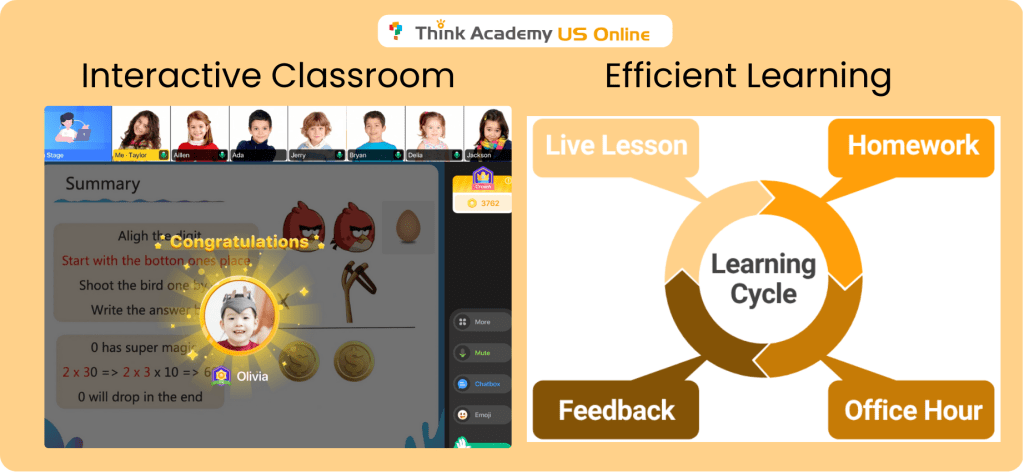
Online learning requires engagement. Our instructors create a high-energy environment.
- Active Participation: Classes mandate interaction. Instructors encourage every student to speak up, express ideas, and solve problems on-screen.
- Comprehensive Support: Learning continues after the class. We provide dedicated Office Hours to answer questions and reinforce difficult concepts.
3. Data-Driven Feedback & Visible Results
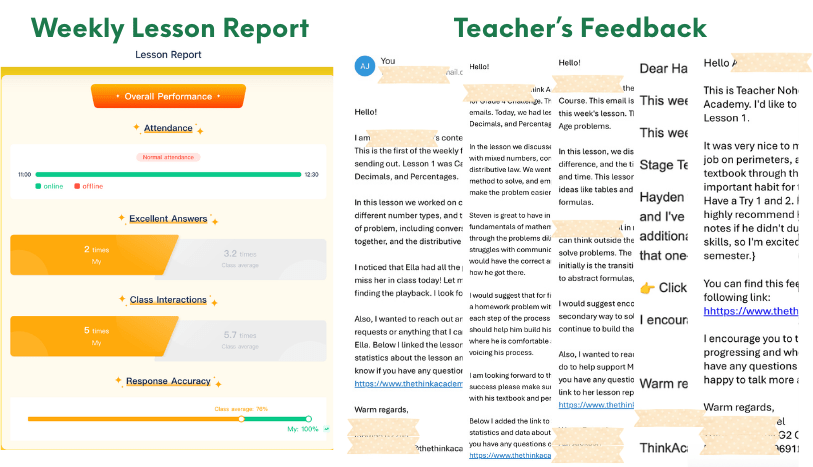
Parents should never have to guess if a math online program works. We provide direct, transparent feedback.
- Regular Reporting: Parents receive detailed class reports and weekly teacher feedback.
- Clear Metrics: We use data to visualize your child’s learning situation. You can verify the effectiveness of the instruction week by week.
Pengi AI — AI-Powered Math Tutoring
- Grades: K–12
- Format: AI-powered personalized tutoring, available 24/7 on any device
- Price: Free to start
- Features: Adaptive learning paths, step-by-step explanations, competition prep (AMC 8, AMC 10, MATHCOUNTS, Math Kangaroo), school curriculum coverage
- Best For: Students who want flexible, on-demand support — from core math skills to competition-level prep
- Pros: Always available, adapts to individual pace and level, covers both school math and competitions
- Cons: AI-based tutoring (no live human instructor)
Try Pengi AI — Smarter Math Practice for Students
Pengi AI supports K–12 learners with personalized math practice, guided explanations, and feedback designed to help them build confidence and improve steadily.