Pengi Editor's Note
The Pengi editorial team selected this Think Academy 2026 MATHCOUNTS ultimate guide. It consolidates everything from competition levels and timelines to preparation resources in one place — a go-to reference for any student or coach navigating the MATHCOUNTS pathway.
Source: Think Academy Blog
2026 MATHCOUNTS Ultimate Guide: Levels, Timeline, Prep & Resources
In this complete guide, we’ll walk you through everything parents need to know about the 2026 MATHCOUNTS Competition Series:
- Levels, timeline, and how students advance
- Key math skills tested and key knowledge modules
- Prep strategies that actually work
- Free resources: formula sheet, practice sets, and official links
- How Think Academy supports advanced learners
Whether your child is new to mathcounts or aiming to qualify for the National Round, this guide will give you a clear path forward.
What is MATHCOUNTS Competition
MATHCOUNTS is a nationwide math competition for Grades 6–8 that builds problem-solving skills and fosters achievement through four levels of fun, in-person contests.
Students compete individually and in teams across rounds that test speed, accuracy, logic, and collaboration. Starting at the school level, top performers can advance to the chapter, state, and finally the national level, where the strongest middle school math students in the country are recognized for their excellence.
Who Can Participate in MATHCOUNTS?
Grade Level
- Only U.S. students in grades 6–8 are eligible.
- Students may participate for a maximum of 3 years.
- MATHCOUNTS is open to students from all 50 U.S. states, D.C., Guam, Puerto Rico, and the U.S. Virgin Islands.
- Overseas schools may participate only if affiliated with the U.S. Departments of Defense or State.
School-Based vs. Non-School Competitors (NSCs)
- MATHCOUNTS is primarily a school-based program. A school representative must register the school.
- If a student’s school will not register or support participation, the student may participate as an NSC (Non-School Competitor).
- NSCs must be registered by a parent/guardian, and a separate registration is required for each child.
- Before registering as an NSC, parents must confirm with school officials that the school will not support their participation.
How to Register for MATHCOUNTS
For Schools: A school representative completes the registration.
For NSC Families:
- A parent or guardian registers the student directly.
- Multiple children require separate forms.
- School confirmation (non-participation) is required before registering.
📅 Registration is open for 2025-2026!
| Registration Period | Deadline | School Competitor (per student) | Non-School Competitor (NSC) |
|---|---|---|---|
| Regular Registration | By Dec 15, 2025 | $45 (up to 14 students/school) | $70 (1 student max) |
| Late Registration | After Dec 15, 2025 | $50 (up to 14 students/school) | $80 (1 student max) |
Please refer to the list of Registered Competition Series Schools for 2025-2026 to see if your student’s school already has registered for this year.
Competition Format: 4 Levels × 4 Rounds
Four Levels
Students must qualify at each level to move on.
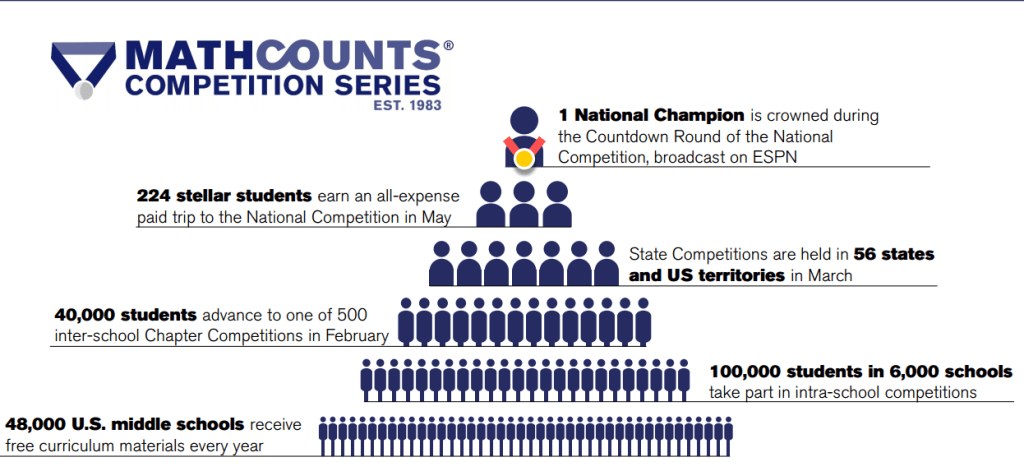
- School Level (Aug 2025–Jan 2026)
- Chapter Level (Feb 2026)
- State Level (Mar 2026)
- National Level (May 2026)
Rounds at Each Level
(Approx. 3 Hours Total)
| Round | Focus | Format | Calculator |
|---|---|---|---|
| Sprint Round | Speed + Accuracy | 30 problems / 40 minutes | ❌ No |
| Target Round | Problem-Solving + Reasoning | 4 pairs of problems / 6 min per pair | ✅ Yes |
| Team Round* | Team Collaboration | 10 problems / 20 minutes | ✅ Yes |
| Countdown Round (optional*) | Speed + Accuracy | up to 45 sec per question | ❌ No |
*Individual competitors take Sprint + Target (not Team). If offered, they may qualify for Countdown, earn individual awards, and advance to State/Nationals—but their results don’t count toward a school team’s advancement.
*The Countdown Round is required only at the National level. Optional at the school, chapter, and state levels.
2025–2026 MATHCOUNTS Competition Timeline
| Level | Dates | What Happens | Who Advances & How |
|---|---|---|---|
| School | Aug 2025 – Jan 2026 | – Students register and prepare for the School Competition.– School-based students train with a coach and take the School Competition at school.- NSCs take the official School Competition independently after parent/guardian registration. | – School-based: Coaches select up to 14 students (4 team + up to 10 individuals) to advance to Chapter.– NSCs: Advancement is based solely on School Competition scores. MATHCOUNTS reviews results and invites top-scoring NSCs directly to the Chapter Level. |
| Chapter | Feb 1 – 28, 2026 | – 500+ local Chapter Competitions across the U.S.– School teams + individuals + NSCs compete. | – Top individual scorers from each chapter advance to State.→ Advancement numbers vary by region (often top 10–25 students). |
| State | Mar 1 – 31, 2026 | – All 50 U.S. states (plus territories) host one official State Competition.– No additional fee to advance. | – Top 4 individuals per state advance to Nationals.→ A total of 224 students advance nationwide. |
| National | May 10 – 11, 2026 | – RTX MATHCOUNTS National Competition.– Students compete individually and as a state team.– All expenses paid by MATHCOUNTS. | – National Champion awarded based on top individual scores, Countdown Round performance, and team rankings. |
Why MATHCOUNTS Matters
For many parents, it’s not just about the contest structure — it’s about what this experience truly brings to their child.
- Faster, Sharper, More Focused
The problems aren’t always the hardest, but the format trains students to think quickly, calculate accurately, and stay focused under pressure.
- Learning to Solve, Not Just Follow Steps
MATHCOUNTS encourages students to solve creatively, not mechanically. Instead of following rote procedures, students learn to break down problems. This kind of thinking strengthens their foundation for long-term mathematical growth.
- Finding a Like-Minded Community
In middle school, there aren’t many math-focused extracurriculars. For many students, MATHCOUNTS is the first time they meet others who genuinely enjoy math. Whether through team practices or study groups, this sense of belonging often becomes more meaningful than any trophy.
“The lesson I got from MATHCOUNTS is one that I have cherished more than any math lecture I have ever received: The best part of doing math is doing it with others.” – Brian, Mathcounts Competition Alumnus
Is Reaching Nationals Worth It?
Parents often wonder — is it worth the time and effort to aim for Nationals?
The truth is, the difficulty of qualifying varies by state. But for students, what matters more is:
- Did they build a consistent training habit?
- Did they gain confidence and self-motivation?
- Did the process help them enjoy math more — and want to go further?
These are the outcomes that last — far beyond the National scoreboard. The habits and confidence built here will shape how they approach long-term goals.
Does a MATHCOUNTS Score Reflect True Math Strength?
Not always.
MATHCOUNTS rewards speed-based thinking. Some students who are excellent deep thinkers may not thrive under tight time limits — and that’s okay.
Rather than focus on rank alone, parents should ask:
- Is my child making steady progress?
- Are their strategies becoming more effective and consistent?
- Are they building confidence through problem solving?
Not every student needs to be a top scorer — but every student can grow through the right kind of training.
MATHCOUNTS vs AMC
Many parents are familiar with AMC 8 or AMC 10, so how does MATHCOUNTS differ — and how do they complement each other?
Here’s a quick comparison:
| Feature | MATHCOUNTS | AMC 8 / AMC 10 |
|---|---|---|
| Grade Level | Grades 6–8 | AMC 8: ≤ Grade 8AMC 10: ≤ Grade 10 |
| Format | In-person, multi-round, team + individual | Individual, single-round, multiple choice |
| Timing | ~3 hours (Sprint, Target, Team, Countdown) | AMC 8: 40 minAMC 10: 75 min |
| Calculator | Allowed in some rounds | ❌ Not allowed |
| Focus | Speed, strategy, collaboration | Deep logic, precision, individual reasoning |
| Progression | School → Chapter → State → National | No progression — one-time score-based exam |
| Awards | Individual + team + advancement | Score thresholds (e.g. Honor Roll, AIME) |
Many top students prepare for both — and the combination helps build a complete problem-solving skill set.
Understand MATHCOUNTS
Skills Required
A. Foundational Fluency (Speed & Accuracy)
Quick and accurate handling of: Mental math; Fractions, decimals, percents ; Unit conversions; Basic algebra and arithmetic; etcs.
Goal: Instantly recognize what method to use, and avoid careless mistakes.
B. Strategic Problem Solving (Strategy & Modeling)
Ability to Model word problems; Estimate and verify; Use diagrams, tables, or organized cases.
Goal: Don’t brute-force — reduce difficulty with smart techniques.
C. Multi-Step Thinking & Synthesis
Handling complex problems that may combine Geometry, Algebra, Counting, Probability, Patterns, Logical reasoning, and Number theory.
Goal: Break big problems into smaller steps without losing track.
Key Knowledge Modules
| Algebra & Number | Geometry | Data & Reasoning |
|---|---|---|
| Algebraic Expressions & Equations | Plane Geometry | Probability & Counting & Combinatorics |
| Number Theory | Coordinate Geometry | Logic & Word Problems |
| Proportional Reasoning | Solid Geometry | Statistics & Data |
| Percents & Fractions | — | Sequences & Patterns |
Question Styles & Difficulty
| Level | Description |
|---|---|
| Easy | One concept, 1–2 steps; suitable for early middle school students |
| Medium | 1–2 concepts, multi-step; requires knowledge of key middle school topics |
| Difficult | Advanced concepts and strategies; multiple steps, often requires synthesis |
How to Prepare MATHCOUNTS Effectively
Success in MATHCOUNTS comes from consistent, focused practice — not last-minute cramming. Here’s how to build the right prep routine:
1) Practice Principles
- Long-term: Start early in the season. Don’t rely on 2-week crash prep.
- Timed practice: Simulate real test conditions to build pace and focus.
- Review and reflect: After each set, identify causes of mistakes — was it reading, timing, method, or calculation?
2) Weekly Training Structure
Since each round of the competition tests different skills, try dividing weekly practice into three focused areas:
| Focus Type | Purpose |
|---|---|
| Speed Sets | Quick, no-calculator drills to boost fluency and reduce careless errors |
| Strategy Sets | Word problems with modeling or estimation to build flexible thinking |
| Mixed Sets | Multi-topic and multi-step problems to build endurance and transfer skills |
3) Know Core Formulas
Don’t wait until the week before the test to memorize. Instead, use key formulas repeatedly in practice until they become second nature.
- Area/volume formulas, angles, similarity
- Ratio/equation setups, number theory (GCD/LCM, divisibility, remainders)
- Mental math tricks (squares, percent-fraction conversions, etc.)
Download: Common Math Formulas for Middle School
We’ve put together a quick-reference formula sheet for MATHCOUNTS, AMC, and other math contests. It’s great for weekly practice and pre-test review.
4) Don’t Lose Points on the Final Answer
Many students lose points not from the math — but from how they write the answer. Train yourself to double-check these common traps:
- Simplified form (simplify fractions, square roots, etc.)
- Correct units or no units, as required
- Round to the correct number of decimal places
- Read the final question carefully — are they asking for total, difference, probability, or area?
For Families Aiming for Higher Scores and Next-Level Advancement
In MATHCOUNTS, all students in Grades 6–8 take the same test.
Younger students — especially those in Grade 6 or early Grade 7 — often struggle to compete if they’ve only followed the school curriculum. Without early exposure to advanced topics, it’s hard to match the speed and depth of older students who’ve trained longer.
Even students in fast-track or honors classes may find their scores inconsistent. Common reasons include:
- Relying on classroom methods but lacking strategy
- Solving too slowly or making mistakes under pressure
- Practicing without reviewing — lots of work, little retention
To reach higher scores and levels like Chapter, State, or Nationals, students need three things working together:
Advanced learning + competition-style practice + systematic review.
Best Resources for MATHCOUNTS
Official MATHCOUNTS Resources
A weekly multi-part problem related to a holiday, season, special event or cool STEM topic. Problems of the Week are released each week, and solutions are released the following week.
Created by Art of Problem Solving, Minis provide detailed explanations for MATHCOUNTS problems and their associated math concepts, plus include activity sheets. They’re great resources for math team practices.
Last year’s school, chapter and state MATHCOUNTS competitions are available for free. We update these competitions throughout the year as the Competition Series takes place.
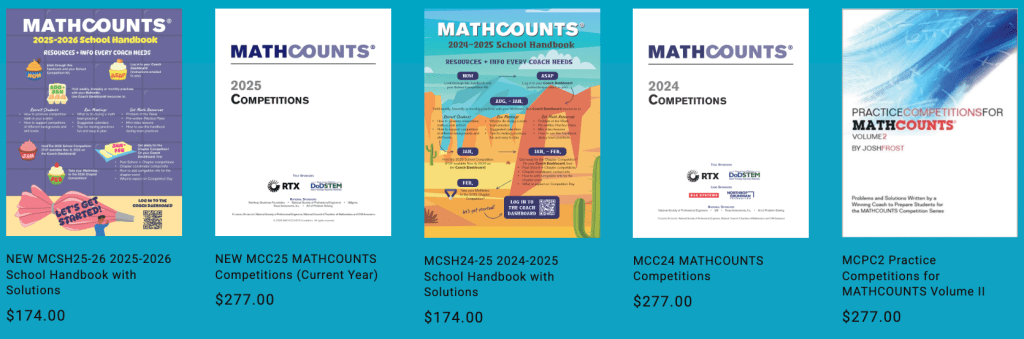
Books, handouts, and practice sets from the MATHCOUNTS Foundation.
A gamified platform to practice MATHCOUNTS-style questions with instant feedback and difficulty leveling.
Pengi AI — AI-Powered Math Tutoring
- Grades: K–12
- Format: AI-powered personalized tutoring, available 24/7 on any device
- Price: Free to start
- Features: Adaptive learning paths, step-by-step explanations, competition prep (AMC 8, AMC 10, MATHCOUNTS, Math Kangaroo), school curriculum coverage
- Best For: Students who want flexible, on-demand support — from core math skills to competition-level prep
- Pros: Always available, adapts to individual pace and level, covers both school math and competitions
- Cons: AI-based tutoring (no live human instructor)
Try Pengi AI — Smarter Math Practice for Students
Pengi AI supports K–12 learners with personalized math practice, guided explanations, and feedback designed to help them build confidence and improve steadily.