Pengi Editor's Note
The Pengi editorial team curated this Think Academy Algebra 1 guide. The comparison with Pre-Algebra and Algebra 2 is particularly useful for students (and their parents) trying to understand what skills are expected at each stage and how to bridge any gaps.
Source: Think Academy Blog
Algebra 1 Guide: Pre-Algebra and Algebra 2 Compared
Algebra 1 is more than just another math class—it’s a gateway to advanced problem-solving and abstract thinking. For many students, it marks the shift from arithmetic to symbolic reasoning. For parents, it often represents a major academic milestone in their child’s math journey.
In this guide, you’ll learn:
- What Algebra 1 covers and when it’s typically taught
- How it compares to Pre-Algebra, Algebra 2, and Math 1
- How to tell if you or your child is ready—and what comes next
- Plus: Free Algebra 1 worksheet downloads and a readiness quiz
Don’t have time to read every word? Our podcast covers it all in just six quick minutes.
Where Does Algebra 1 Fit in the Math Sequence?
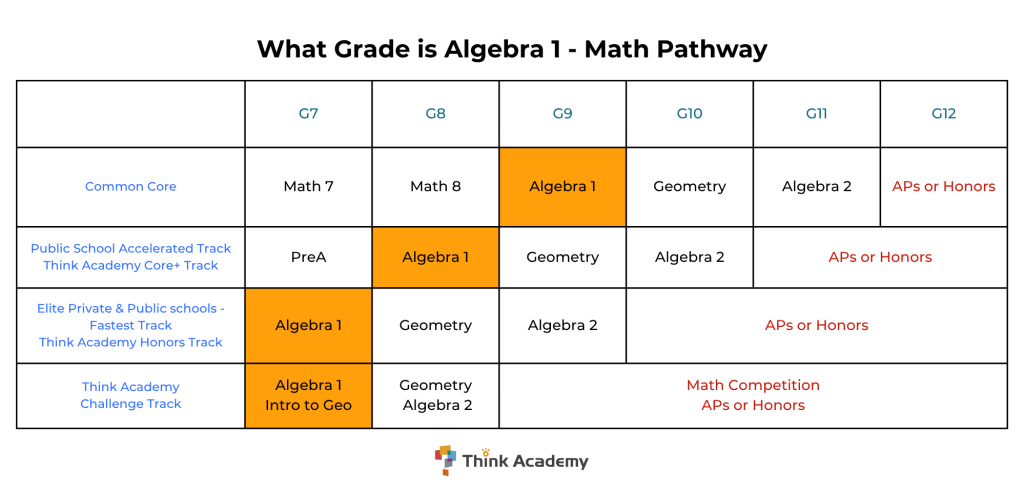
Most students take Algebra 1 between Grade 7 and Grade 9, depending on their school’s curriculum and academic readiness.
Here’s how it fits into common U.S. math pathways:
- Traditional Track: Pre-Algebra → Algebra 1 → Geometry → Algebra 2 → Pre-Calculus / AP Calculus
- Integrated Math Track: Math 1 (includes most Algebra 1 topics) → Math 2 → Math 3
Understanding where Algebra 1 falls in this sequence helps families plan ahead and prepare for each step with confidence.
What Do You Learn in Algebra 1?
Algebra 1 introduces students to the language of mathematics—using symbols, rules, and operations to represent and solve problems. These concepts build a foundation for future courses like Algebra 2, Geometry, and standardized tests such as the SAT.
- Number and Quantity: operation of radicals, exponents, ratio, rate, and proportion
- Expressions: exponential expressions, radical expressions, operation of polynomials, factorization of polynomials
- Equations: linear equations, quadratic equations, system of linear equations
- Inequalities: linear inequalities, compound inequalities
- Functions: linear functions, quadratic functions, exponential functions, square root functions, inverse and direct functions, graph transformation
- Sequences: arithmetic sequences, geometric sequences, recursive formula
- Statistics and Probabilities: statistical plots, data measurement, correlation, regression line, best fit line
Learn more about the topics covered in Algebra 1:
- How to Multiply Polynomials: From 1 Term to 3 Terms
- How to Divide a Polynomial by a Monomial in 2 Simple Steps
What Grade Is Algebra 1?
Students are usually placed in Algebra 1 based on test scores, previous math grades, and teacher recommendations. In some districts, students take it as early as Grade 7 or 8, especially if they’ve mastered Pre-Algebra.
Early placement can create more opportunities for advanced courses later in high school.
Is Algebra 1 Hard?
It depends on the student’s background and mindset. Algebra 1 is often the first class to require:
- Abstract thinking (working with symbols instead of numbers)
- Multi-step problem-solving
- Interpreting graphs and patterns
For students who are well-prepared and practice regularly, Algebra 1 can be challenging but rewarding. A shaky Pre-Algebra foundation, however, may lead to frustration.
Pre-Algebra vs. Algebra 1 vs. Algebra 2
Understanding how algebra evolves across Pre-Algebra, Algebra 1, and Algebra 2 helps students and families make smarter decisions about readiness, placement, and long-term learning.
Below are four examples showing how math topics progress across Pre-Algebra, Algebra 1, and Algebra 2.
| Concept | Pre-Algebra | Algebra 1 | Algebra 2 |
|---|---|---|---|
| Expressions & Equations | Simplifying expressions with variables (e.g., 3x + 2) | Solving linear equations and inequalities (e.g., 2x + 5 = 11) | Solving quadratic, rational, and exponential equations (e.g., x² + 3x = 10) |
| Polynomials | Recognizing terms (monomial, binomial), basic operations | Adding, subtracting, multiplying polynomials | Factoring higher-degree polynomials, long division, synthetic division |
| Functions | Intro to functions as input-output rules | Linear, quadratic functions; interpreting and graphing | Polynomial, rational, exponential, and logarithmic functions |
| Number Systems | Whole numbers, integers, fractions, decimals | Real numbers, irrational numbers | Complex numbers (e.g., i, imaginary solutions to quadratic equations) |
Highlights of Algebra Progression
Pre-Algebra
- Introduces the use of letters (variables) to represent unknowns
- Focuses on fluency with numbers and simple algebraic thinking
- Acts as the bridge from arithmetic to algebra
Algebra 1
- Expands on Pre-Algebra with functions, graphing, polynomials, and systems of equations
- Shifts from solving equations to modeling relationships between variables
- Still within the real number system, but begins formal symbolic reasoning
Algebra 2
- Deepens Algebra 1 topics and introduces more abstract math
- Evolves from:
- Linear & quadratic equations → higher-degree polynomials
- Basic functions → exponential, logarithmic, and trigonometric functions
- Real numbers → complex numbers
- Simple graphing → Analytic geometry
- Requires algebraic fluency and prepares students for advanced math
Summary
- Pre-Algebra → Algebra 1: From understanding variables to using functions to express relationships
- Algebra 1 → Algebra 2: From simple modeling to analyzing multi-step, abstract functions with geometry connections
- A strong foundation at each level supports long-term success in math, science, and standardized testing
Algebra 1 vs. Math 1 (Integrated Math)
Math 1 is part of the Integrated Math model, which blends Algebra 1 with Geometry and basic Statistics. Students revisit and deepen these topics over time (Math 1 → Math 2 → Math 3).
| Algebra 1 | Math 1 |
|---|---|
| Focuses on algebra only | Combines algebra, geometry, and some statistics |
| Traditional sequence | Integrated sequence |
| Taught in 8th–9th grade | Usually 9th grade in integrated districts |
If your school uses the Integrated Math pathway, Math 1 replaces Algebra 1, though the topics may be covered in a different order or depth.
A Snapshot from Real Students
A recent community poll with over 240 votes showed just how varied Algebra 1 experiences can be:
- 39% said they can solve polynomials easily
- 27% said they have occasional trouble
- 10% struggle a lot
- 4% don’t understand anything
- 17% said: “What even is a polynomial?”
Students shared a wide range of experiences—from excelling with strong teaching, to struggling due to missing foundational skills or inconsistent instruction.
As one student said:
“Algebra 1 isn’t hard—it’s just different. You need space to experiment, try things in multiple ways, and really understand what each step means.”
Possible Challenges Facing Algebra 1
Struggling with Algebra 1 is more common than it seems, and it’s not a sign of low ability. Here are some common reasons students may find it difficult:
- Weak Pre-Algebra Foundation: Gaps in basic skills (like solving simple equations or understanding variables) make Algebra 1 harder to grasp.
- Learning Style Mismatch: Not all teaching methods work for everyone. Some students need visual aids, real-world examples, or step-by-step breakdowns.
- Ineffective Study Habits: Long cram sessions can be less effective than short, consistent practice.
- Emotional Pressure: Stress, fear of failure, or lack of confidence can block focus and learning.
The good news? With the right support, pacing, and resources, most students can turn Algebra 1 from a struggle into a success.
“I studied for hours, stayed up late, and still failed—until I realized I wasn’t learning the way my brain needed. Once I found the right explanation, everything started to make sense.” – A Grade 8 student
“It’s not that I’m bad at math—I just missed one key concept early on. Fixing that one thing made the rest of Algebra 1 finally click.” – A Grade 9 student
How to Know If You’re Ready for Algebra 1
Here are a few key signs:
- You’re confident solving one-step and two-step equations
- You understand ratios, proportions, and percentages
- You can apply math to real-world problems
- You’re curious about patterns and logic
Still unsure?
✅ Jump to [G6 and Above] and:
Download Algebra 1 Free Worksheet
✅ Take the Readiness Quiz
What Comes After Algebra 1?
After completing Algebra 1, students typically move on to:
- Geometry (logic, proofs, and spatial reasoning)
- Algebra 2 (advanced functions and symbolic reasoning)
- Or Math 2 (if in the integrated track)
These courses continue developing students’ ability to solve real-world and theoretical problems and prepare them for Pre-Calculus and AP-level coursework.
More Middle School Algebra Resources Ready for You
We’ve created a full library of printable resources — from foundational math to logic-based challenges — organized by grade to support every stage of your child’s journey.
Final Thoughts: Build the Right Foundation Now
Algebra 1 is more than a subject—it’s a turning point. It opens up advanced math, improves test readiness, and builds habits of logical thinking.
Pengi AI — AI-Powered Math Tutoring
- Grades: K–12
- Format: AI-powered personalized tutoring, available 24/7 on any device
- Price: Free to start
- Features: Adaptive learning paths, step-by-step explanations, competition prep (AMC 8, AMC 10, MATHCOUNTS, Math Kangaroo), school curriculum coverage
- Best For: Students who want flexible, on-demand support — from core math skills to competition-level prep
- Pros: Always available, adapts to individual pace and level, covers both school math and competitions
- Cons: AI-based tutoring (no live human instructor)
Try Pengi AI — Smarter Math Practice for Students
Pengi AI supports K–12 learners with personalized math practice, guided explanations, and feedback designed to help them build confidence and improve steadily.