Pengi Editor's Note: This article was originally published by Think Academy. We're sharing it here for educational value. Think Academy is a leading K-12 math education provider.
AMC 10 Case Studies: How to Achieve AMC 10 AR, HR, DHR and AIME Qualifier
AMC 10 is one of the highest-signal checkpoints for students building a long-term math contest pathway (AMC → AIME → USA(J)MO). It measures much more than school computation—AMC 10 rewards structured problem-solving, strategy selection under time pressure, and error control.
If your child is planning to take AMC 10 in the next 1–3 years and you’re aiming for a multi-year contest plan (not short-term cramming), these real stories will show what “effective preparation” looks like in practice—habits, systems, and training stages that compound over time.
Quick Award Reference for Parents
Before the case studies, here’s a quick and accurate framework for what these awards mean:
AMC10 format & scoring
AMC10 is a 25-question, 75-minute multiple-choice contest. Scoring (official) is 6 points correct, 1.5 points blank, 0 points incorrect.
What do AR / HR / DHR / AIME mean?
- Achievement Roll (AR) is typically a recognition for younger students who earn a high score relative to grade level (commonly discussed for middle/elementary students taking higher-level contests).
- Honor Roll (HR) generally refers to a top-performer band (commonly discussed as top 5% in many summaries and score reports).
- Distinguished Honor Roll (DHR) generally refers to top 1% scorers.
- AIME qualification is guaranteed for at least the top 2.5% of AMC10 participants (with yearly cutoffs published).
In this blog, AR/HR/DHR are used as parent-friendly labels for performance tiers; AIME qualification follows the official cutoff.
Recommended for beginners: AMC 10 FAQ and Resources: Your Ultimate Guide
Below are three Think Academy students who earned strong results in 2025 AMC10—and they’ll share what worked, what was hard, and what they’d do again.
Case Study 1 – Michael Lin
For privacy reasons YouTube needs your permission to be loaded.
I Accept
Background
Michael is a 6th grader who has trained with Think Academy for four years. In 2025, he was in Olympiad Year 1, focusing on contest foundations while starting to build AMC-level readiness early.
2025 AMC10 Result
Michael earned Achievement Roll (AR) in the 2025 AMC10, a strong result for a younger student competing on an advanced exam.
Motivation & Long-Term Goal
Michael’s goal is long-term and elite: to one day represent the U.S. at IMO. He approaches AMC10 as part of the skill-building ladder toward that destination.
His Long-Term Training Habits
Mistake Journal
Michael’s most effective habit is a mistake journal. After every practice set, he records the problems he missed—where he went wrong, why it happened, and what cue will help him avoid it next time.
“I keep a journal with all my mistakes.”
He reviews this “error list” before bed and even right before the AMC10, using it as both a learning tool and a confidence tool:
- It helps him spot his most common traps and reduce repeat mistakes
- It also calms him down on test day, because he feels prepared
In his words, revisiting the journal “prevents me from making the same mistakes,” and turns anxiety into readiness.
This habit creates a tight feedback loop: identify error → encode lesson → reduce repeat mistakes → stabilize performance.
What Think Academy Helped for Him
Michael emphasizes a classroom factor that matters especially for younger students: psychological safety and clarity.
“We have really great teachers… and are open to questions.”
He adds a powerful signal for parents evaluating learning environments:
“Never once have I been afraid to raise my hand.”
For families, that line often translates to the real driver of progress: students ask more, clarify faster, and stay consistent longer.
Takeaway for Families Targeting AR
Michael’s early AMC 10 success wasn’t just about harder math—it started with a mistake journal that turns every miss into a repeatable fix: find the error, name the cause, write a cue, and review, so the same traps don’t come back and his performance stays stable. Just as importantly, he learns in a classroom where questions are genuinely welcomed—he says he’s “never been afraid to raise my hand”—which helps younger students clear confusion quickly and stay consistent long enough for results to compound beyond AR.
Next Step for Targeting AR
If your child has completed Math 8 (Pre-algebra), or already has some competition experience and now wants a clear entry point into the AMC pathway, our AMC 10 Introduction Online Math Class is designed for this stage.
- Student goals at this stage: build a competition-ready foundation and aim for a strong first AMC 10 performance—typically 70–90 on the first attempt, setting up a realistic path toward AIME qualification the following year.
- What students will work on: solidify Algebra 1 and Geometry for both school acceleration and contest readiness, while getting an early introduction to Number Theory and Combinatorics—the core language of AMC-style thinking. Students will also practice problems that approach the difficulty of the first 10 AMC 10 questions, building speed, accuracy, and confidence step by step.
For more course details and enrollment, visit AMC 10 Introduction Online Math Class — 2026 Spring Semester
Case Study 2 – Boyao Wang
For privacy reasons YouTube needs your permission to be loaded.
I Accept
Background
Boyao is a 6th grader who has studied with Think Academy for four years. By 2025, he was enrolled in the AMC10 AIME Camp, preparing for higher-level competition math while still in middle school.
2025 AMC10 Result
In his first-ever AMC10, Boyao earned 106.5—a score that qualified him for AIME.
Motivation & Long-Term Goal
Boyao views AMC10 as a strategic step in a longer competition pathway. His goal is explicit and ambitious: qualify for JMO by 7th grade and ultimately reach IMO.
His Long-Term Training Habits
Varied Question Types
Rather than repeating the same sets, Boyao prioritized variety—training his brain to handle changing formats and unfamiliar problem types. His recommendation is simple and scalable for families:
- practice a wide variety of question types
- avoid “overfitting” to one problem set
- build flexible problem-solving, not memorization
In his words, “focus on doing a variety of questions” and avoid doing the same set repeatedly because it can become “memorizing formulas and memorizing answers.”
What Think Academy Helped for Him
Boyao credits Think Academy’s structured lesson design as the key accelerator—especially for younger students aiming above grade level. He emphasizes the learning sequence that matched how he absorbs math:
“The order from concepts to math explorations to practices really goes with my brain.”
This concept → exploration → practice structure helped him turn understanding into transferable skill, which matters in AMC10 where question types shift rapidly.
Takeaway for Families Targeting AIME
Boyao’s story is a strong fit for families who want a systematic pathway (not random worksheets): start early, train for variety, and rely on a structured curriculum that builds transferable thinking.
Next Step for Targeting AIME
If your child is in one of these stages, it may be time to transition from foundation-building to a focused AMC 10 → AIME push:
- Stage 1 (Strong school foundation): students in accelerated school tracks who have already completed Algebra 1 and Geometry and want to convert that strength into contest performance.
- Stage 2 (Ready to level up): students currently scoring 70–90 on AMC 10 who are aiming for 110, targeting AIME qualification and/or Honor Roll-level results.
Student goal at this stage: a clear, long-term milestone—qualify for AIME through AMC 10, with the strategy and execution skills needed to perform reliably on test day.
To support this transition, Think Academy’s AMC 10 AIME Camp is specifically designed to address the most common bottlenecks at this level—helping students transform strong school foundations into true competition readiness, and build the skills, confidence, and strategy needed to excel in AMC 10 and qualify for AIME.
For more course details and enrollment, visit AMC 10 AIME Online Math Class — 2026 Spring Semester
Case Study 3 – Clair Wang
For privacy reasons YouTube needs your permission to be loaded.
I Accept
Background
Clair is a 10th grader who has studied at Think Academy for four years. After qualifying for the AIME, she continued her studies in Think Academy’s AIME 10-Point Class, focusing on high-difficulty problems and accuracy training.
2025 AMC10 Result
In 2025 AMC 10, Clair earned a Distinguished Honor Roll score on AMC10A and an Honor Roll score on AMC10B.
Motivation & Long-Term Goal
When she started competitions, Clair’s goal was clear: qualify for AIME. She describes it as a multi-year process:
“It took about three years of training specifically AMC 10 to reach that goal.”
Along the way, she also aimed to build broader problem-solving ability—because AMC demands more than school math.
Her Long-Term Training Habits
Consistent Practice
Clair’s progress came from three years of steady, systematic training, not short-term bursts. She focused on complete coverage + realistic simulation:
“I work through every single AMC previous exam…”
“…and completed a lot of full-length practice tests with Think Academy.”
By nearly finishing past exams and doing repeated full-length mocks, she trained not only content, but also pacing and decision-making.
Time Management
Clair says time management was the hardest part—especially when getting stuck early. With recent exams mixing difficulty order, she adopted a clear rule: skip fast, return later.
- If you’re not making progress, move on
- Look for higher-efficiency points elsewhere
- Return only after securing the easier wins This shift helped her protect the only outcome that matters on test day: total score.
Knowledge Foundation: Precalculus
Clair also highlights a reality many families underestimate: AMC10 difficulty has increased, and relying on school math alone can become limiting for students aiming for HR/DHR. Her advice:
- Build a solid Precalculus foundation
- In some cases, basic calculus intuition can reduce solution time—giving a real advantage when minutes matter.
This is less about “learning calculus early” and more about having enough mathematical language and tools to recognize shortcuts and avoid long, brute-force approaches.
What Think Academy Helped for Her
Clair points to two Think Academy strengths that directly supported her HR/DHR outcomes:
1) Practice tests that match real contest difficulty
She emphasizes the importance of accurate mocks—especially as it becomes harder to find reliable material online:
“The quality of its practice tests… really closely matches the actual contest difficulty.”
2) Courses that keep training deep, engaging, and sustainable
Beyond materials, she highlights the learning environment and instruction quality:
Think Academy’s AMC prep courses are “very in-depth and engaging,” with “very knowledgeable and qualified teachers.”
And she valued learning alongside peers “genuinely excited to learn.”
That combination—high-quality teaching plus a motivated peer group—helps students stay consistent for the multi-year timeline that HR/DHR-level performance often requires.
Takeaway for Families Targeting HR/DHR
Clair’s story is a blueprint for students who want to move beyond “good at math” into high-performance AMC10 execution: three-year consistency + full-length timed simulation + clear time-management rules + stronger foundations, supported by practice tests that are genuinely close to the real contest.
Next Step for Targeting HR/DHR
If you’re currently in an accelerated Grade 8–9 math track—or you’ve already finished Geometry—and your goal is AMC 10 strong performance toward HR/DHR, and then AIME contest, the next step is to get clear on one thing: are your skills truly competition-ready?
At this stage, high goals require two types of readiness:
- Knowledge readiness: Algebra & Geometry topics are mastered, not just “learned.”
- Contest readiness: you can apply them flexibly under time pressure, with strong accuracy and strategy.
That’s exactly why an evaluation helps. It pinpoints what you already have, what’s missing, and which weaknesses are costing you points—so your preparation becomes targeted, efficient, and measurable, instead of more random practice.
Get a clear diagnosis of your topic mastery and contest problem-solving level, then build a focused plan to pursue AMC 10 HR/DHR.
What These 3 Stories Have in Common
1) Long-term goals
All three students started with a clear long-term direction—whether it’s AIME, JMO, or even IMO. That clarity matters because AMC10 prep isn’t a short sprint; it’s a plan that rewards students who can stay consistent for months (and often years).
2) Consistent, high-quality practice
Their methods look different on the surface—variety practice, full-length mocks + past papers, mistake journaling—but they share the same core: daily/weekly high-quality reps with a feedback loop.
- Boyao trains adaptability with many question types
- Clair builds execution with past AMC exams + full-length practice tests
- Michael protects points with a mistake journal (reviewing errors before bed and before contests)
3) Multi-year training beyond “school math”
None of them relied on school math alone. Over multiple years of systematic learning with Think Academy, they built competition-ready skills: problem decomposition, strategy selection, pattern recognition, and fast reasoning—the exact abilities AMC10 rewards. This is the kind of growth that comes from structured modules and repeated exposure to contest-style thinking, not just classroom homework.
4) Time commitment that matches the goal
Think Academy’s weekly class time (about 2 hours) is only the foundation. Each student also put in time outside class for homework, review, and timed practice. That’s the real takeaway for families: strong AMC10 results come from a realistic routine—class + assignments + deliberate review—sustained over time.
Long-term Competition Pathway
As we’ve seen in the stories of Michael, Boyao, and Claire, their success didn’t come from random practice or one-off efforts. It came from a systematic, long-term approach—one that combined focused content review, flexible problem-solving, error control, and consistent practice. This method ensured they stayed on track, made progress over time, and avoided the common pitfalls of short-term cramming.
To achieve success in AMC 10 and progress to AIME, a structured system is essential. It’s not just about doing harder problems; it’s about deepening your understanding, sharpening your strategy, and preparing efficiently for the unique challenges of math competitions. Think Academy’s curriculum is designed to provide this comprehensive approach, guiding students step by step toward their goals.
Think Academy Competition Pathway
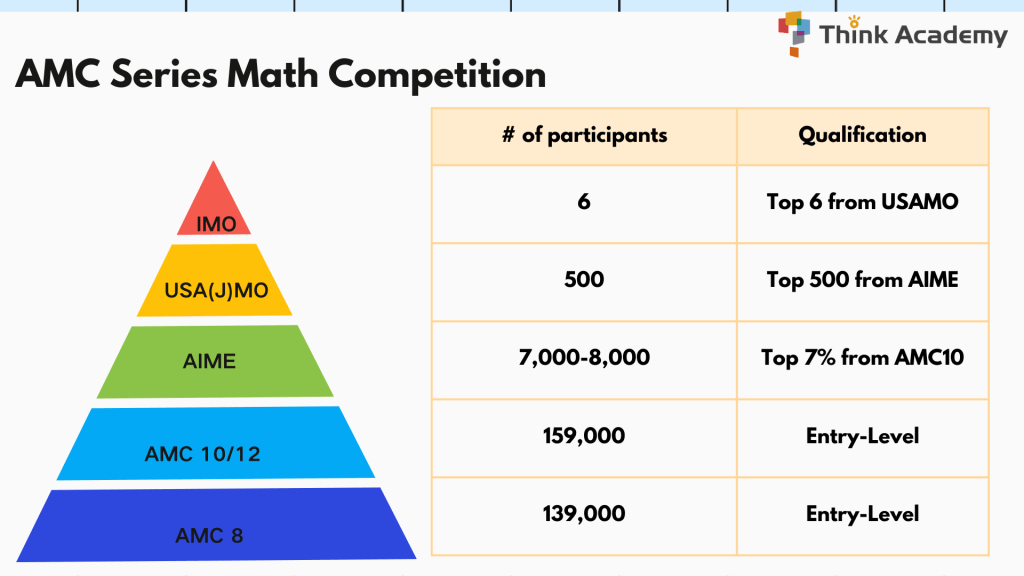
Think Academy’s Competition Pathway is specifically designed to guide students step by step from their foundational math studies to advanced competitions like AMC 10 and AIME, and ultimately to the highest levels such as USA(J)MO and IMO.
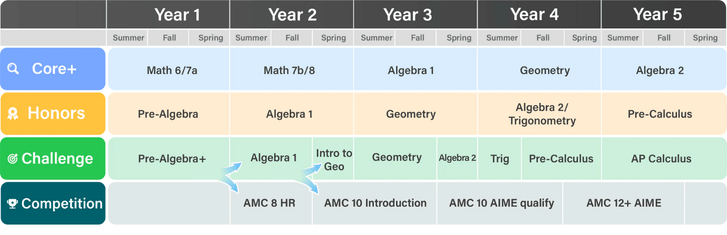
Our middle school pathway is structured as follows:
- Year 1: Students begin with AMC 8 preparation, targeting an entry-level understanding of competition math.
- Year 2–3: As students progress, they advance through AMC 10 Introduction and begin focusing on core contest-level skills like Algebra, Geometry, and Number Theory.
- Year 4–5: Students target AIME qualification by Year 4, with more intensive problem-solving and strategies for contest success.
The path culminates in AIME qualification and sets the stage for future contests, including USA(J)MO and IMO.
By following this path, students will develop the critical problem-solving techniques, time management skills, and strategic thinking that are essential to AMC 10, AIME, and beyond.
Start your journey today by enrolling in one of our targeted AMC 10 courses, designed to help students qualify for AIME and further competitions.
Try Think Academy AMC 10 Prep Class
At Think Academy, we believe in a systematic, multi-layered approach to mastering competition-level math. Our courses are designed to ensure students not only understand the content but also apply it effectively under real exam conditions.
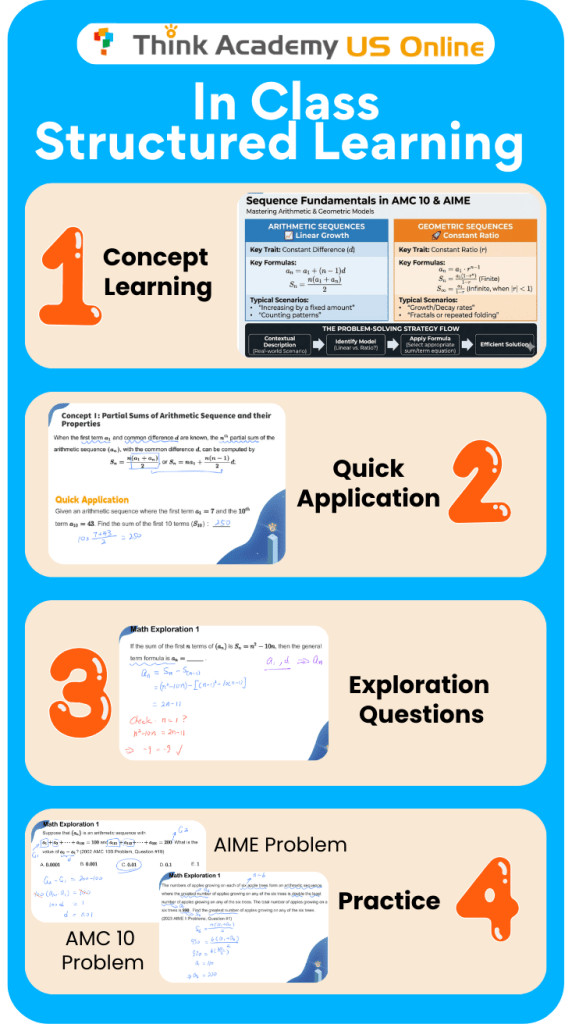
Structured Class Learning
Our structured learning incorporates a wide range of problems, from foundational exercises to advanced, contest-style questions. Each lesson is paired with:
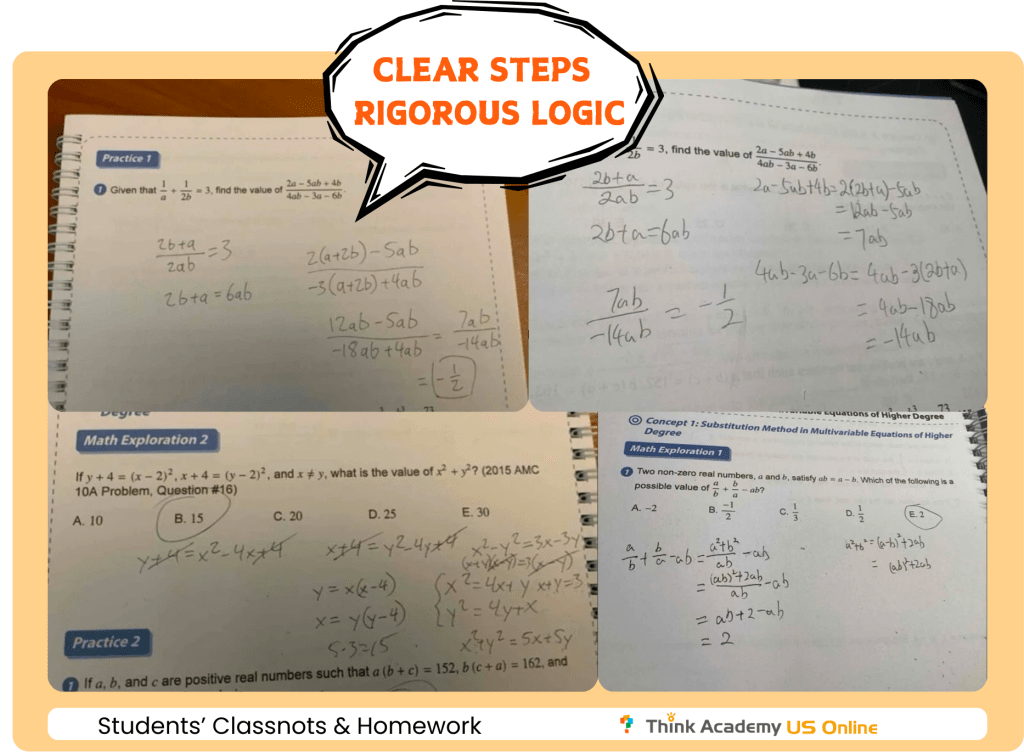
- Concept Learning: Key math principles are taught clearly, followed by Quick Applications and Math Explorations to reinforce understanding.
- Practice: After every concept is introduced, students work through AMC 10 and AIME-level problems, progressively building their problem-solving skills and speed.
Extensive Practice Resources
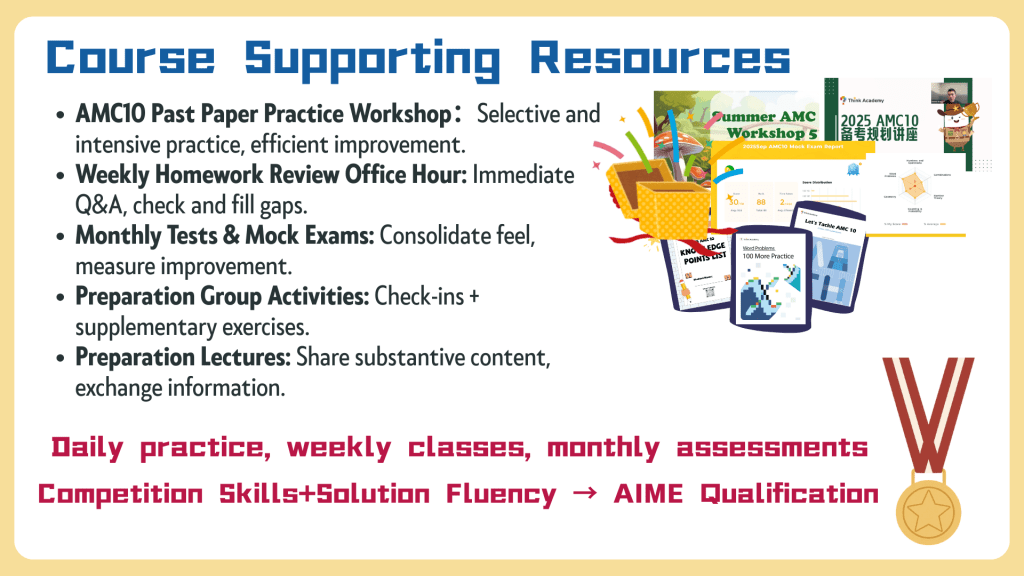
To ensure students are fully prepared for the AMC 10 and AIME, Think Academy offers a range of high-quality resources and supporting materials that complement the structured curriculum. With all the supporting resources, for exmaple, daily practice, weekly classes, and monthly assessments, Think Academy prepares students to build the competition skills and solution fluency needed to succeed, eventually achieving AIME qualification and beyond.
Interactive Classroom
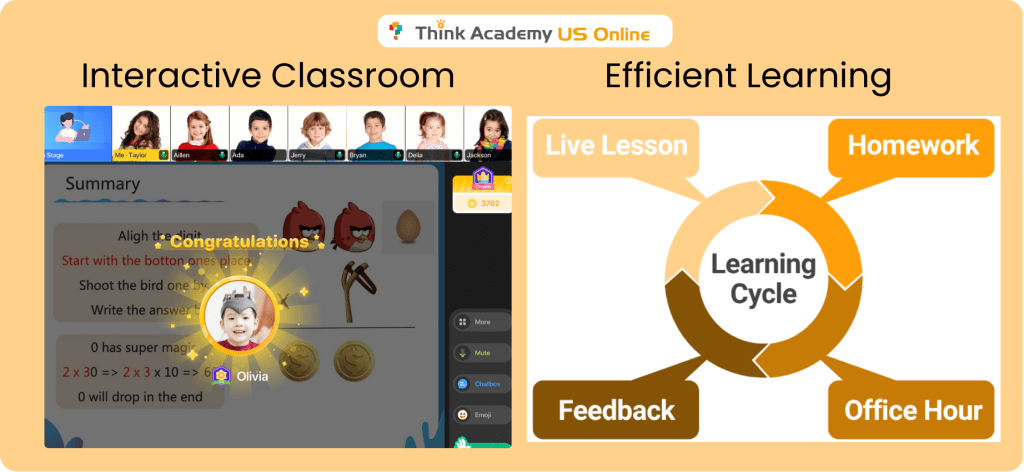
Learning at Think Academy is interactive and collaborative. Students engage directly with their peers and teachers in real-time:
- Live lessons allow for direct interaction.
- Homework helps reinforce class content and Office Hours ensure personalized support.
- Feedback is provided continuously, allowing students to adjust and refine their strategies.
Expert Teachers
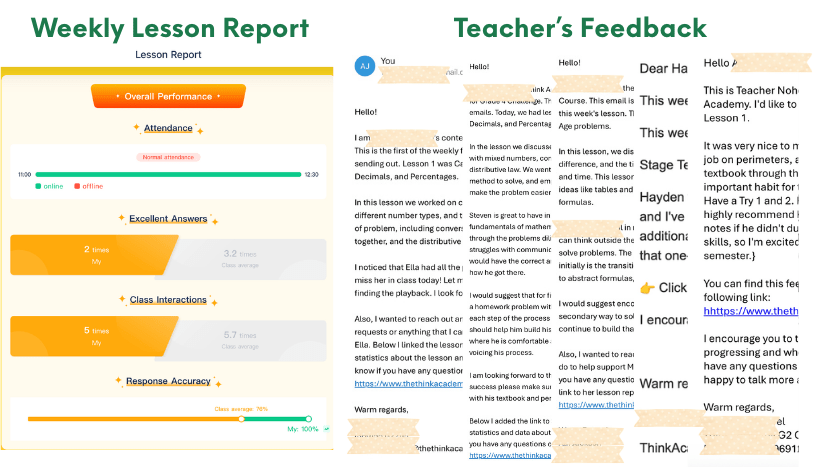
Our teachers go through a rigorous 5-round hiring process (with a <0.1% acceptance rate). They bring not only strong math expertise but also years of experience teaching in a classroom setting. After each class, students receive class report and personalized feedback, ensuring continuous improvement and deeper mastery of the material.
More AMC 10 Resource
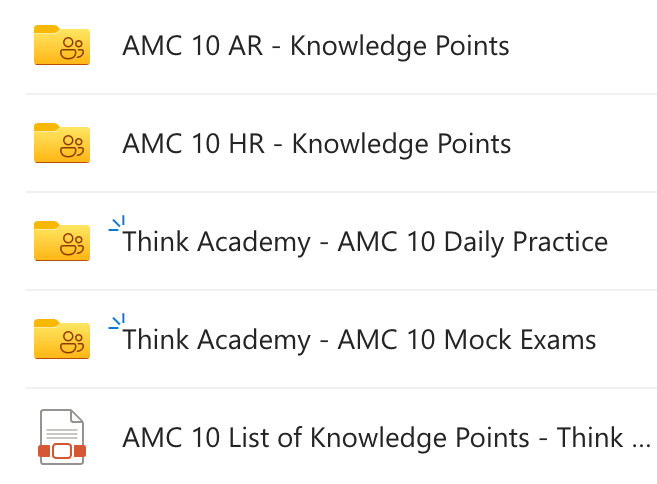
Download AMC 10 Mock Exam & Practice Pack
Download AMC 10 mock exams with full solutions, key AR/HR knowledge reviews, and daily practice sets — perfect for focused and efficient prep.
- Mock Exams: Timed practice with full explanations to build test readiness and review mistakes.
- Knowledge Points: Covers must-know Algebra, Geometry, and Number Theory concepts for AMC 10.
- Daily Practice: Sharpen accuracy and speed with high-frequency AMC-style problems.
*Please enter a valid email address to access the materials and receive future prep updates.
AMC 10 Resources Pack
Free Download
Parent's Email Address: *
Zip Code *
Phone Number (Optional)
Student's First Name *
Student's Last Name *
Student’s Grade *
Pre-K3Pre-K4KindergartenGrade 1Grade 2Grade 3Grade 4Grade 5Grade 6Grade 7Grade 8Grade 9Grade 10Grade 11Grade 12
By submitting the form, you'll join our mailing list for free math worksheets, educational trends, event updates, and more. You can unsubscribe anytime.
Submit
After submission, the download link is in the confirmation message on this page.
Thank You for Completing the Form!You can download the resource using this link: bit.ly/AMC10-Resources-Pack-Think-Academy Password: ThinkAMC104g1fu0×
Oops! Something went wrong. Please try again later.
×
Try Pengi AI — Smarter Math Practice for Students
Pengi AI supports K–12 learners with personalized math practice, guided explanations, and feedback designed to help them build confidence and improve steadily.