Pengi Editor's Note: This article was originally published by Think Academy. We're sharing it here for educational value. Think Academy is a leading K-12 math education provider.
AMC 10 FAQ and Resources: Your Ultimate Guide
Thinking about AMC 10 but not sure where to start? This guide covers everything parents and students need to know—from what AMC 10 is, what grade it’s for, and how hard it is, to what counts as a good score. Think Academy provides clear explanations, proven prep strategies, and structured practice materials to help students build confidence and succeed on this nationally recognized math competition. Scroll down to explore detailed articles, access past exam solutions, and download free AMC 10 practice PDFs for targeted and efficient preparation.
What is AMC 10
The America Mathematics Competition (AMC) 10 is a challenging and prestigious mathematics competition hosted by Mathematical Association of America (MAA) every year.
- Why AMC 10 Matters: Identifies math talent, qualifies students for advanced competitions (AIME, USAMO), and strengthens college applications, highlighting STEM aptitude.
- Who Can Participate? Students in Grade 10 or below, under 17.5 years old on contest day.
- Competition Focus: Algebra, geometry, number theory, and combinatorics—many of which go beyond regular school math.
If you are interested in participating in the upcoming AMC 10, check this page for the latest info.
What’s the Difference Between AMC 10A and AMC 10B?
- Two Separate Exams: AMC 10 includes two tests—AMC 10A and AMC 10B—with identical formats but different questions, and separate scores and AIME qualification cutoffs calculated for each exam.
- Comparable Difficulty: The AMC 10A and AMC 10B each have unique question sets and similar—but not identical—difficulty. Students are encouraged to take both exams, as only the higher score counts, maximizing their chances of success.
- Higher Score Counts: Only the higher score between AMC 10A and AMC 10B counts for awards and qualification.
- Flexible Testing: Students can take AMC 10A and AMC 10B at different locations (e.g., school and Think Academy).
AMC 10 Format and Scoring
- Number of Questions: 25 multiple-choice questions
- Time Limit: 75 minutes
- Formats: Paper-based exam or Computer-based exam
- Scoring System:
- Correct answer: 6 points
- Unanswered: 1.5 points
- Incorrect answer: 0 points
- Maximum Score: 150 points
What is a “Good Score” for AMC 10?
Based on award data from recent years, Think Academy recommends aiming for the following scores to achieve these goals.
| Student’s Goal | Recommended AMC 10 Score |
|---|---|
| Qualifying for AIME | 105+ |
| Honor Roll / College & STEM Applications | 115+ |
| USA(J)MO Advanced Competition Preparation | 130+ |
AMC 10 Awards and Qualifications
AMC 10 awards recognize outstanding mathematical achievement at various levels:
| Award Name | Qualification Criteria | Importance & Impact |
|---|---|---|
| Certificate of Achievement (AR) (Achievement Roll) | 90+ points (8th grade or younger) | Specifically recognizes younger students; score closely aligns with AIME qualification. Usually indicates readiness for AIME. |
| AIME Qualification | 95–105 points (Top 6–8% of participants) | Entry-level qualification achievable through consistent study and practice. Beneficial for college applications, especially for Top 30–50 universities. |
| Honor Roll | 100–115 points (Top 5% of participants) | Slightly higher than AIME cutoff; similar in prestige to AIME qualification, though not yet at USA(J)MO level. Useful for applications to Top 30–50 universities. |
| Distinguished Honor Roll | 130–135 points (Top 1% of participants) | The highest AMC 10 award. Students in this category typically have strong chances to qualify for USA(J)MO. Valuable for admissions to Top 30 universities. |
Is AMC 10 Hard?
AMC 10 is a prestigious math competition widely recognized for secondary school and college admissions, as well as qualification for advanced math competitions such as AIME. Achieving a high score is challenging due to its complexity and competitive nature. However, determining the difficulty isn’t simply a matter of “easy” or “hard”; it depends significantly on your goals, current mathematical knowledge, and problem-solving abilities. Read the content below for an in-depth comparison between AMC 10, school mathematics, and other math competitions.
Comparison between in-school math and AMC 10
AMC 10 covers topics primarily from Algebra 1, Geometry, and parts of Algebra 2 (not include advanced topics like trigonometry or calculus), but the competition goes beyond basic concepts. It emphasizes flexible use of formulas, combined applications of multiple concepts, and solving problems presented in more complex contexts. Additionally, AMC 10 tests knowledge of number theory and combinatorics—topics generally not covered by standard school curricula. Explore the blogs below to clearly understand the differences between typical in-school math problems and AMC-style competition problems.
- Polynomial Multiplication in Algebra: Formulas, Examples, and AMC 10 Applications
- Pythagorean Theorem: Formulas, School and AMC Examples
Comparison between AMC 8 and 10
One of the most common questions about AMC 10 is its difficulty level versus AMC 8.
The AMC 8 and AMC 10 are both designed by the Mathematical Association of America (MAA) to challenge students’ mathematical thinking, but they differ significantly in scope and difficulty.
- The AMC 8 targets middle school students (grades 8 and below), covering foundational problem-solving and logic.
- The AMC 10, aimed at high school students (grades 10 and below), involves more advanced topics such as algebra, geometry, number theory, and combinatorics.
Think Academy has done detailed research about AMC 10 and AMC 8, read the article below to understand its difference.
How Hard is AMC 10 in Comparison to AMC 8 and In-School Math?
We also have student who share the real journey of getting through AMC 8 to AMC 10. Read the article below.
A Rising Star: Conquering the Leap from AMC 8 Achievement Roll to AMC 10 Honor Roll
Comparison between AMC 10 and 12
While both AMC 10 and AMC 12 competitions cover similar mathematical domains—algebra, geometry, combinatorics, and number theory—there are important differences to consider in terms of content scope, difficulty, and competitiveness:
Content Differences
- AMC 10: Primarily covers Algebra 1 & 2, Geometry, fundamental Number Theory, and basic Combinatorics.
- AMC 12: Includes all AMC 10 topics, plus more advanced subjects such as complex numbers, trigonometric functions, logarithms, advanced algebra, and analytic geometry.
Difficulty Level
- Shared Questions: AMC 10 and AMC 12 typically have about 9–12 overlapping problems each year, but these appear as later (more difficult) problems on the AMC 10 and as earlier (easier) ones on AMC 12.
- Overall Difficulty: AMC 12 is generally considered significantly harder, with more complex algebraic manipulations, higher-level geometry, and a greater emphasis on advanced mathematics skills.
Competition & Advancement
- AMC 12 Competitiveness: AMC 12 participants include high school juniors and seniors, often with stronger mathematical foundations, increasing the competitiveness compared to AMC 10.
- Scoring Trends: AMC 12 tends to have slightly higher average scores, but a higher proportion of students advance to AIME. For example, in 2021 Fall AMC 10, the average AMC 10A score was 59.63 (AIME cutoff at 96 points, top 6.16%), while AMC 12A had an average of 63.65 (AIME cutoff at 91.5 points, top 12.62%).
Overall, students aiming for top universities, particularly STEM-focused programs, often shift from AMC 10 to AMC 12 to demonstrate mastery of higher-level mathematical concepts and readiness for rigorous academic challenges.
Who Should Take the AMC 10?
1. Advanced Math Students with Strong Grades
- AMC 10 is more difficult than typical school math.
- Ideal for students already in accelerated math classes and earning strong grades.
- If struggling in school math, prioritize improving grades first.
Interest matters:
- Great fit for students who enjoy challenging math problems.
- Provides rewarding experiences and deepens math engagement.
2. Students Planning STEM Majors
- AMC 10 tests skills beyond regular algebra, including number theory, combinatorics, and logical reasoning.
- Universities (especially STEM-focused) value success in math competitions.
- High AMC 10 scores highlight mathematical talent and academic potential.
Additional Benefits:
- Demonstrates resilience, passion, and persistence.
- Attractive to selective college admissions.
3. Students with Math Competition Experience
- Students with prior experience (AMC 8, Math Kangaroo, MATHCOUNTS) have an advantage.
- Familiarity with problem-solving skills and advanced concepts.
Newcomers Also Welcome:
- Previous competition experience not required.
- Structured preparation and consistent effort can lead to success regardless of starting point.
AMC 10 Data Facts
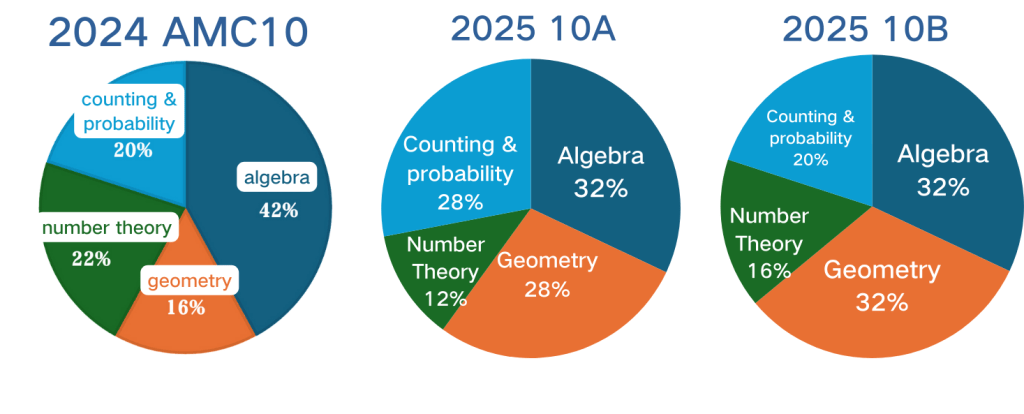
2025 AMC 10 Exam Trends
A deep dive into this year’s problem styles, difficulty level, and what the changes mean for future tests.
- 2025 Algebra module decreased by about 8%
- 2025 Geometry module increased significantly
- Difficulty increased for the first 15 problems, decreased for the last 10 problems.
Official 2025 AMC 12 Cutoff Scores
AMC 12A
- AIME cutoff score: 96
- Honor Roll Distinction (Top 1%): 150
- Distinction (Top 5%): 127.5
- Average score: 64.44
AMC 12B
- Average score: 65.99
- AIME cutoff score: 100.5
- Honor Roll Distinction (Top 1%): 145.5
- Distinction (Top 5%): 127.5
Next-Step Planning for All Students:
- If you qualified for AIME: How to structure your preparation, core topics to prioritize, and timeline planning.
- If you did not qualify: How to rebuild fundamentals and create an effective roadmap for the 2026 AMC 10.
This webinar helps every student take the most efficient and strategic next step after the 2025 exam.
For privacy reasons YouTube needs your permission to be loaded.
I Accept
AMC 10 Knowledge Modules 2020-2024
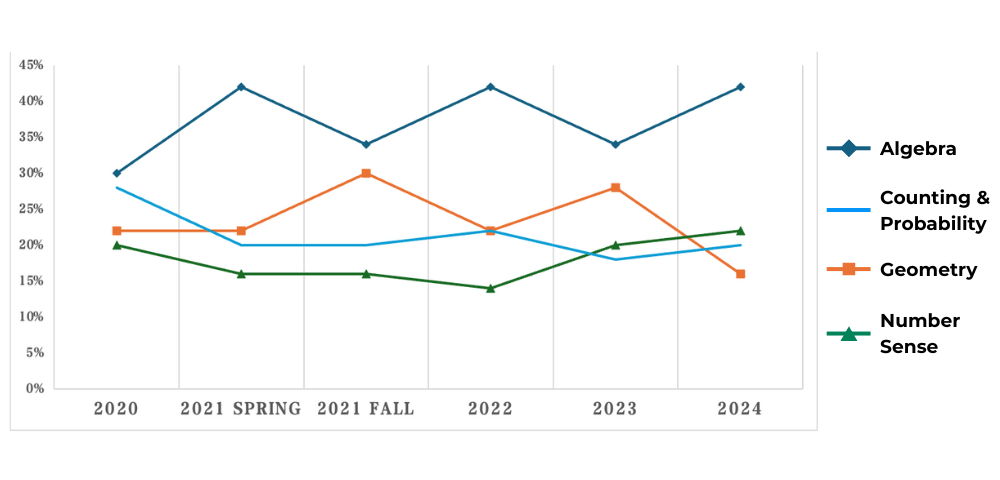
Think Academy-AMC 10 Modules and Trends (2020–2024)
| Module | Trends & Observations | Key Data Points | Recommendations |
|---|---|---|---|
| Algebra | Highest overall proportion, significant annual fluctuations. Increasing trend since 2020. | +2.4% overall since 2020.Yearly fluctuations (~8% swing annually). | Build comprehensive algebra knowledge; no topic weaknesses allowed. |
| Geometry | Inverse relationship with algebra proportion; fluctuates notably. Stable combined total (~60%) with Algebra. | ~60% combined proportion with Algebra each year. | Prepare in coordination with algebra due to inverse relationship. |
| Number Theory | Rapidly increasing prominence, now second-largest module. Historically undervalued by students. | Consistent rise since 2022. Previously lowest, now second-highest proportion. | Allocate extra preparation time; increased emphasis required. |
| Counting & Probability | Most stable module, consistently around 20% since 2021. | Stable ~20% yearly. | Maintain steady practice; critical but predictable area. |
Key Insights & Recommendations:
- Algebra consistently holds the largest share of AMC 10 questions. However, no single topic completely dominates, so students must ensure comprehensive coverage across all mathematical areas without significant weaknesses.
- Recent shifts in question difficulty indicate that the first 10 questions have become harder, while the last five have become easier. This adjustment allows more students to complete all problems, meaning speed and accuracy are now the primary differentiators among top scorers.
AMC 10 Participants and Official Cutoff Scores
AMC 10A
| Year | Total Participant | DHR(1%) | HR(5%) | AIME Cutoff (~6-8%) | Average score |
|---|---|---|---|---|---|
| 2025 | 136.5 | 112.5 | 105 | 57.13 | |
| 2024 | 30,545 | 132 | 105 | 94.5 | 58 |
| 2023 | 30,043 | 136.5 | 111 | 103.5 | 64.74 |
| 2022 | 27,411 | 120 | 99 | 93 | 58.32 |
| 2021 Fall | 117 | 100.5 | 96 | 59.63 | |
| 2021 Spring | 132 | 112.5 | 103.5 | 65.53 |
AMC 10B
| Year | Total Participant | DHR(1%) | HR(5%) | AIME Cutoff (~6-8%) | Average score |
|---|---|---|---|---|---|
| 2025 | 133.5 | 105 | 99 | 57 | |
| 2024 | 23,364 | 138 | 114 | 105 | 61.77 |
| 2023 | 22,912 | 135 | 112.5 | 105 | 63 |
| 2022 | 22,885 | 114 | 100.5 | 94.5 | 58.32 |
| 2021 Fall | 120 | 100.5 | 96 | 56.57 | |
| 2021 Spring | 126 | 108 | 102 | 61.31 |
To learn more about AMC statistics, click here.
Think Academy Achievements
Think Academy’s AMC 10 Achievements: Each number represents the total students receiving awards per year.
| Year | AIME Qualifier | HR | DHR | Perfect Score |
|---|---|---|---|---|
| 2024 | 136 | 97 | 23 | 3 |
| 2023 | 115 | 56 | 15 | 4 |
| 2022 | 55 | 35 | 7 |
*updated 05/2025
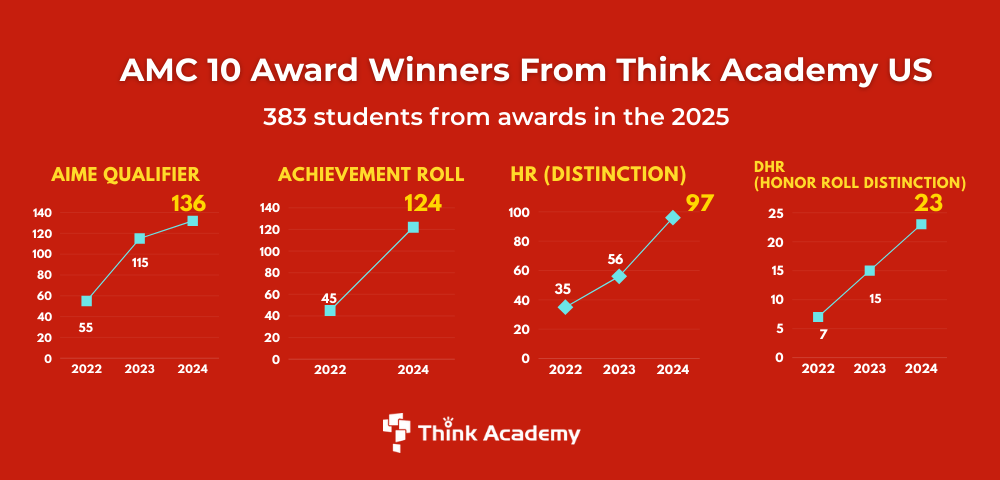
Think Academy – 2022-2024 AMC 10 Award Winners
To read more Think Academy students’ achievements on other math competitions:
- 2024-2025: 2024 AMC 10, 2025 AMC 8, 2025 Math Kangaroo
- 2023-2024: 2023 AMC 10, 2024 AMC 8, 2024 Math Kangaroo
- 2022-2023: 2022 AMC 10, 2023 AMC 8, 2023 Math Kangaroo
How to Prepare Effectively for Upcoming AMC 10
Math Knowledge Covered in AMC 10
AMC 10 covers advanced math topics typically learned by Grade 10, including:
- Algebra: Quadratic equations, factoring, abstract algebraic reasoning.
- Geometry: Similarity, congruency, geometric proofs.
- Number Theory: Integers, divisibility, primes.
- Counting & Probability: Basic combinatorial principles and probability theory.
AMC 10 problems go far beyond regular Grade 10 Common Core math. They require deeper conceptual understanding, abstract reasoning, and rapid problem-solving skills.
Differences from School Math:
- Algebra and Geometry : AMC problems expand significantly beyond standard Algebra 1 and Geometry courses. Regular classes emphasize structured proofs and straightforward calculations, while AMC 10 demands quick identification and application of advanced concepts like similarity and congruency. Algebra problems require greater algebraic fluency and abstract logic.
- Number Theory, Counting & Probability : Typically less familiar, these topics are rarely covered thoroughly in regular curricula. Though their scope on AMC 10 is narrower, students still need focused practice to master efficient problem-solving techniques.
Due to AMC 10’s complexity and the typical high-school workload, a one-year preparation timeline can be challenging. Students should adopt a structured long-term plan to build foundational knowledge systematically. Complementing this approach with an intensive short-term sprint before the competition will maximize the student’s chance of achieving high scores.
Comprehensive AMC 10 Long-term Preparation Roadmap:
Three Phases of AMC 10 Preparation:
- Phase 1 (Grades 6–8) : Build foundational math knowledge and concepts essential for AMC 10.
- Phase 2 (Typically Grades 7–9) : Develop targeted problem-solving skills to consistently complete the first 15 AMC 10 questions within 45 minutes (target: AMC 10 Achievement Roll).
- Phase 3 (Typically Grades 7–9) : Master advanced problem-solving techniques to effectively complete 20 or more AMC 10 questions (including the challenging final 10) within 70 minutes (target: AIME qualification).
- Grade 10 Students: Since AMC 10 eligibility ends after grade 10, students currently in grade 10 should either pursue intensive short-term preparation for AMC 10 or shift their focus toward preparing for AMC 12.
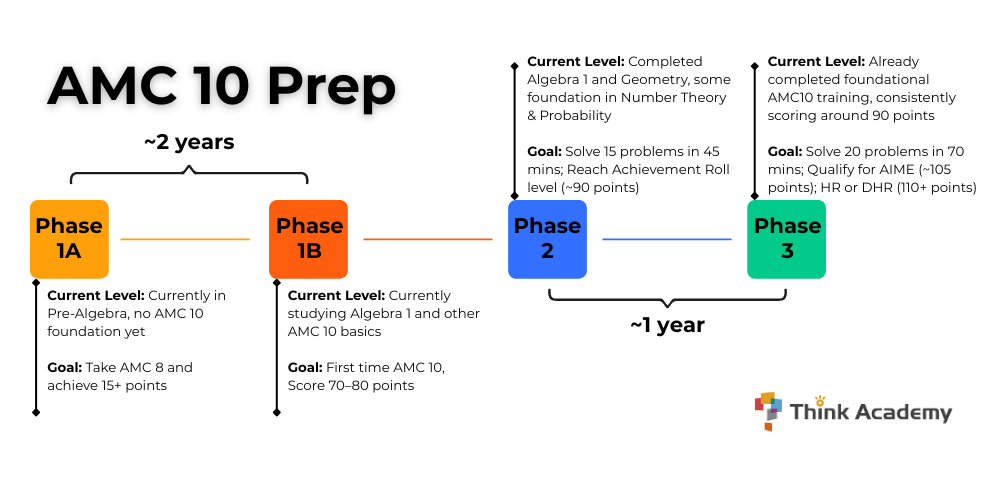
Think Academy – AMC 10 Long-term Preparation Timeline
Expert tips for earning AMC 10 awards and qualifying for AIME and USAJMO
AMC 10 Knowledge Packs
Download AMC 10 Mock Exam & Practice Pack
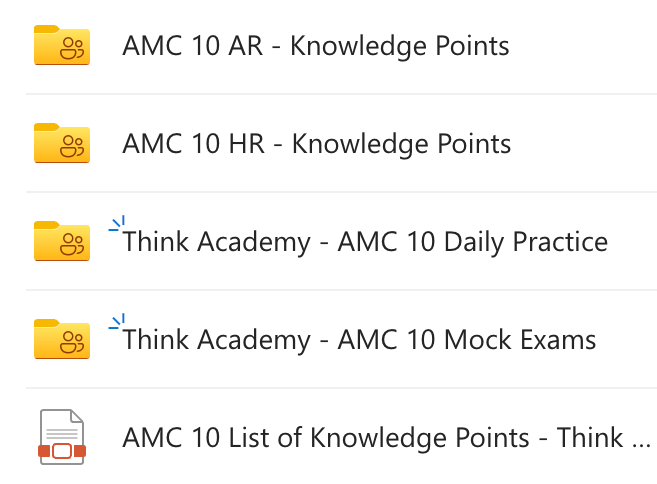
Download AMC 10 mock exams with full solutions, key AR/HR knowledge reviews, and daily practice sets — perfect for focused and efficient prep.
- Mock Exams: Timed practice with full explanations to build test readiness and review mistakes.
- Knowledge Points: Covers must-know Algebra, Geometry, and Number Theory concepts for AMC 10.
- Daily Practice: Sharpen accuracy and speed with high-frequency AMC-style problems.
*Please enter a valid email address to access the materials and receive future prep updates.
AMC 10 Resources Pack
Free Download
Parent's Email Address: *
Zip Code *
Phone Number (Optional)
Student's First Name *
Student's Last Name *
Student’s Grade *
Pre-K3Pre-K4KindergartenGrade 1Grade 2Grade 3Grade 4Grade 5Grade 6Grade 7Grade 8Grade 9Grade 10Grade 11Grade 12
By submitting the form, you'll join our mailing list for free math worksheets, educational trends, event updates, and more. You can unsubscribe anytime.
Submit
After submission, the download link is in the confirmation message on this page.
Thank You for Completing the Form!You can download the resource using this link: bit.ly/AMC10-Resources-Pack-Think-Academy Password: ThinkAMC104g1fu0×
Oops! Something went wrong. Please try again later.
×
Post-exam Analysis
Think Academy provides detailed trend analyses after each year’s exam, covering topic proportions, difficulty trends, and key insights. Read the articles below to deepen your understanding of AMC 10 changes.
If you’re considering an AMC 10 preparation class, we highly recommend reading this article:
Is School Math Enough for AMC 10? How Prep Classes Help
Try Pengi AI — Smarter Math Practice for Students
Pengi AI supports K–12 learners with personalized math practice, guided explanations, and feedback designed to help them build confidence and improve steadily.