
Pengi Editor's Note
This Think Academy article traces the history and mathematics of the circle — from Stonehenge to Archimedes to da Vinci's Vitruvian Man — and explains why circles remain central to K–12 math. The Pengi editorial team recommends it for students and parents wanting to understand the "why" behind circle geometry before studying area and circumference formulas.
Source: Think Academy Blog
The Circle's Journey: From Ancient Skies to Math in Daily Life
Thousands of years ago, humans gazed at the sun and moon tracing perfect arcs across the heavens. They carved circular patterns into stones, built monuments like Stonehenge, and wondered: what makes this shape so perfect, so eternal? From ancient astronomy to Leonardo da Vinci's notebooks, circles have carried both mystery and meaning.
In this article, we'll explore what a circle is, how ancient civilizations studied it, Archimedes's groundbreaking discovery of the area formula, da Vinci's artistic legacy, and why circles remain essential in both modern life and math education.
What Is a Circle?
A circle is one of the most fundamental shapes in geometry.
Definition:
A circle is the set of all points in a plane that are the same distance from a fixed point, called the center.
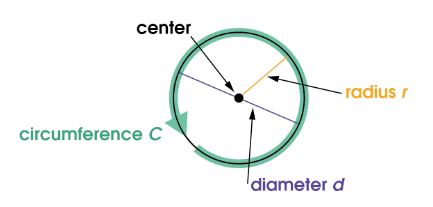
Key elements include:
- Radius (r): Distance from the center to any point on the circle
- Diameter (d): Twice the radius, passing through the center
- Circumference (C): The curved path around the circle
The Origins of the Circle
Linguistic Origins
The word circle traces back through multiple languages:
- Greek: kírkos ("ring") and krikos ("hoop") described curved shapes.
- Latin: Became circulus ("small ring") and circus ("enclosure").
Historical Origins
Circles were more than shapes — they symbolized unity and eternity across cultures.
- Prehistoric Times: Early humans observed the sun and moon, carving circular patterns into stone and building monuments like Stonehenge.
- Egyptians (~1700 BCE): The Rhind Papyrus recorded one of the earliest methods for approximating a circle's area.
- Babylonians: Used early values of π to calculate areas of circles.
- Ancient Greece (~300 BCE): Euclid's Elements formalized circle properties, while Archimedes used polygons to approximate π with precision.
- China (5th century CE): Mathematician Zu Chongzhi calculated π as 355/113, the most accurate approximation for nearly 1,000 years.
Who Discovered the Circle's Area Formula?
In the 3rd century BCE, Archimedes devised a brilliant way to calculate the area of a circle.
He imagined cutting a circle into countless thin wedges. When rearranged, the wedges resembled a triangle:
- The base was half the circumference: 𝜋𝒓
- The height was the radius: 𝒓
From this, Archimedes concluded:
- 𝑨 = 𝜋𝒓²
This insight was more than geometry — it was imagination. Archimedes turned a curved figure into a straight one, laying the foundation for calculus.
Circle Formulas: Circumference and Area
Building on Archimedes's insight, mathematicians formalized the formulas still taught today:
- Circumference: 𝑪 = 2𝜋𝒓, 𝑪 = 𝜋𝒅
- Area: 𝑨 = 𝜋𝒓²
These appear in middle school geometry and later bridge into trigonometry and calculus.
Circles in Art: Da Vinci's Vitruvian Man
One of the most iconic artistic uses of the circle is Leonardo da Vinci's Vitruvian Man (1490). Inspired by the Roman architect Vitruvius, da Vinci drew a human figure fitting perfectly inside both a circle and a square.
- The circle represented the cosmic and divine.
- The square symbolized the earthly and material.
The man's outstretched limbs touched the circle's edge, symbolizing harmony between the human body and the universe. This drawing united geometry, anatomy, and philosophy, proving that circles are not only mathematical objects but also enduring cultural symbols.
Why Circles Matter
Circles surround us in both function and design: the wheels that move us, the pizzas we share, the domes of architecture, and the gears that power machines. Ancient astronomers modeled the heavens with circles, and engineers today still rely on circular turbines and tracks.
For students, circles are often the first step into abstract reasoning. They learn about:
- π as a universal constant
- How radius, diameter, and circumference connect
- How visual proofs (like Archimedes's wedges) lead toward algebra and calculus
Later, the unit circle becomes the foundation of trigonometry, linking geometry with algebra. Concepts like arc length and sector area reappear in calculus, deepening understanding.
Try Pengi AI — Smarter Math Practice for Students
Pengi AI supports K–12 learners with personalized math practice, guided explanations, and feedback designed to help them build confidence and improve steadily.