Pengi Editor's Note: This article was originally published by Think Academy. We're sharing it here for educational value. Think Academy is a leading K-12 math education provider.
Common AMC 8 Mistakes: Why Strong Students Lose Points
Many students preparing for the AMC 8 are surprised by their results.
They understand school math.
They recognize most topics.
Yet their AMC 8 scores stall — often in the 12–16 range.
This usually leads to the wrong conclusion:
“I need to learn more math.”
In reality, most AMC 8 score loss does not come from missing content.
It comes from how students read, interpret, and approach problems under competition conditions.
AMC 8 is designed to reward structural thinking, efficiency, and decision-making — not just correct formulas.
Let’s look at what actually goes wrong.
What Do AMC 8 Mistakes Look Like in Practice?
Across hundreds of AMC 8 papers, student mistakes tend to cluster into a few repeatable patterns:
- Solving the right math for the wrong question
- Ignoring a single constraint word that changes everything
- Spending too long on easy problems
- Brute-forcing when structure or symmetry exists
- Running out of time despite knowing the material
- Making careless errors under pressure
- Treating AMC 8 like a school worksheet instead of a contest
These are not random errors.
They reflect how AMC 8 is intentionally designed.
Why AMC 8 Punishes These Mistakes
AMC 8 problems are not ordered by topic.
They are ordered by thinking demand.
Early questions test reading precision.
Middle questions test structure and modeling.
Later questions test insight, symmetry, and judgment.
Students who approach every problem the same way — even strong ones — are likely to lose points.
With that context, let’s break down the 7 most common AMC 8 mistake patterns, why they happen, and how to fix them.
Mistake #1: Misreading the Actual Question
This is the single most common AMC 8 error.
Students often calculate something meaningful — but not what the question asked.
Examples:
- Finding an intermediate value instead of the final result
- Calculating an area when the question asks for a ratio
- Ignoring units or the word “how many”
This happens frequently in:
- geometry
- statistics
- word problems
Why it happens
Students start calculating before fully processing the question.
How to fix it
Before solving, restate the question in one sentence:
“What exactly does my answer represent?”
If you cannot answer that clearly, don’t compute yet.
Mistake #2: Ignoring Constraints (“At Least”, “Exactly”, “Distinct”)
AMC 8 hides logic inside constraint words.
Commonly missed words:
- at least
- at most
- exactly
- distinct
- integer
- multiple of
Ignoring just one of these often makes a correct-looking solution invalid.
This mistake appears often in:
- counting
- inclusion–exclusion
- number theory
- optimization problems
Why it happens
Students read quickly and focus on numbers instead of language.
How to fix it
Train yourself to mentally highlight constraint words before touching the math.
Many AMC 8 problems are unsolvable without using the constraint correctly.
Mistake #3: Over-Solving Easy Questions
Some students lose the AMC 8 not on hard questions — but on time.
Common signs:
- Using algebra where arithmetic works
- Over-diagramming simple figures
- Rechecking early problems too many times
This leaves insufficient time for questions that actually determine score separation.
Why it happens
School math trains students to show full work, not to optimize time.
How to fix it
Problems 1–10 should feel efficient.
If an early solution feels long, you are probably over-solving.
Mistake #4: Brute-Forcing When Structure Exists
AMC 8 is designed to punish brute force.
This mistake shows up in:
- symmetry problems
- “sum of all” questions
- remainder problems
- counting and probability
Students try to list cases instead of recognizing:
- pairing
- cycles
- invariants
- symmetry
Why it happens
Students search for procedures instead of structure.
How to fix it
When a problem asks for all, total, or sum, pause.
Ask what stays the same across cases before computing anything.
Mistake #5: Poor Time Allocation Across Q1–25
AMC 8 difficulty increases quietly.
Common timing patterns:
- Too slow on Q1–10
- Rushing Q11–15
- Panicking on Q16–25
This is not a math problem. It’s a decision-making problem.
Why it happens
Students treat all questions as equal.
How to fix it
If no clear plan appears within ~30 seconds, mark the problem and move on.
Skipping is a strategic choice, not a failure.
Mistake #6: Careless Errors Under Pressure
Even top students lose points to:
- arithmetic slips
- sign errors
- copying mistakes
These usually occur late in the test or after time pressure builds.
Why it happens
Rushed execution, not weak understanding.
How to fix it
Slow down execution on multi-step problems.
Careless errors are best reduced by controlled pacing, not more practice.
Mistake #7: Treating AMC 8 Like a School Test
School math rewards:
- predictable formats
- formula recall
- step-by-step procedures
AMC 8 rewards:
- structural recognition
- flexible thinking
- choosing the right approach
Students who rely only on school methods often plateau.
How to fix it
Shift your mindset from
“Which formula do I use?”
to
“What is this problem really testing?”
Where Do These Mistakes Come From?
These mistakes are not random — they are tied to specific knowledge areas that AMC 8 repeatedly tests. The table below helps connect mistake patterns to underlying knowledge gaps:
AMC 8 Knowledge Areas That Commonly Trigger Mistakes
| Knowledge Area | Typical AMC 8 Topics | Mistakes It Often Causes |
|---|---|---|
| Sequences & Patterns | Arithmetic, geometric, recursive sequences | Pattern guessing, wrong formula choice |
| Rates & Motion | Distance–rate–time, relative speed | Wrong variable setup, ratio confusion |
| Percentages & Ratios | Discounts, profit, percent change | Wrong base value, formula misuse |
| Optimization | Maximum/minimum problems | Missing boundary cases |
| Statistics | Mean, median, tables | Misreading data relationships |
| Composite Geometry | Perimeter and area | Double counting, missing edges |
| Coordinate Geometry | Area by coordinates | Missing intersections |
| Similarity | Similar triangles, scale factors | Side vs area ratio confusion |
| Counting & Probability | Counting principles, probability | Brute force, missing cases |
| Number Theory | Divisibility, remainders, parity | Not recognizing modular structure |
This table is not meant to overwhelm.
It helps you answer one key question:
Which knowledge areas are causing which types of mistakes for you?
How to Use This Framework Effectively
Don’t try to fix everything at once.
A better approach:
- Identify your top 2–3 mistake patterns
- Find the related knowledge areas
- Practice with awareness, not speed
As reading, structure recognition, and timing improve, content gaps shrink naturally.
Next Step: Diagnose Your AMC 8 Mistakes Precisely
To improve efficiently:
- Practice with official AMC 8 past papers
- Label each error by mistake type, not just topic
- Then take Think Academy’s free math evaluation to identify:
- which mistake patterns limit your score
- which knowledge areas matter most at your level
- how to prepare strategically instead of blindly
Download AMC 8 Past Papers
Download 2025 AMC 8 Problems & Solution
Download 2024 AMC 8 Problems & Solution
Download 2023 AMC 8 Problems & Solution
Download 2022 AMC 8 Problems & Solution
Download 2020 AMC 8 Problems & Solution
Download 2019 AMC 8 Problems & Solution
Download 2018 AMC 8 Problems & Solution
Download 2017 AMC 8 Problems & Solution
Download 2016 AMC 8 Problems & Solution
Notes: The AMC series adjusted its schedule, with the 2021 exam held in early 2022, so no separate 2021 test paper exists.
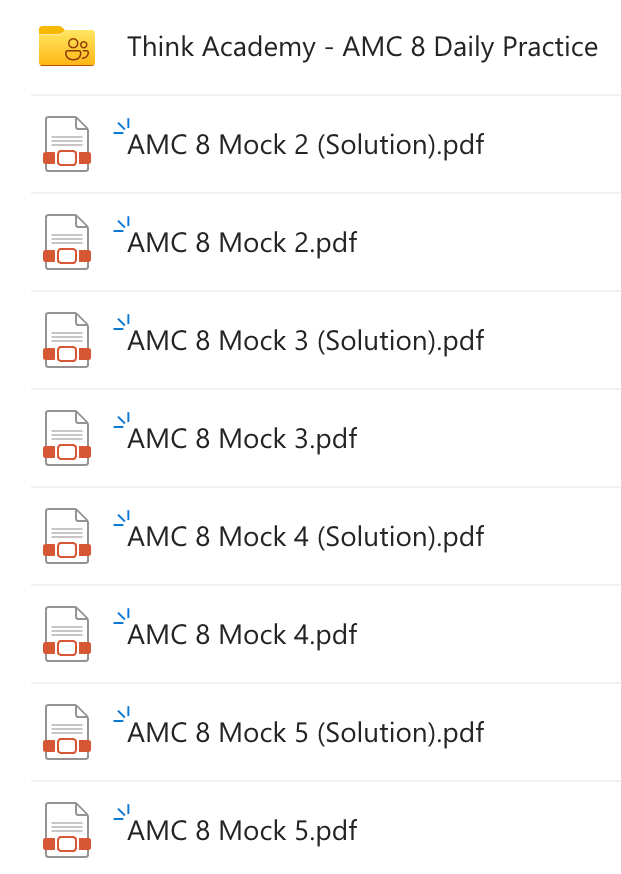
Download AMC 8 Mock Exams & Daily Practice Pack
Targeted AMC 8 preparation requires both daily skill-building and timed mock exam training. Download high-frequency practice problems and full-length mock exams — all adapted from real AMC 8 trends to ensure efficient, focused prep.
- Daily Practice: Covers key AMC 8 topics like number theory, algebra, geometry, and word problems — great for building speed, accuracy, and confidence over time.
- Mock Exams: Timed practice helps students simulate real test conditions, improve pacing, and reduce careless mistakes.
*Please enter a valid email address to access the materials and receive future prep updates.
AMC 8 Resources Pack
Free Download
AMC 8 Mock Exams & Daily Practice
Parent's Email Address: *
Zip Code *
Phone Number (Optional)
Student's First Name *
Student's Last Name *
Student’s Grade *
Pre-K3Pre-K4KindergartenGrade 1Grade 2Grade 3Grade 4Grade 5Grade 6Grade 7Grade 8Grade 9Grade 10Grade 11Grade 12
By submitting the form, you'll join our mailing list for free math worksheets, educational trends, event updates, and more. You can unsubscribe anytime.
Submit
After submission, the download link is in the confirmation message on this page.
Thank You for Completing the Form!You can download the resource using this link: bit.ly/AMC8-Resources-Pack-Think-Academy Password: ThinkAMC8pv9kyo×
Oops! Something went wrong. Please try again later.
×
For more detailed module resources, please visit the All-in-one AMC8 Resource Hub, featuring module practice, mock tests, and biweekly updates.
Try Pengi AI — Smarter Math Practice for Students
Pengi AI supports K–12 learners with personalized math practice, guided explanations, and feedback designed to help them build confidence and improve steadily.