Pengi Editor's Note: This article was originally published by Think Academy. We're sharing it here for educational value. Think Academy is a leading K-12 math education provider.
Gifted Programs vs. Acceleration vs. Enrichment: How to Choose the Best Path for K-12 Students
Parents of high-achieving children frequently encounter three distinct educational approaches: gifted programs, academic acceleration, and enrichment. While these terms are sometimes used interchangeably, they represent meaningfully different strategies — each with distinct benefits, trade-offs, and ideal use cases.
Pengi AI — AI-powered personalized math tutoring platform that adapts to each student's level, offering 24/7 practice and instant feedback.
Defining the Three Approaches
Gifted Programs
Gifted programs are formal educational designations, typically requiring identification through testing (IQ assessments, achievement tests, or multi-measure evaluations). Students identified as gifted receive specialized instruction, often in separate classes or schools, designed to meet their learning needs.
Key characteristics:
- Formal identification process required
- Often funded by state or district
- May include pull-out programs, self-contained gifted classrooms, or gifted magnet schools
- Focus on developing advanced learners' potential holistically
Academic Acceleration
Acceleration means moving through academic content at a faster pace than typical peers. It can take many forms:
- Grade skipping: Advancing a student one or more grades
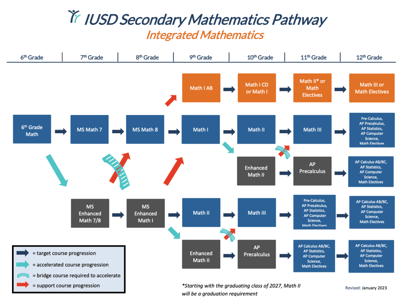
- Subject acceleration: Taking a higher-grade course in one subject (e.g., a 6th grader taking 8th grade math)
- Early college enrollment: Taking community college or university courses while in high school
- Dual enrollment: Earning college credit during high school
Key characteristics:
- Focuses on pacing and content advancement
- Can be done without formal "gifted" identification
- Most common form: math and reading subject acceleration
Enrichment
Enrichment expands and deepens the curriculum without moving faster. Enrichment programs offer students more challenging, complex, and creative learning experiences within or alongside their regular grade level.
Key characteristics:
- Does not require formal identification (though some programs prioritize advanced students)
- Adds depth and breadth rather than speed
- Can include extracurricular programs, competition prep, project-based learning
- Examples: Math Kangaroo prep, science fairs, debate, writing competitions
Comparing the Three Approaches
| Dimension | Gifted Programs | Acceleration | Enrichment |
|---|---|---|---|
| Identification needed | Yes (formal testing) | Often (for school programs) | Usually No |
| Pacing | Often faster | Faster | Same or self-directed |
| Depth | Varies | Less emphasis | Primary focus |
| Cost | Free (in public schools) | Free–moderate | Free–significant |
| Social implications | Peer group changes | Potential social concerns | Minimal |
| Best for | Broadly gifted students | Students far ahead in content | Students wanting deeper mastery |
When Is Gifted Program Placement the Right Choice?
Gifted program placement makes the most sense when:
- Your child demonstrates consistently advanced abilities across multiple domains
- The standard curriculum is causing disengagement, boredom, or behavioral issues
- Your school district offers a high-quality gifted program with qualified teachers
Caution: Not all gifted programs are equal in quality. A "gifted" label in one district may mean substantively different things than in another.
When Is Acceleration the Right Choice?
Acceleration (particularly subject acceleration in math) tends to work well when:
- A student has demonstrably mastered current grade-level content
- The student is emotionally mature enough to handle advanced content and peer dynamics
- The subject acceleration is supported by strong foundational skills (not just speed)
Caution: Accelerating in math without ensuring deep conceptual understanding can create gaps that surface in later years. True mastery — not just procedural fluency — should precede acceleration.
When Is Enrichment the Right Choice?
Enrichment is often the most appropriate choice when:
- A student is advanced in one or two subjects but not globally gifted
- A student needs depth and breadth, not just faster pacing
- A family wants to supplement school learning without formal identification
- A student is motivated by curiosity and challenge, not just advancement
Enrichment is also valuable as a complement to both gifted programs and acceleration.
The Hybrid Approach
Many high-performing families use a combination of all three:
- Gifted program for school-day learning
- Subject acceleration in mathematics (one or two years ahead of grade level)
- Enrichment through after-school programs, competitions, and independent projects
This combination provides both appropriate pacing and genuine depth — which neither acceleration nor gifted programs alone typically deliver.
Common Mistakes to Avoid
- Confusing speed with depth: Finishing a curriculum faster does not guarantee mathematical understanding or problem-solving ability.
- Chasing labels: The goal is appropriate challenge and engagement, not the prestige of a "gifted" designation.
- Ignoring social-emotional needs: Highly gifted students may struggle socially if placed too far ahead of peers. Balance academic needs with developmental readiness.
- Underestimating enrichment: Many families overlook enrichment in favor of formal acceleration, missing the deeper mathematical thinking that non-routine problems develop.
Try Pengi AI — Smarter Math Practice for Students
Pengi AI supports K–12 learners with personalized math practice, guided explanations, and feedback designed to help them build confidence and improve steadily.