Pengi Editor's Note: This article was originally published by Think Academy. We're sharing it here for educational value. Think Academy is a leading K-12 math education provider.
How to Solve Equations with Parentheses in 4 Simple Steps
Equations are one of the most important tools in math. They allow us to describe relationships, balance values, and solve for unknowns. In this blog, we’ll explain what equations are, what solutions and like terms mean, and walk through a clear four-step method for solving equations with parentheses—complete with worked examples and practice problems.
What Is an Equation?
An equation is a mathematical sentence that says two expressions are equal. It has an equal sign in the middle.
Example:
4(5𝑥 − 3𝑥 + 1 + 3) = 3(𝑥 + 2𝑥 − 11 + 14)
What Is a Solution?
A solution is the number that makes the equation true.
For example, in:
𝑥 + 5 = 12,
the solution is 𝑥 =7, because 7 + 5 = 12.
What Are Like Terms?
Like terms are terms that have the same variables raised to the same powers. Constants are also like terms. Combining like terms makes calculations easier.
For example, in
4(5𝑥 − 3𝑥 + 1 + 3) = 3(𝑥 + 2𝑥 − 11 + 14),
- Inside the left parentheses: Equation: 5𝑥 and Equation: −3𝑥 are like terms, and Equation: 1 and Equation: 3 are like terms.
- Inside the right parentheses: Equation: 𝑥 and Equation: 2𝑥 are like terms, and Equation: −11 and Equation: 14 are like terms.
Four Steps to Solve Equations with Parentheses
Let’s continue with this example:
4(5𝑥 − 3𝑥 + 1 + 3) = 3(𝑥 + 2𝑥 − 11 + 14)
Step 1: Combine Like Terms Inside Parentheses

We can combine like terms inside the parentheses right away. If there are like terms outside different parentheses, we’ll need to remove the parentheses first (by distributing) before combining them.
Therefore:
4(2𝑥 + 4) = 3(3𝑥 + 3)
Step 2: Remove Parentheses by Distributive Property
Multiply the number outside the parentheses by each term inside:
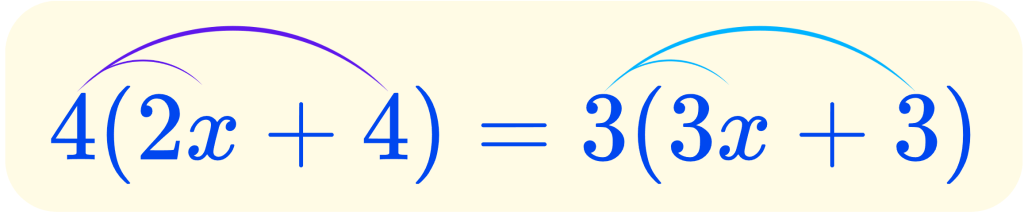
Therefore:
8𝑥 + 16 = 9𝑥 + 9
Step 3: Move Variables to the Left Side, Constants to the Right
Move the variable terms to the left
Subtract 9𝑥 from both sides:
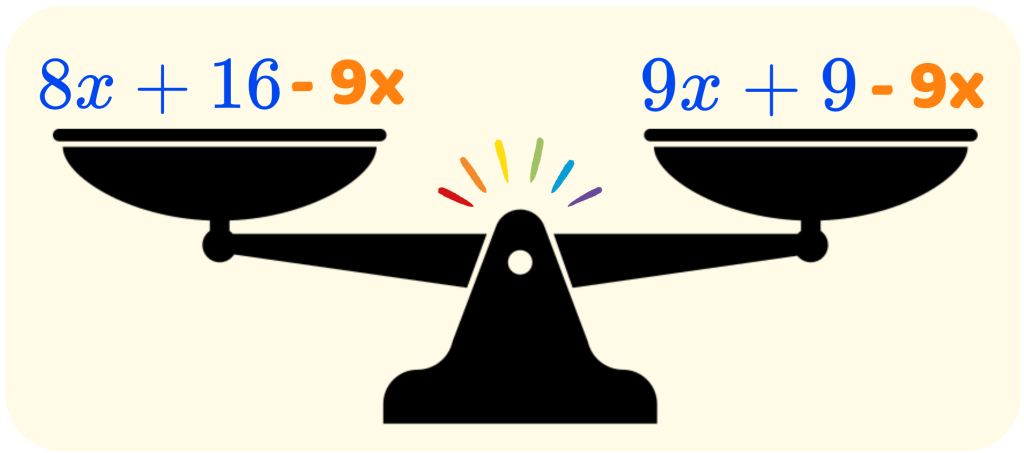
Therefore:
−𝑥 + 16 = 9
Move the constants to the right
Subtract 16 from both sides:
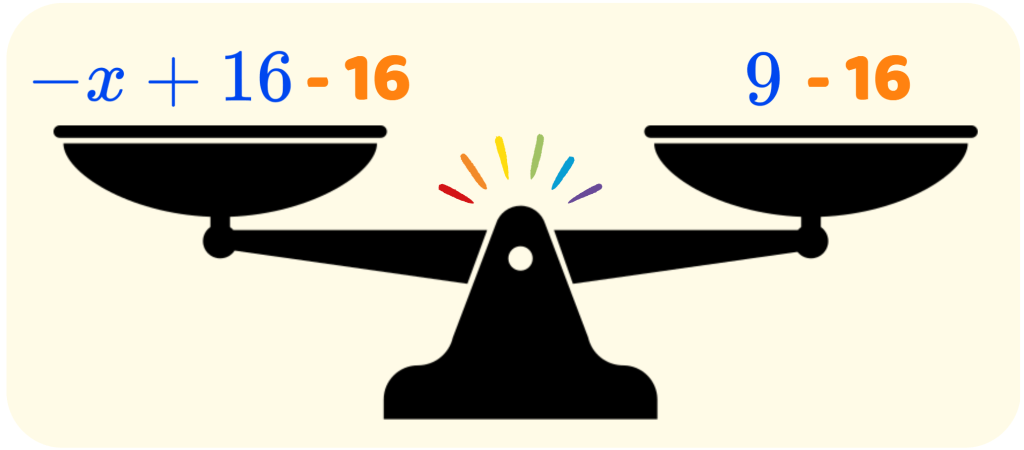
Therefore:
−𝑥 = −7
Step 4: Solve for the Variable
Divide both sides of the equation by the coefficient-1to get the final answer:
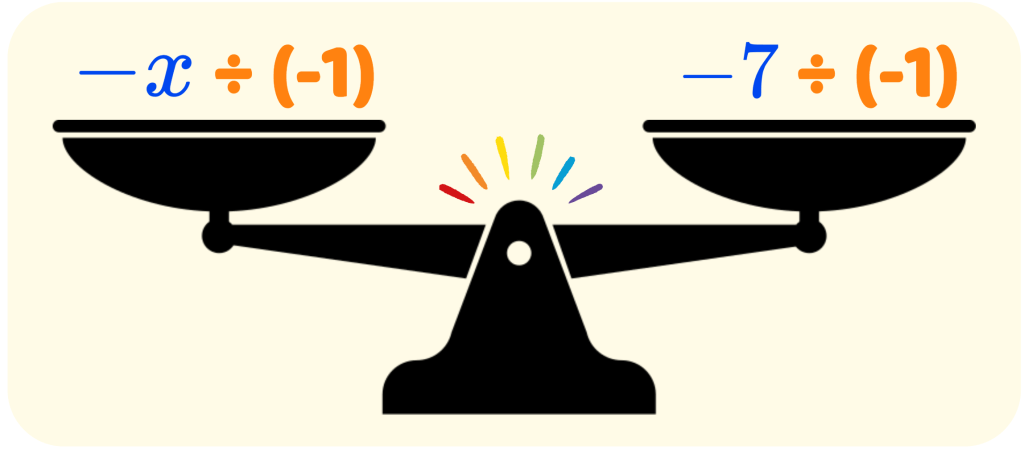
Therefore:
𝑥 = 7
Example Problems: How to Solve Equations with Parentheses
Example 1
Find the solution to the equation:
3(2𝑥 − 𝑥 + 2) = 2(𝑥 + 10 − 3)
Solution:
Step 1: Combine like terms inside parentheses
3(𝑥 + 2) = 2(𝑥 + 7)
Step 2: Remove parentheses by distributing
3𝑥 + 6 = 2𝑥 + 14
Step 3: Move variables left, constants right:
3𝑥 + 6 – 2𝑥 = 2𝑥 + 14 – 2𝑥
𝑥 + 6 = 14
𝑥 + 6 – 6= 14 – 6
𝑥 = 8
Step 4: Solve for the variable
The final result is 𝑥 = 8.
Example 2
Find the solution to the equation:
4(3𝑦 − 2𝑦 + 5) = 2(4𝑦 − 3𝑦 + 8 − 4)
Solution:
Step 1: Combine like terms inside parentheses
4(𝑦 + 5) = 2(𝑦 + 4)
Step 2: Remove parentheses by distributing
4𝑦 + 20 = 2𝑦 + 8
Step 3: Move variables left, constants right
4𝑦 + 20 – 2𝑦 = 2𝑦 + 8 – 2𝑦
2𝑦 + 20 = 8
2𝑦 + 20 – 20 = 8 – 20
2𝑦 = -12
Step 4: Solve for the variable
2𝑦 ÷ 2 = −12 ÷ 2
𝑦 = −6
The final result is 𝑦 = −6.
Summary: How to Solve Equations with Parentheses
When solving equations with parentheses:
- Combine like terms inside parentheses first.
- Distribute numbers outside the parentheses to remove them.
- Rearrange the equation so all variables are on one side and constants on the other.
- Solve by dividing the constant by the coefficient of the variable.
Want more printable practice?
Try Pengi AI — Smarter Math Practice for Students
Pengi AI supports K–12 learners with personalized math practice, guided explanations, and feedback designed to help them build confidence and improve steadily.