Pengi Editor's Note: This article was originally published by Think Academy. We're sharing it here for educational value. Think Academy is a leading K-12 math education provider.
How to Solve One-Variable Linear Inequalities
By Grade 7 at Think Academy (Grade 8 in school), students work with one-variable linear inequalities. The challenge is not the arithmetic itself but remembering the rules—many forget to flip the inequality sign when multiplying or dividing by negatives, or mix up the direction of shading on number lines. This guide breaks down the steps so those mistakes don’t block progress.
What Are Inequalities?
An inequality is like an equation, but instead of showing two sides are equal, it shows that one side is bigger, smaller, or possibly equal to the other.

Inequalities describe a range of possible answers, not just one solution.
What Is the Solution to an Inequality?
The solution to an inequality is all the values of the variable that make the statement true.
For example:
𝑥 > 5
means any number greater than 5 works.
Note the position of the variable and the number:
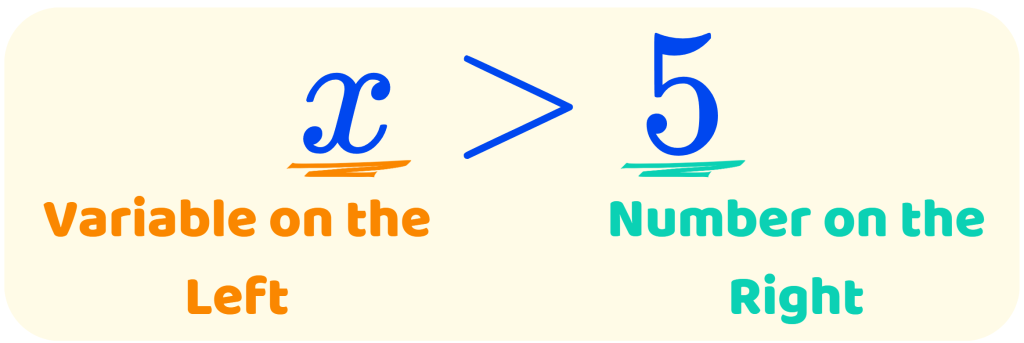
This makes our answer easier to read and avoids confusion.
For example, if our work leads to:
5 < 𝑥,
flip and rewrite it as:
𝑥 > 5.
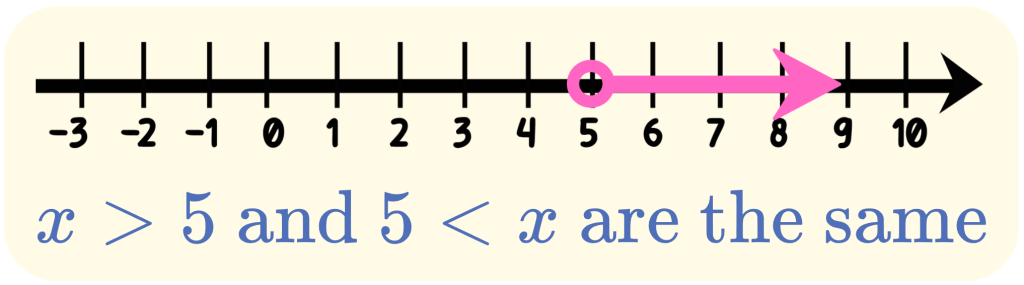
The inequality sign retains its original meaning: the larger side continues to point toward the larger quantity, and the smaller side continues to point toward the smaller quantity.
How to Solve One-Variable Linear Inequalities
Solving inequalities is very similar to solving equations. The difference is that we must be careful about the direction of the inequality sign.
Addition
Adding the same number to both sides does not change the inequality sign.
𝑥 – 3 > 7
Add 3 to both sides:
𝑥 – 3 + 3 > 7 + 3
𝑥 > 10
Subtraction
Subtracting the same number from both sides also does not change the inequality sign.
𝑥 + 4 ≤ 12
Subtract 4 from both sides:
𝑥 + 4 − 4 ≤ 12 − 4
𝑥 ≤ 8
Multiplication
- If we multiply both sides by a positive number, the inequality direction stays the same.
\[\frac{1}{2}x < 5\]
\[\frac{1}{2}x \cdot 2 < 5 \cdot 2\]
𝑥 < 10
- If we multiply both sides by a negative number, reverse the inequality sign.
\[-\frac{1}{3}x > 7\]
Multiply both sides by -3:
\[\left(-\frac{1}{3}x\right) \cdot (-3) < (7) \cdot (-3)\]
x < -21
Division
The rules are the same as multiplication:
- Divide by a positive number → sign stays the same.
2𝑥 ≥ 10
Divide both sides by 2:
2𝑥 ÷ 2 ≥ 10 ÷ 2
𝑥 ≥ 5
- Divide by a negative number → sign flips.
−3𝑥 < −6
Divide both sides by -3:
(−3𝑥) ÷ (−3) > (−6) ÷ (−3)
𝑥 > 2
Example Problems: Solving One-Variable Linear Inequalities
Example 1
Solve the inequality and graph the solution on the number line.
5𝑥 – 7 > 8
Solution:
Add 7 to both sides:
5𝑥 – 7 + 7 > 8 + 7
5𝑥 > 15
Divide both sides by 5:
5𝑥 ÷ 5 > 15 ÷ 5
𝑥 > 3

Example 2
Solve the inequality and graph the solution on the number line.
−2𝑥 + 4 ≤ 10
Solution:
Subtract 4 from both sides:
−2𝑥 + 4 − 4 ≤ 10 − 4
−2𝑥 ≤ 6
Divide both sides by -2 and flip sign:
(−2𝑥) ÷ (−2) ≥ 6 ÷ (−2)
𝑥 ≥ −3

Summary: Solving One-Variable Linear Inequalities
When solving inequalities:
- Adding or subtracting any number → inequality sign stays the same.
- Multiplying or dividing by a positive number → inequality sign stays the same.
- Multiplying or dividing by a negative number → inequality sign flips.
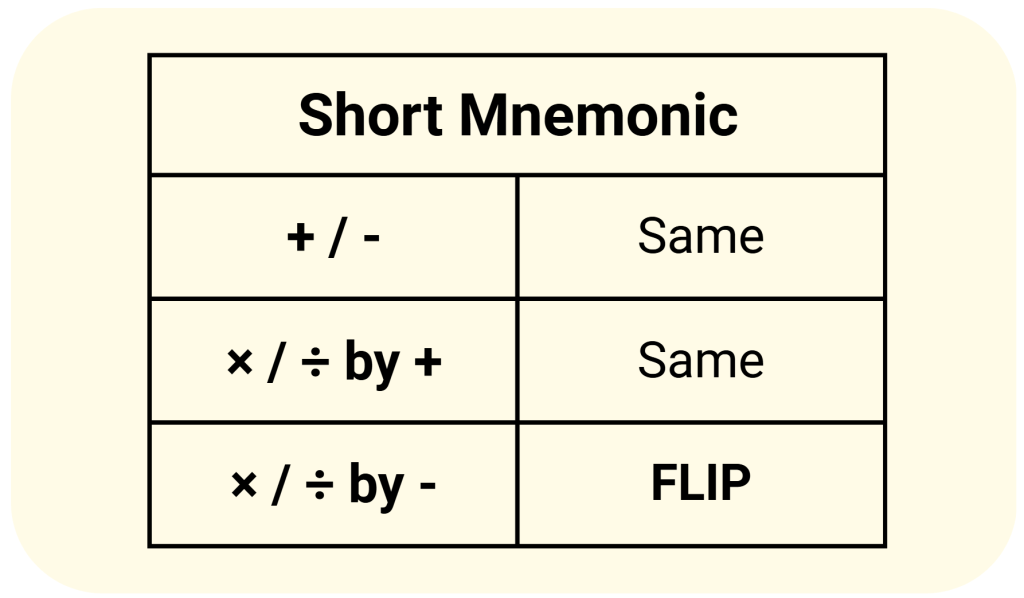
Want more printable practice?
Additional Math Topics for Grade 8 – with Free Worksheets
Try Pengi AI — Smarter Math Practice for Students
Pengi AI supports K–12 learners with personalized math practice, guided explanations, and feedback designed to help them build confidence and improve steadily.