Pengi Editor's Note: This article was originally published by Think Academy. We're sharing it here for educational value. Think Academy is a leading K-12 math education provider.
How to Solve Quadratic Equations: Forms and Methods
If you’ve ever opened Google and seen its logo come alive with animation, you’ve experienced a Google Doodle—those playful redesigns that celebrate everything from holidays to history-makers. Since the very first Doodle in 1998, more than 5,000 have appeared, from Pac-Man to the Olympics. On September 8, 2025, Google gave math its moment in the spotlight with the Quadratic Equation Doodle. The letters of “Google” became part of a basketball shot tracing a perfect parabola, a clever nod to how the quadratic formula describes real-world motion.
But let’s be real—we’re not here to analyze Google’s logo. We’re an online math class brand, and today’s spotlight is on the quadratic equation itself. Quadratic equations are a cornerstone of Algebra, showing up in everything from projectiles to area optimization.
In this guide, we’ll explain what a quadratic equation is, what the quadratic graph (parabola) looks like, when students typically learn quadratics in U.S. schools, why they can be challenging, and the three main solving methods—factoring, using the quadratic formula, and completing the square—with examples of each step.
What Is a Quadratic Equation?
A quadratic equation is a polynomial equation of degree two, written as:
𝑎𝑥² + 𝑏𝑥 + 𝑐 = 0, 𝑎 ≠ 0
- 𝑎, 𝑏, 𝑐 are constants, 𝑎 is not equal to zero.
- 𝑥 is the variable.
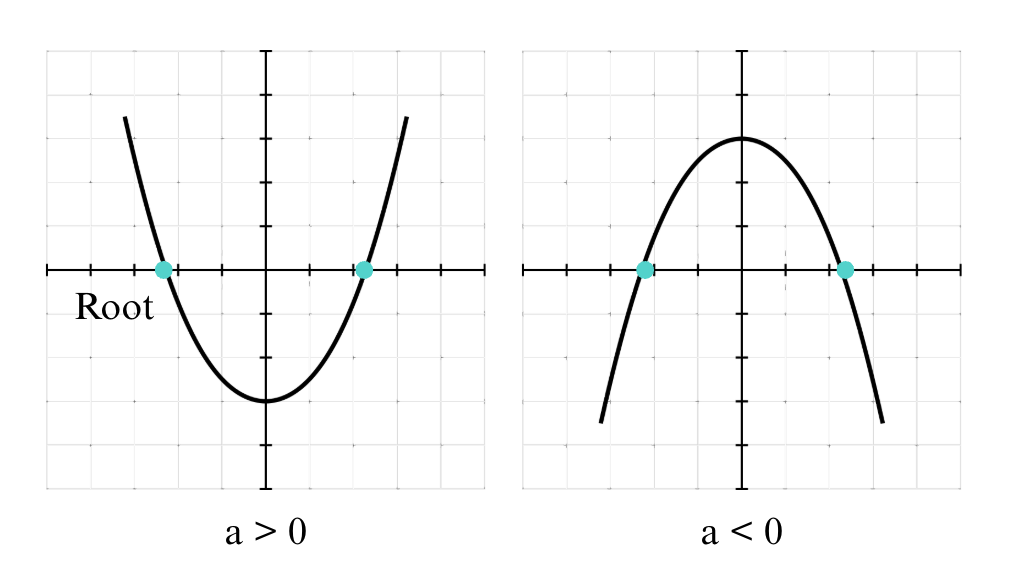
- The solutions (roots) are the 𝑥-values where the parabola crosses the x-axis.
How to Graph a Quadratic Function (Parabola Explained)
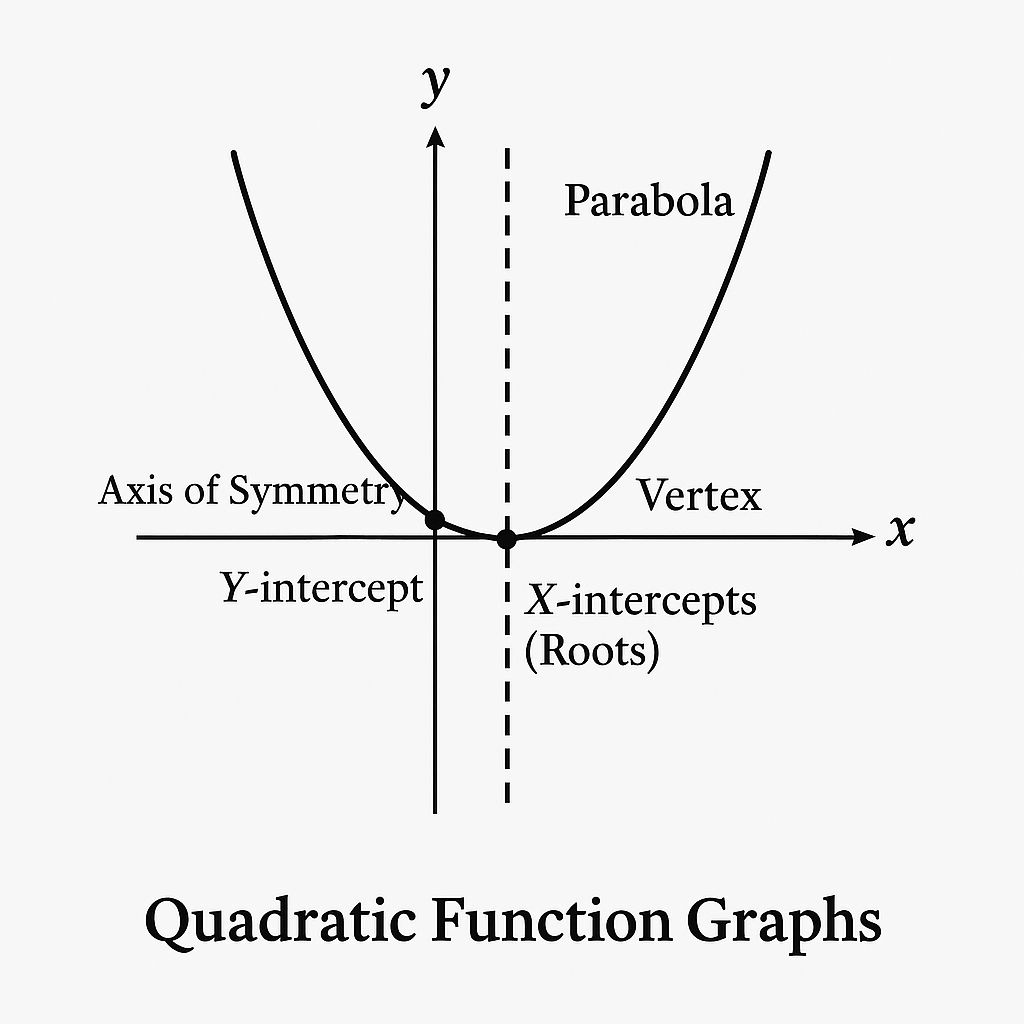
The graph of a quadratic equation is a U-shaped curve called a parabola. Every parabola has key features that make it easier to analyze and graph.
Key Features of a Parabola
- Parabola: The U-shaped curve formed by graphing a quadratic function.
- Vertex: The turning point of the parabola, which is the minimum (if it opens upward) or maximum (if it opens downward).
- Axis of Symmetry: A vertical line that divides the parabola into two mirror halves. If the vertex is (ℎ, 𝑘), the axis of symmetry is 𝑥 = ℎ.
- Opening Direction:
- If 𝑎 > 0 in the quadratic equation 𝑓(𝑥) = 𝑎𝑥² + 𝑏𝑥 + 𝑐, the parabola opens upward.
- If 𝑎 < 0, the parabola opens downward.
- Intercepts:
- Y-intercept: The point where the parabola crosses the y-axis (set 𝑥 = 0).
- X-intercepts (Roots): The points where the parabola crosses the x-axis. These can be found by solving the quadratic equation.
Types of Quadratic Functions
Quadratic equations can be expressed in three common forms. Each highlights different properties of the parabola.
| Form | Equation | What It Shows | When It’s Useful |
|---|---|---|---|
| Standard Form | 𝑎𝑥² + 𝑏𝑥 + 𝑐 = 0 | Coefficients 𝑎, 𝑏, 𝑐 | Using the quadratic formula; identifying coefficients |
| Vertex Form | 𝑎(𝑥 − ℎ)² + 𝑘 = 0 | Vertex at (ℎ, 𝑘) | Graphing; finding the vertex directly |
| Factored (Intercept) Form | 𝑎(𝑥 − 𝑝)(𝑥 − 𝑞) = 0 | Roots (𝑝, 𝑞) | Quickly identifying x-intercepts |
When Do Students Learn Quadratic Equations?
Quadratic equations are usually introduced in Algebra 1.
- Public schools: Typically taught in high school (9th–10th grade), or as early as 8th grade in accelerated tracks.
- Private/advanced programs: Sometimes introduced as early as 7th grade.
- Quadratics return in later courses such as Geometry, Algebra II, Pre-Calculus, and also appear on standardized tests like the SAT and ACT.
Why Are Quadratic Equations Challenging?
Students often struggle because:
- Multiple solving methods can feel confusing.
- Negative signs and square roots lead to mistakes.
- Graphing links algebra with geometry
- The discriminant introduces abstract cases with complex solutions.
- Set real world model by quadratic equations
How to Solve Quadratic Equations
1. Factoring
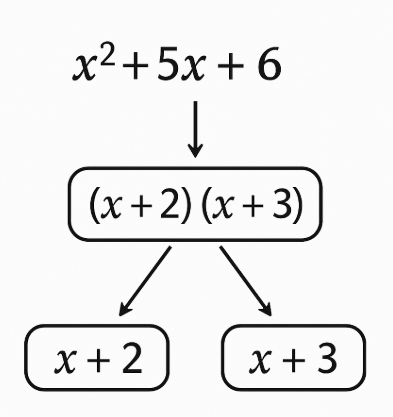
If the quadratic factors neatly, this is the quickest method.
Example:
𝑥² + 5𝑥 + 6 = 0
(𝑥 + 2)(𝑥 + 3) = 0 ⇒ 𝑥 = −2, −3
2. Quadratic Formula
The universal method for solving a quadratic equation is:
\[ x = \frac{-b \pm \sqrt{b^{2} – 4ac}}{2a} \]
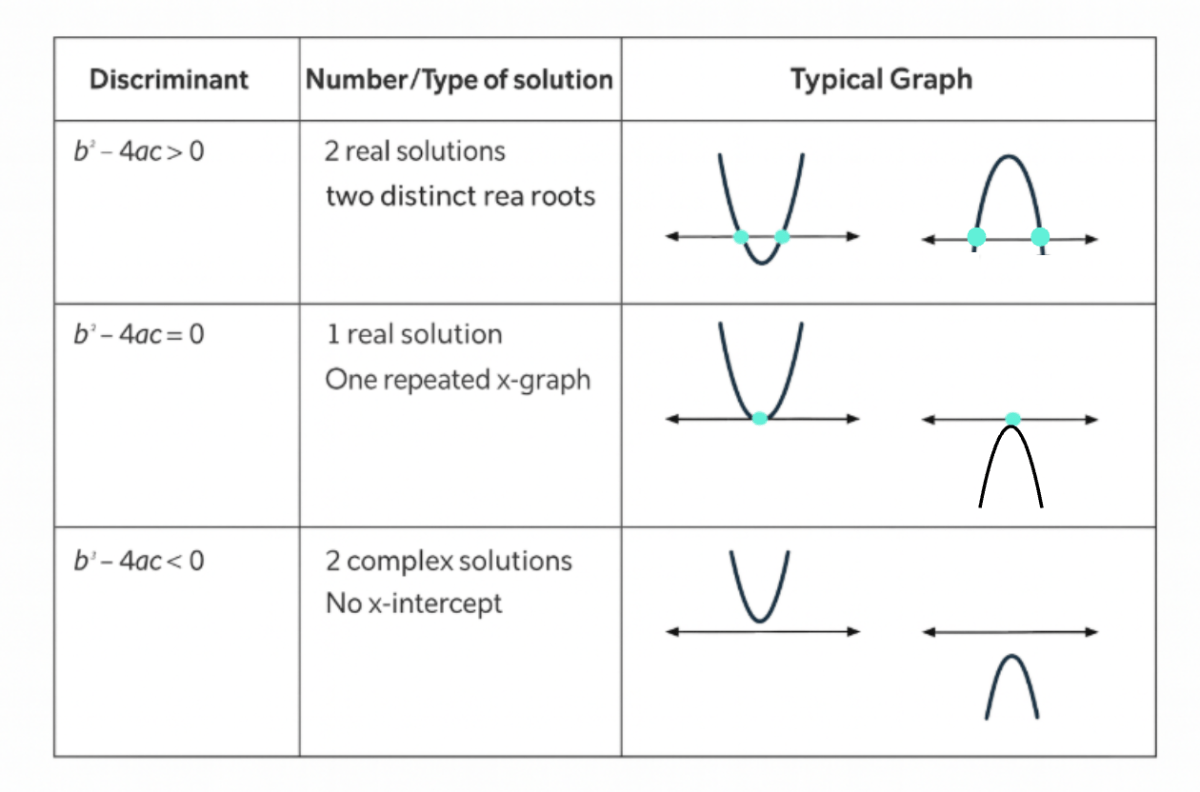
The part under the square root, 𝑏² − 4𝑎𝑐, is called the discriminant.
Why does the discriminant matter?
- If 𝑏² − 4𝑎𝑐 > 0 → two distinct real roots
- If 𝑏² − 4𝑎𝑐 = 0 → one repeated real root
- If 𝑏² − 4𝑎𝑐 < 0 → two complex roots
3. Completing the Square
This rewrites the quadratic as a perfect square trinomial.
Example:
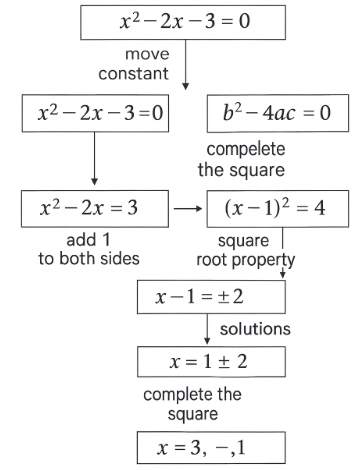
𝑥² − 2𝑥 − 3 = 0
𝑥² − 2𝑥 = 3
𝑥² − 2𝑥 + 1 = 4
(𝑥 − 1)² = 4 ⇒ 𝑥 = 1 ± 2
Final result: 𝑥 = 3, −1
Example: Three Ways of Solving the Same Quadratic
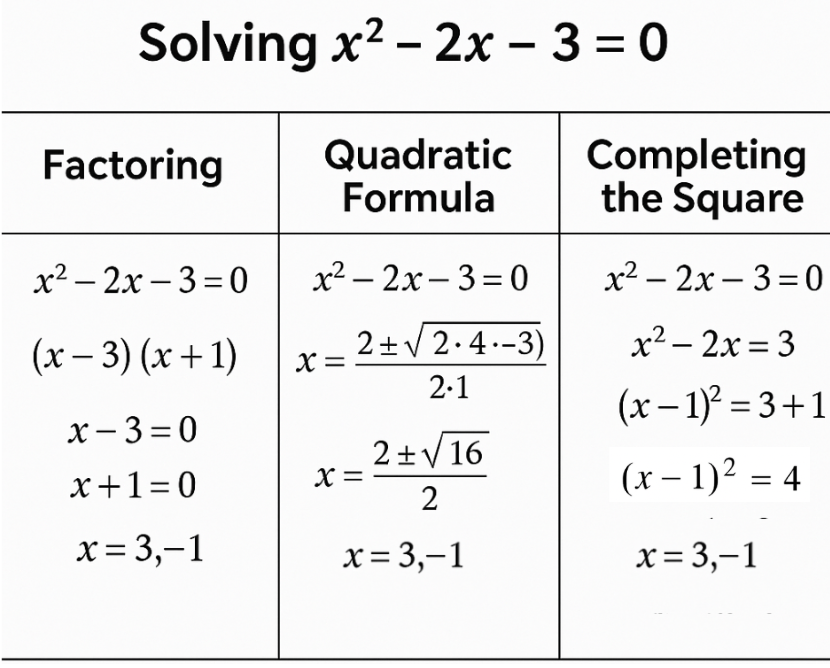
Problem:
Solve the equation
𝑥² − 2𝑥 − 3 = 0
Solution:
Factoring
(𝑥 − 3)(𝑥 + 1) = 0 ⇒ 𝑥 = 3, −1
Apply Quadratic Formula
\[ x = \frac{-(-2) \pm \sqrt{(-2)^{2} – 4(1)(-3)}}{2(1)} \]
⇒ 𝑥 = 3, −1
Completing the Square
(𝑥 − 1)² = 4 ⇒ 𝑥 = 3, −1
Summary: Key Takeaways of Quadratic Equations
- Quadratics have the form 𝑎𝑥² + 𝑏𝑥 + 𝑐 = 0.
- Factoring is fastest but not always possible
- The quadratic formula always works
- The discriminant shows whether solutions are two real, one repeated, or complex
- Completing the square connects algebra with graphing
Additional Math Topics for Algebra I – Free Worksheets
More Middle School Algebra Resources Ready for You
We’ve created a full library of printable resources — from foundational math to logic-based challenges — organized by grade to support every stage of your child’s journey.
Explore the K–12 Worksheets Hub
More related articles
- How to Multiply Polynomials: From 1 Term to 3 Terms
- Polynomial Multiplication in Algebra: Formulas, Examples, and AMC 10 Applications
- How to Divide a Polynomial by a Monomial in 2 Simple Steps
- How to Divide Polynomials in 4 Simple Steps
Think Academy Math Program
If you’re looking to build on math strengths or close math gaps, we offer comprehensive K–12 math programs designed to:
- Catch up: Fill in gaps and strengthen foundational skills
- Stay ahead: Maintain a competitive edge and accelerate math progress
- Go further: Take on challenge math competitions, Math kangaroo, AMC competitions
Next Step: Take a personalized evaluation to understand your child’s current math progress and get a tailored roadmap for courses, pacing, and goals.
Try Pengi AI — Smarter Math Practice for Students
Pengi AI supports K–12 learners with personalized math practice, guided explanations, and feedback designed to help them build confidence and improve steadily.