Pengi Editor's Note
This guide from Think Academy covers parallel and perpendicular linear functions — a key Algebra 1 topic that trips up many students. The Pengi editorial team selected it for its clear step-by-step examples and practical worked problems that directly map to middle and high school curriculum.
Source: Think Academy Blog
Linear Functions: Parallel and Perpendicular Lines Explained
Parallel and perpendicular lines are everywhere in Algebra 1. In this guide, we'll explain how to recognize them, write their equations, and solve problems step by step — with examples and free worksheets.
What Are Parallel Linear Functions?
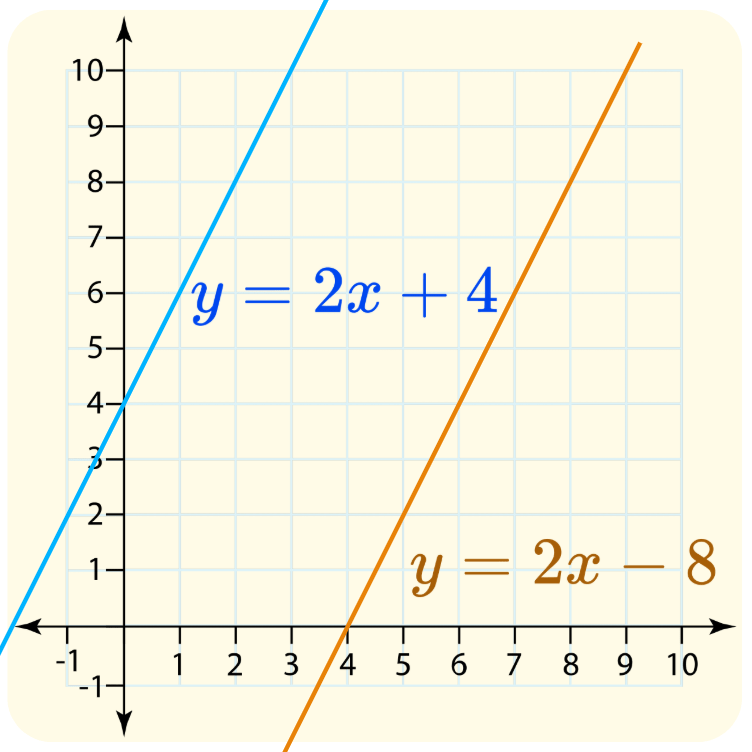
Parallel lines are lines that never meet. They stay the same distance apart forever. In math, this means parallel linear functions have the exact same slope, but different y-intercepts. (If the y-intercepts were also the same, we would have just one line!)
If two lines are parallel, their equations will look like this:
[ y = m_1x + b_1 \quad \text{and} \quad y = m_2x + b_2 ]
And the key rule is:
[ m_1 = m_2,\quad b_1 \neq b_2 ]
What Are Perpendicular Linear Functions?
Perpendicular lines are lines that meet at a right angle (90°). In math, this means their slopes are negative reciprocals of each other. When we multiply the two slopes together, the result is -1.
If two lines are perpendicular, their equations will look like:
[ y = m_1x + b_1 \quad \text{and} \quad y = m_2x + b_2 ]
And the key rule is:
[ m_1 \cdot m_2 = -1 ]
Example Problems (with Solutions): Parallel & Perpendicular Linear Functions
Example 1 – Parallel Line through a Point
Problem:
Find the equation of the line parallel to y = 3x – 2 that goes through the point (1, 4).
Solution:
Step 1: Use the same slope (parallel means same slope)
m = 3
Step 2: Use point-slope form
y − y₁ = m(x − x₁)
y – 4 = 3(x – 1)
Step 3: Simplify
y = 3x + 1
Final result: y = 3x + 1
Example 2 – Perpendicular Line through a Point
Problem:
Find the equation of the line perpendicular to (y = -\frac{1}{4}x + 6) that passes through the point (2, 3).
Solution:
Step 1: Take the negative reciprocal of the slope:
[m = -1 \div \left(\frac{1}{4}\right) = 4]
Step 2: Use point-slope form:
y – 3 = 4(x – 2)
Step 3: Simplify:
y = 4x – 5
Final result: y = 4x – 5
Summary: Keys to Parallel & Perpendicular Linear Functions
- Parallel Lines → Same slope
- Perpendicular Lines → Slopes are negative reciprocals
- Use point-slope form to find the equation when given a point
Additional Math Topics for Algebra 1
More related articles from Think Academy:
- How to Represent Linear Functions: Slope-Intercept vs Point-Slope Form
- Different Forms of Linear Functions: Standard, Slope-Intercept & Point-Slope
- How to Graph and Solve a Linear Function Step by Step
Try Pengi AI — Smarter Math Practice for Students
Pengi AI supports K–12 learners with personalized math practice, guided explanations, and feedback designed to help them build confidence and improve steadily.