Pengi Editor's Note: This article was originally published by Think Academy. We're sharing it here for educational value. Think Academy is a leading K-12 math education provider.
Math Kangaroo 5-Point Questions: The Most Common Types + How to Solve Them
If you want your child to win a Math Kangaroo award this year, what do you think matters most? Is it solving problems faster? Is it practicing thousands of questions until they’ve seen every possible scenario?
Before you answer, ask yourself: Do you truly understand how the scoring system shapes the competition?
Here is the reality: For competitive students, the first two-thirds of the test—the 3-point and 4-point questions—are just the “price of admission.” Most top candidates will get those right. The difference between a participation certificate and a National Top 20 award comes down to one specific area: The 5-Point Questions.
In this article, we’re going to decode this critical section. We will explain exactly why the 5-point questions are the “award deciders” and show you that success here isn’t about memorizing more formulas. We’ll break down the flexible mindset required to crack them, analyze the most common question types, and highlight the common mistakes you need to help your child avoid.
Why 5-Point Questions Decide the Awards
To understand why 5-point questions matter so much, we need to start with the math.
In Math Kangaroo Level 1–4, students can earn:
- 24 points from 3-point questions
- 32 points from 4-point questions
Together, that’s 56 points—and strong students are often expected to get most or all of these correct. These easier and medium questions form the base score—almost like the “price of admission” to award-level performance.
Now consider this: in 2025, the minimum score to earn a Top 20 National Rank hovered around 75 points for Grades 1–4.
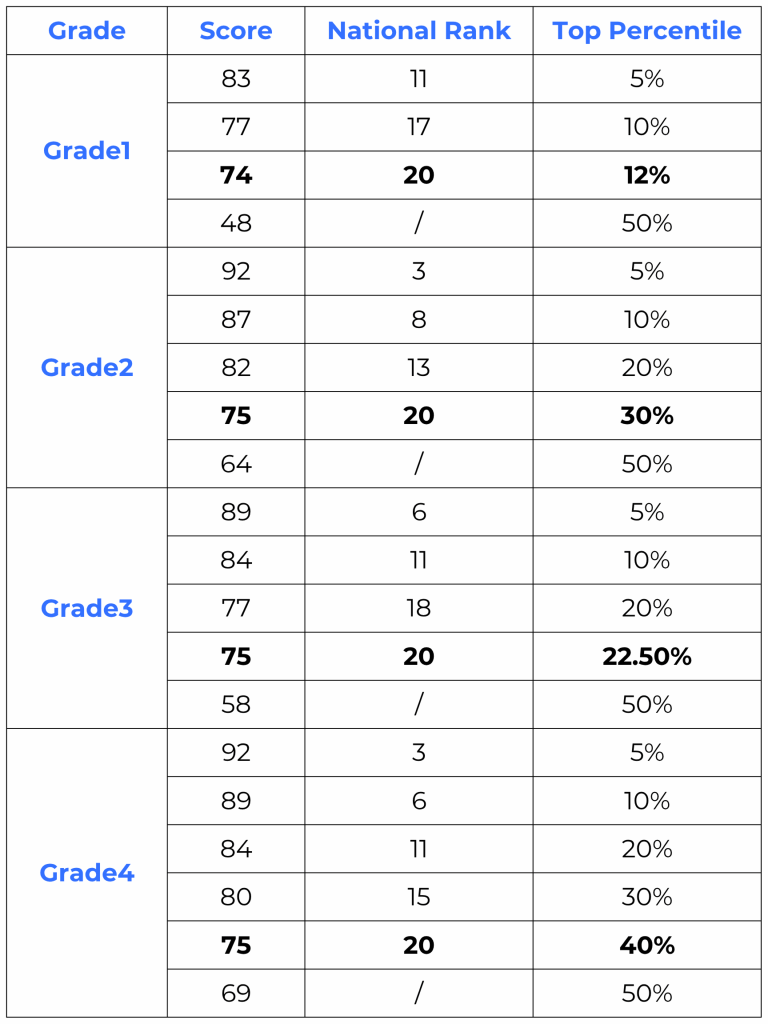
Think Academy – 2025 Math Kangaroo Results Score for Grades 1–4
That means students must close around 19-point gap with the remaining 5-point questions. In practical terms, they need to solve at least 3 questions of the hardest problems correctly—without burning too much time or making avoidable mistakes.
In Summary, the first 16 questions (3- and 4-point) are often viewed as “gettable” for well-prepared students, the final rankings depend almost entirely on who can break into the 5-point zone. This is where most scores start to spread out—and where students secure an award spot.
Why 5-Point Questions Are Hard
If 5-point questions are the barrier, what makes them difficult? Actually these problems don’t always require new formulas—they require flexible strategy and reading precision.
The real test is in habits and mindset:
- Can your child stay organized when the problem looks unfamiliar?
- Can they avoid rushing and instead slow down to find a method?
- Can they keep trying after the first idea doesn’t work?
In short, these questions expose more than just content knowledge—they reveal problem-solving maturity. And if your child has only practiced familiar types or hasn’t built enough habits through review, they’re likely to struggle even if their “math level” seems high.
That’s why training for 5-point questions isn’t about doing more problems—it’s about building the right thinking process. Let’s take a look at what these questions really test—and how to approach them.
The Most Common 5-Point Question Types
We have analyzed past exams to categorize the high-frequency difficult questions for each level.
MK Lv 1-2 (Grades 1-2)
From Observation to Logic:
At this stage, the challenge shifts from simple counting to spatial reasoning and multi-step logic.
1. Logical Reasoning & Fun Math
- Operations without Numbers: Using symbols (e.g., 🍎 + 🍎 = 10) to introduce algebraic thinking.
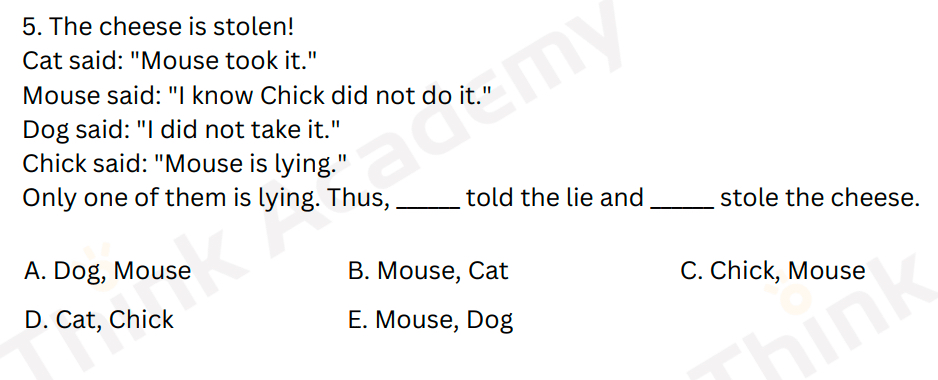
- Logic (Truths & Lies): Determining who is telling the truth in a group.
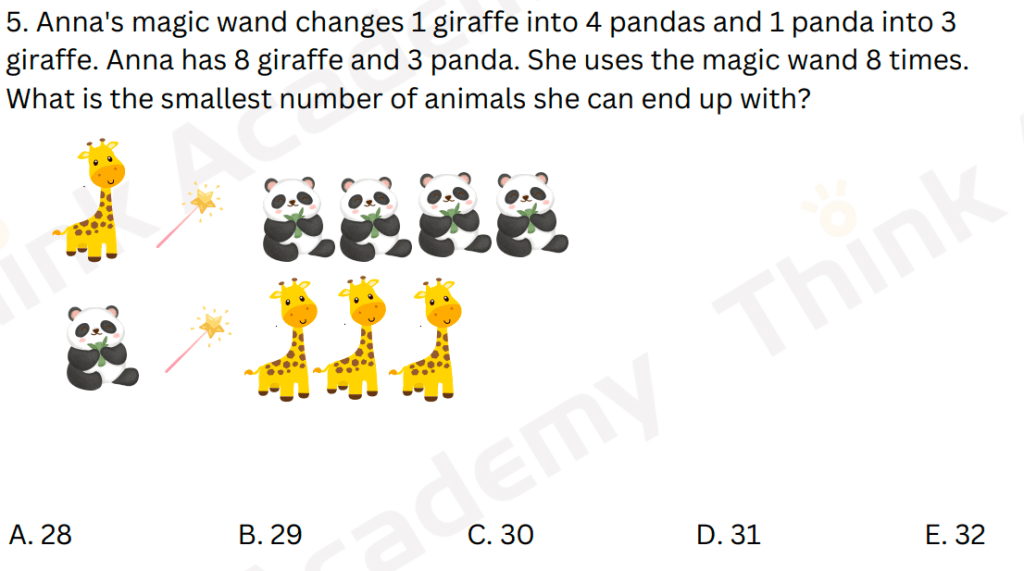
- Minimum & Maximum: Problems asking for the “least number of moves” to achieve a goal.
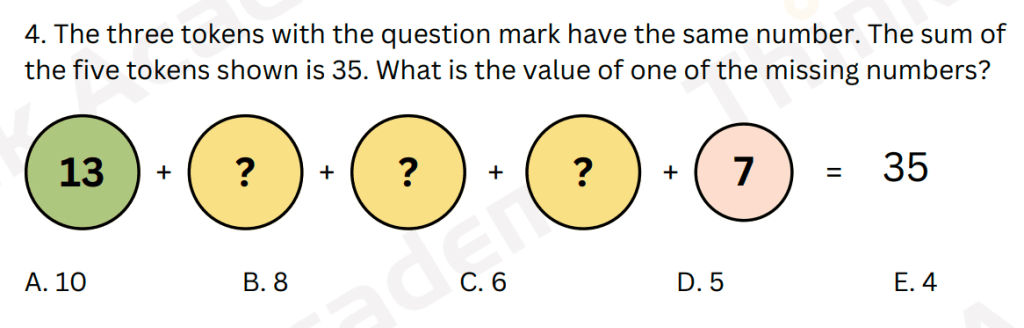
2. Word Problems
- Lining Up: Calculating position. Students often forget to subtract themselves.
- Operational Problems: Real-world scenarios involving money or multi-step exchanges.
3. Geometry & Spatial Sense
- Dice: Visualizing opposite faces or rotations.
- Gear Rotations: Determining direction (clockwise/counter-clockwise) and number of turns.
- Shape Regrouping: Tangrams or composing shapes from parts.
- Sum & Difference in Line Segments: Calculating overlapping lengths.
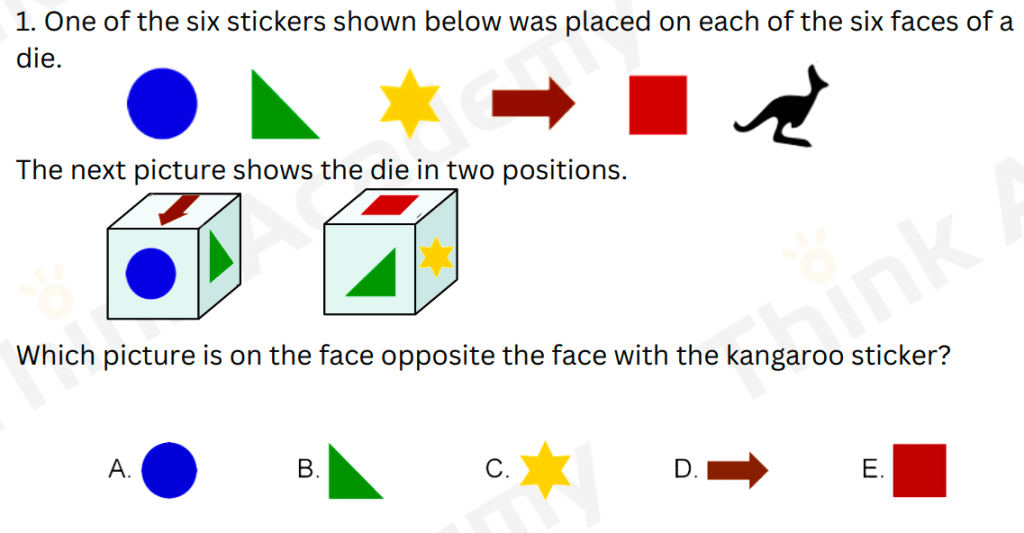
MK Lv 3-4 (Grades 3-4)
Abstract Logic & Number Theory
At this level, questions have more text, more traps, and introduce standard competition math modules.
1. Advanced Logical Reasoning
- Picture & Word Reasoning: Extracting conditions from complex diagrams or dialogues.
- Chicken & Rabbit Problems: Solving for two variables using logic (e.g., counting heads and legs).
- Page Problems: Distinguishing between counting pages vs. counting digits.
- Sports Competitions: Tournament brackets and round-robin logic.
2. Number Operations
- Divisibility: Identifying patterns for division, for exmaple 2, 3, 5, or 9.
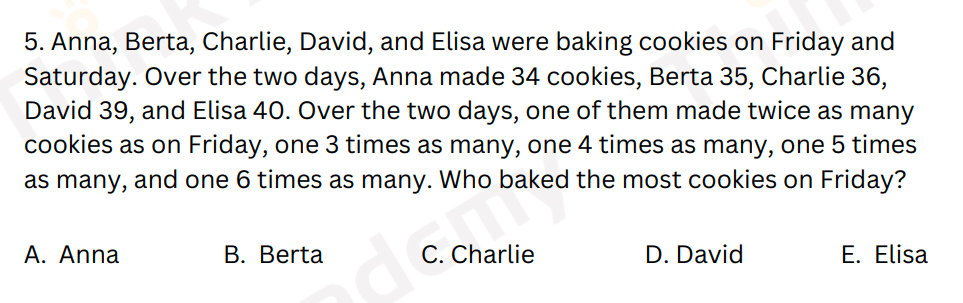
- LCM & GCF: Least Common Multiple problems often appear as “cycle” or “meeting” problems.
- Fun Calculation: Using properties of addition/multiplication to simplify complex equations.
3. Advanced Geometry
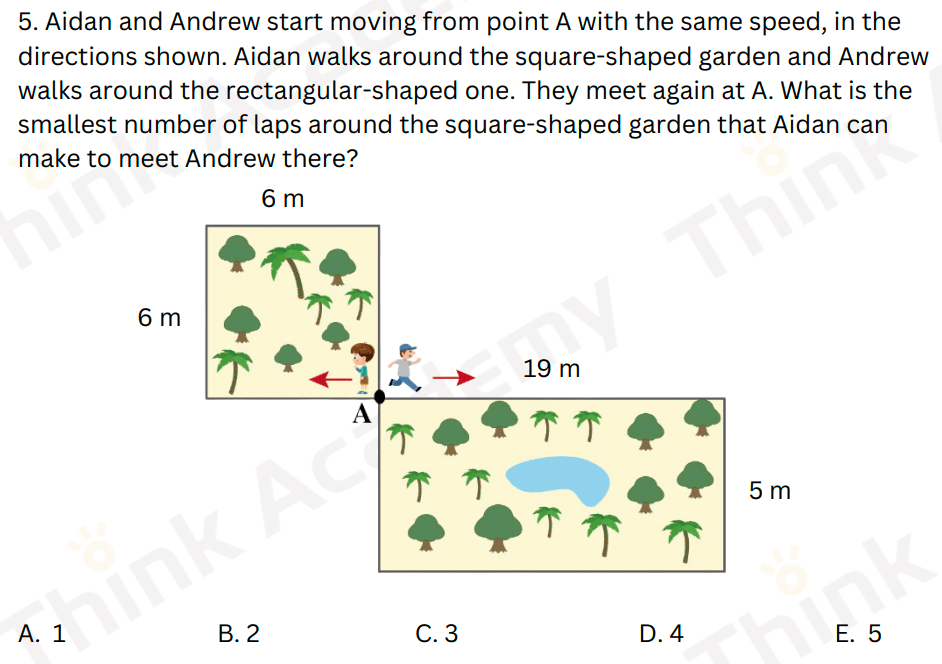
- Perimeter (2D & 3D): Calculating perimeters of irregular shapes (using the translation method) or surface area.
How to Approach 5-Point Questions
When a student misses a 5-point question, it is rarely because they haven’t learned the math. It is usually due to a breakdown in process.
Core Reasons for Common Mistakes
- Poor Reading Comprehension: Missing limiting words like “Not,” “At least,” “Remaining,” or “Integer.”
- Weak Logical Reasoning: Inability to hold multiple conditions in their head simultaneously.
- Afraid of long questions: Giving up because the problem text looks too long.
The 3-Step Solution Strategy
Teach your child to follow this exact process for every 5-point question:
Step 1: Decode & Visualize
- Circle Keywords: Highlight every number, unit, and logic word (e.g., “every,” “only”).
- Draw it: For Lv 1-2, draw the objects. For Lv 3-4, use tables or line plots. If the problem is about a line, draw the line.
Step 2: Simplify & Model
- Make it Smaller: If the problem uses “2024,” try solving it with “4” first to find the pattern.
- Work Backwards: For maze or calculation problems, starting from the answer choices is often faster.
- List Cases: Write down options systematically to ensure nothing is missed.
Step 3: Verify & Eliminate
- Double Check: Does the answer make sense? (e.g., You cannot have 3.5 people).
- Elimination: If stuck, plug the multiple-choice answers back into the question to see which one fits all conditions.
Practice 5-point Sample Questions
MK Lv1-2 Sample question
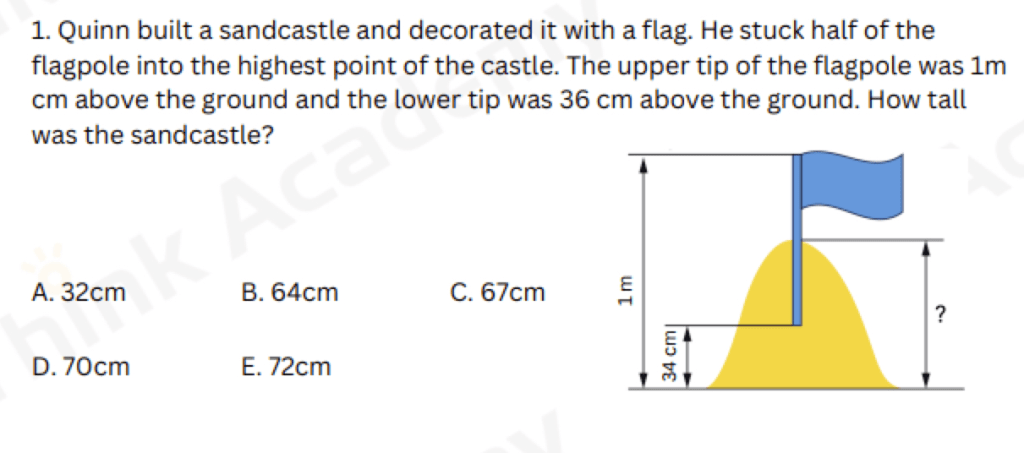
The Sum & Difference in Line Segments Problem
Why Students Get This Wrong:
1.Unit Mismatch: They subtract 34cm from 1 (ignoring that one is meters and one is cm).
2.Visualizing “Half”: They calculate the length of the pole but forget that the “height of the castle” corresponds to the midpoint of the pole, not the top or bottom.
3.Information Overload: They struggle to combine the text description with the diagram data.
Applying the 3-Step Strategy
Step 1: Decode & Visualize
- Circle Keywords: “Half,” “1 m,” “34 cm.”
- Standardize Units: This is the most critical step. Change “1 m” to 100 cm immediately. Now both numbers (100 and 34) speak the same language.
- Identify the Goal: We need to find the height of the top of the sand pile (where the pole enters the sand).
Step 2: Simplify & Model
Instead of guessing, break it down into two simple calculations:
1) Find the total length of the pole:
Top−Bottom=Pole Length: 100 cm−34 cm=66 cm
2) Find the length of “Half” the pole:
66 cm÷2=33 cm
3) Calculate the Castle Height:
The top of the castle is exactly in the middle of the pole.
Method A (Work Down): Top Tip−Half Pole=100−33=67 cm
Method B (Work Up): Bottom Tip+Half Pole=34+33=67 cm
Step 3: Verify & Eliminate
- Double Check: The castle must be lower than the top of the flag (100 cm) but higher than the bottom of the pole (34 cm).
- The Answer: 67 cm fits this logic perfectly.
MK Lv3-4 Sample question
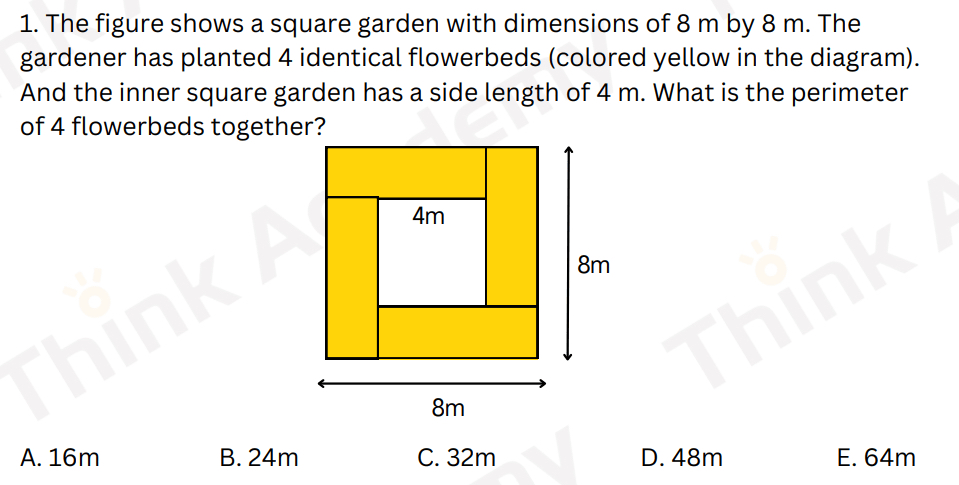
Finding Perimeter Problem
Why Students Get This Wrong:
- **The “calculation” Trap:**Students try to calculate the specific Length (L) and Width (W) of the rectangles. While possible, it is time-consuming and prone to calculation errors for a 4th grader.
- Confusing Area vs. Perimeter: Many students default to subtracting the areas (64−16) because that is a more common problem type.
- **Misinterpreting “Together”:**Some students calculate the perimeter of the yellow shape (Outer Border + Inner Border) rather than the sum of the four individual rectangles.
Applying the 3-Step Strategy
Step 1: Decode & Visualize
- Circle Keywords: “Perimeter,” “4 identical,” “Together.”
- Define the Goal: We need the perimeter of one rectangle, then multiply by 4.
- Formula: Perimeter=2×(Length+Width)
- Observe the Geometry: Look at the top edge of the large square. It is composed of the Long side of one flowerbed and the Short side of its neighbor.
Step 2: Simplify & Model (The Visual Shortcut)
Do not solve for X and Y. Use the “Whole” method.
1) Find (Length + Width):
Look at the diagram. The side of the large square (8m) is exactly equal to the Length of a rectangle plus the Width of a rectangle.
Length+Width=8m
2) Calculate One Flowerbed:
Since we know L+W=8, so the perimeter of one rectangle is: 2×(L+W)=2×8=16m
3) Calculate Total:
There are 4 identical flowerbeds. 16m×4=64m
Step 3: Verify & Eliminate
- Double Check (The Hard Way): If L+W=8 and the inner gap is 4 (L−W=4), then L=6 and W=2. Perimeter of one: 6+6+2+2=16. The shortcut holds true.
- The Answer: 64 m.
5-point Questions Workbook from Think Academy
Free download practice questions
All the questions above are high-frequency test points adapted from MK’s previous years’ real exam questions by Think Academy. They are compiled and categorized by knowledge points and question types. Download the collection of 100 practice questions to help your child efficiently train for 5-point questions.
Download MK Lv1-2 5-pointers Workbook
Download MK Lv3-4 5-pointers Workbook
Targeted MK Prep Class
Our Course Focus
An intensive pre-exam program designed to reinforce high-frequency Math Kangaroo (MK) concepts and strengthen essential skills in a short period of time. The curriculum covers:
- High-value 5-point MK problem types that have appeared frequently in recent years (these questions carry the highest point value and are key to determining whether a student can earn an award).
- Common error-prone 4-point problem types, focusing on patterns students most often miss.
- Problems involving complex logical conditions, multi-step reasoning, and deeper conceptual understanding.
Our Course Design
Step-by-Step Learning
- Start with the fundamental logic that children can master.
- Gradually transition to questions that require deeper thinking.
- Finally incorporate appropriately challenging exercises to guide them in enhancing their problem-solving abilities step by step.
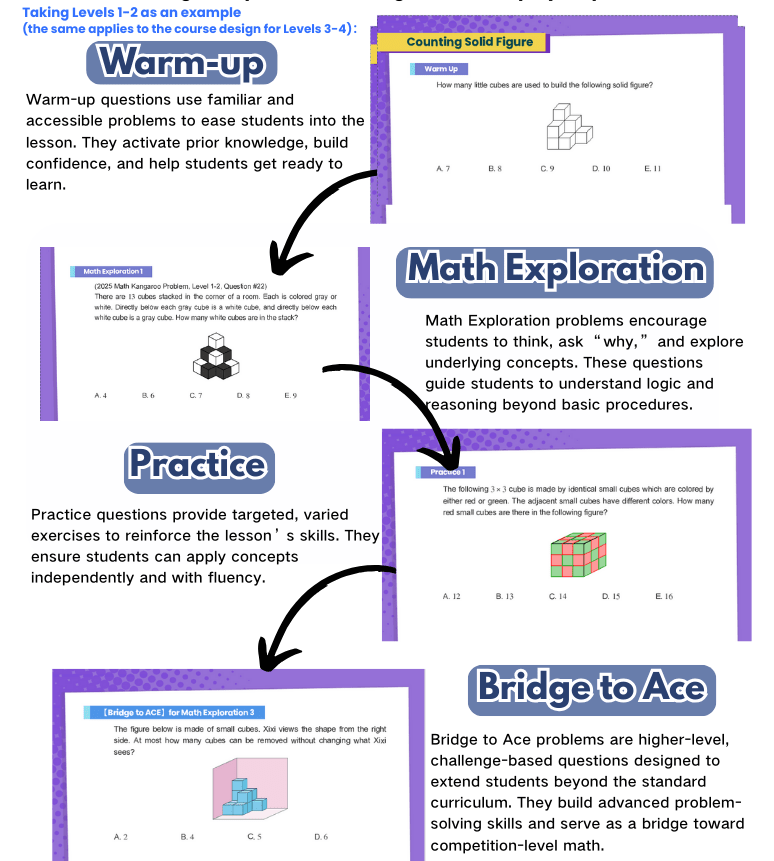
Our Efficient Learning Cycle
We don’t just teach — we help students absorb, practice, and reflect through a high-impact learning loop:
- Pre-class preview to activate prior knowledge
- Live, interactive lessons to guide discovery
- After-class homework with detailed video solutions
- Live Office Hours & 1on1 tutor to close gaps
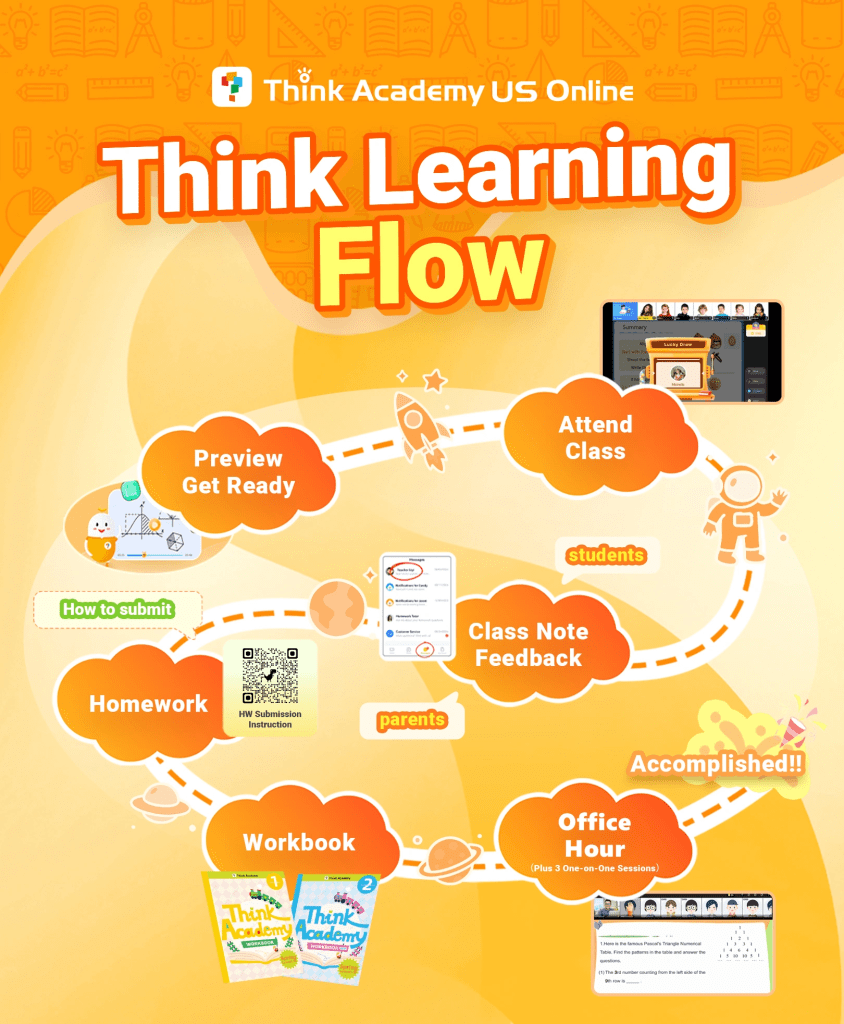
Our Weekly Feedback
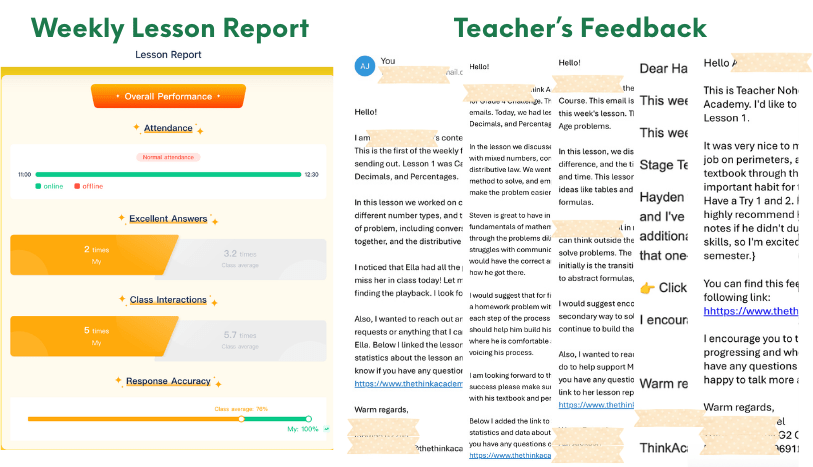
- Our parent app keeps you connected 365 days a year — with weekly progress feedback to reach your child’s teacher anytime.
- Every class report goes beyond scores — you’ll know what your child is doing well, where they’re improving, and how you can support them at home.
Real MK Results
- 700+ award-winning students trained by Think Academy in 2025
- Perfect-score award rate: 4× the official average
- Top 3 award rate: 6× the official average
- Overall award rate: 70%, compared to the official average of 20%

Recommend Reading
- Math Kangaroo 4-Point Questions: The Most Common Types + How to Solve Them
- Math Kangaroo 3-Point Questions: The Most Common Types + How to Solve Them
- Math Kangaroo: How to Solve 3-, 4-, and 5-Point Questions for a Higher Score
Try Pengi AI — Smarter Math Practice for Students
Pengi AI supports K–12 learners with personalized math practice, guided explanations, and feedback designed to help them build confidence and improve steadily.