Pengi Editor's Note
This article from Think Academy gives a thorough overview of the six most popular US math competitions — Math Kangaroo, MOEMS, AMC series, Math League (.com and .org), and Beestar — with real sample questions and a comparison table. It also offers concrete recommendations on which contest suits each grade range, making it a practical guide for parents planning their child's competition journey. The Pengi editorial team finds this especially useful for families new to the US math competition ecosystem.
Source: Think Academy Blog
From Math Kangaroo to AMC 8: Popular Math Contests That Help Students All the Way to AIME
The world of math competitions in the United States is vast and diverse. In addition to top-tier contests like the IMO (International Mathematical Olympiad) and USAMO (United States of America Mathematical Olympiad), there are many competitions open to elementary school children, including:
- Perennial Math
- Game-a-thon
- Math League
- Online Math League
- National Trimathlon
- Math Kangaroo
- Noetic Learning Math Contests
- Math Bee
- Math Madness
- Math Olympiads for Elementary and Middle Schools (MOEMS)
What Are the Most Popular Math Competitions?
Based on the number of participants each year and the level of interest from parents, here are the top six most popular competitions:
Math Kangaroo
Math Kangaroo is an annual international math competition. It originated in France and was first held in Paris in 1991. As of now, there are 49 participating countries worldwide. In 2023, more than 30,000 children participated in the US, with over 14,200 in California alone. The problems are interesting and challenging at a moderate difficulty level, which is why it is often called Pre-AMC.
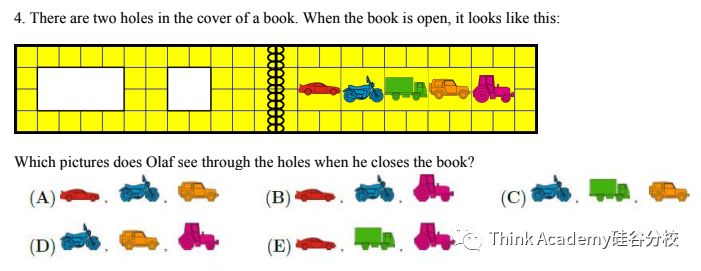
2019 Math Kangaroo Level 3 and 4 Sample Question
MOEMS
MOEMS stands for the Mathematical Olympiads for Elementary and Middle Schools. It originated with American educator George Lenchner in 1977. The quality of MOEMS problems is high, and student participation is strong.

2019 MOEMS Sample Question
AMC Competition Series
In terms of popularity in the US, the AMC system tops the list. The unique feature of the AMC system is that it goes through multiple levels of selection and can lead all the way to the International Mathematical Olympiad (IMO). AMC 8 and AMC 10 alone have 160,000 student participants annually in the US, with many elementary school students starting to prepare from grade 4.
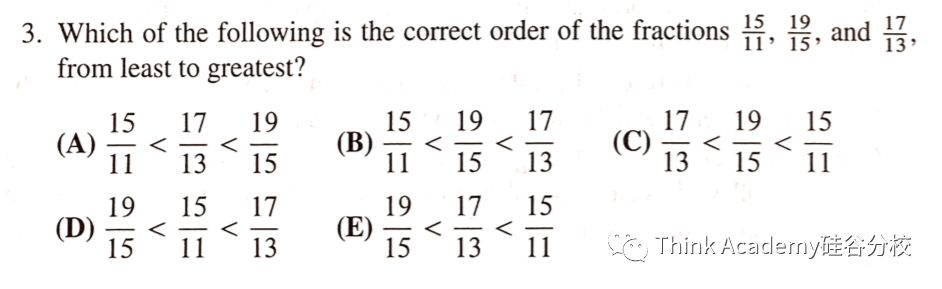
2019 AMC 8 Original Question #3
Math League (.com)
Math League was founded in 1977 by two high school teachers, Steven R. Conrad and Daniel Flegler. Math League problems are flexible and lively, very close to real life.
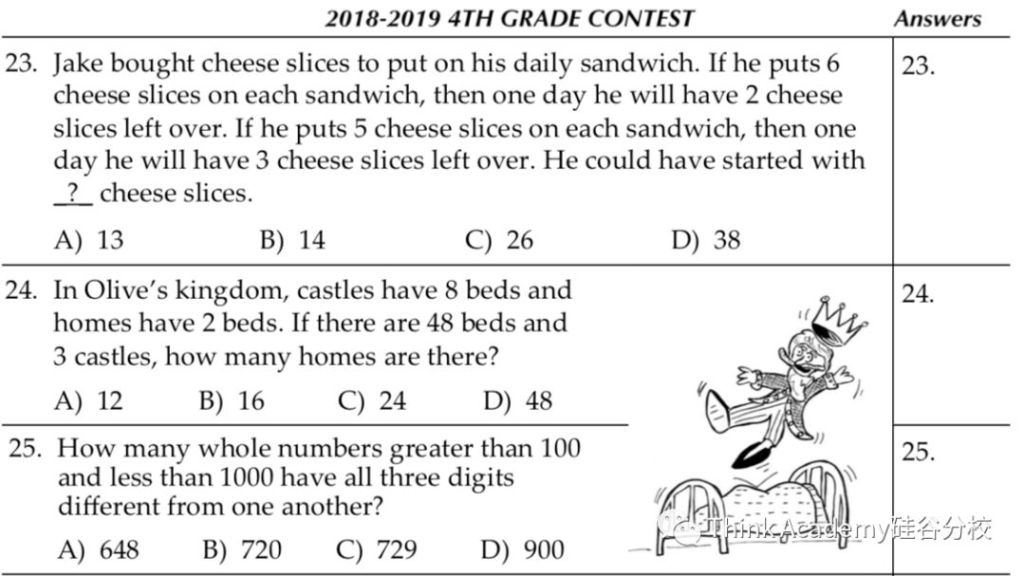
2018-2019 Sample 4th Grade Contest
Math League (.org)
Math League (.org), whose predecessor was the Great Plains Math League (GPML), is a competition originating from the Midwest. Its test format includes a mixture of MATHCOUNTS and ARML, with Number Sense Round, Target Round, Sprint Round, and Team Round. State and Regional competitions also include a Power Round.
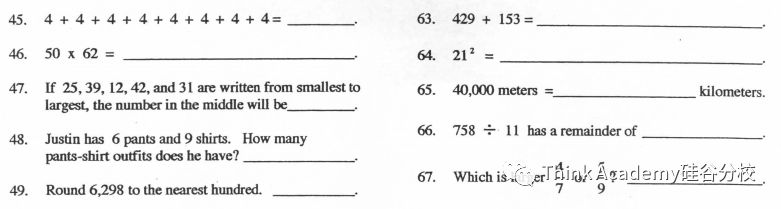
Math League Official Elementary Sprint Round Sample
Beestar Competition
The Beestar math competition is sometimes called the "strongest brain" competition for American elementary school students. The competition is divided into two rounds: Dash and Spark, each lasting 48 hours. Children need to complete four sub-competitions in the designated 48 hours on their computer. The competition is held twice a year. Beestar is often called a mini-MATHCOUNTS.

Difficulty level reference (similar to Beestar's Gifted Assessment)
Math Competition Comparison Summary:
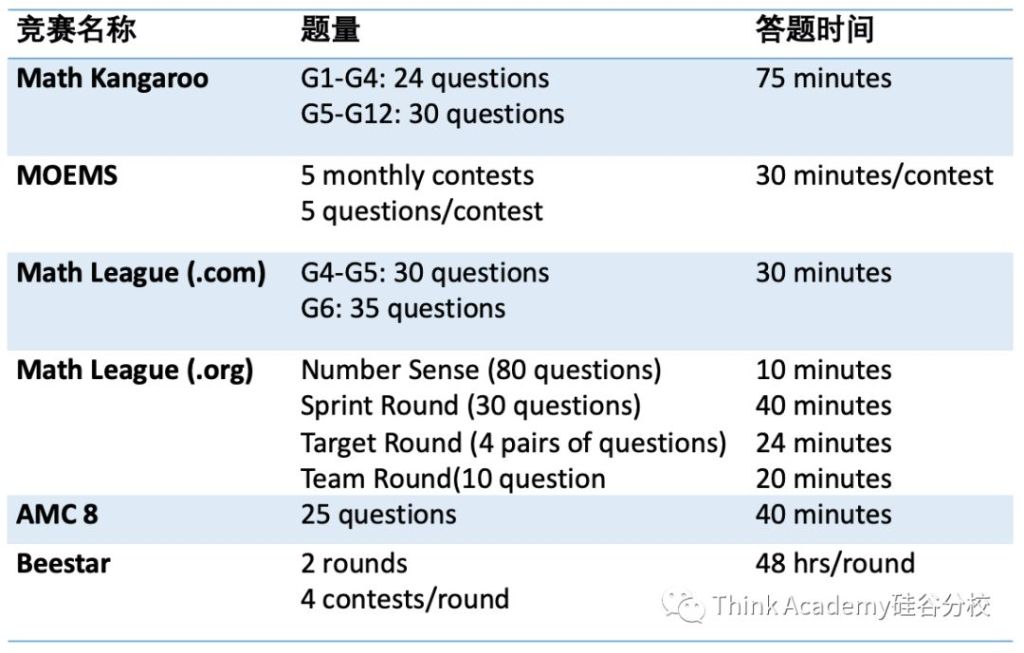
Recommended Competitions by Grade Level
Grades 1–3: Math Kangaroo
Interest is the best teacher, and learning math in grades K–3 is all about cultivating interest and laying a strong foundation. Math Kangaroo tests logic and reasoning skills rather than just math knowledge. Each exam is divided into age groups, with grades 1–2 taking the same test. Math Kangaroo also gives every child a t-shirt and gift to stimulate their competitive spirit.
Friendly reminder: Math Kangaroo registration fills up quickly after opening. It is recommended that interested parents register as soon as possible.
Grades 3–5: Math League (.com)
Math League focuses on developing children's mathematical thinking by presenting problems closely related to real-life situations. The exam consists of 30 multiple-choice questions and lasts 30 minutes, helping children develop time management skills.
Grades 5–8: AMC 8
AMC is recommended because it is part of a systematic competition system that leads from AMC 10 and 12 all the way to the International Mathematical Olympiad (IMO). A high score on the AMC exam can also give students an advantage when applying to universities.
For Students Interested in MATHCOUNTS
Online practice: Beestar Math Competition — Question types are very similar to those in MATHCOUNTS, making it an ideal practice ground.
Offline experience: Math League (.org) — For students who want to experience offline competition with peers and get a head start on MATHCOUNTS.
Developing mathematical thinking: MOEMS — MOEMS accepts team registration and awards both team and individual prizes. Speed is not emphasized, but it develops mathematical thinking. The difficulty is lower than the last few questions on AMC 8, making upper primary school students well-positioned to try the junior high school level (DIVISION M).
Try Pengi AI — Smarter Math Practice for Students
Pengi AI supports K–12 learners with personalized math practice, guided explanations, and feedback designed to help them build confidence and improve steadily.