Pengi Editor's Note: This article was originally published by Think Academy. We're sharing it here for educational value. Think Academy is a leading K-12 math education provider.
Math Kangaroo: How to Solve 3-, 4-, and 5-Point Questions for a Higher Score
If your child is preparing for Math Kangaroo, it’s important to understand this: practice alone won’t guarantee a high score—what matters is practicing the right types of problems.
In this article, we’ll break down a clear, score-focused prep plan for Grades 1–4, using the 3-point, 4-point, and 5-point question structure to show where score gains actually come from. We’ll start with the 2025 award score range to set a realistic target. But before you scroll down, ask yourself: How close to “perfect” does a child need to be to win a National Top 20 rank? The actual number might surprise you—and it changes the entire strategy for the final prep period.
2025 Math Kangaroo Award Scores Analysis
First, let’s take a quick look at the 2025 national data.
Many parents assume that winning requires a score of 90+ or near perfection. Is the bar really that high, or is there more room for error than you think?
To earn a Top 20 National Rank, here’s the actual minimum score in 2025 needed by grade:
- Grade 1: 74 points
- Grade 2: 75 points
- Grade 3: 75 points
- Grade 4: 75 points
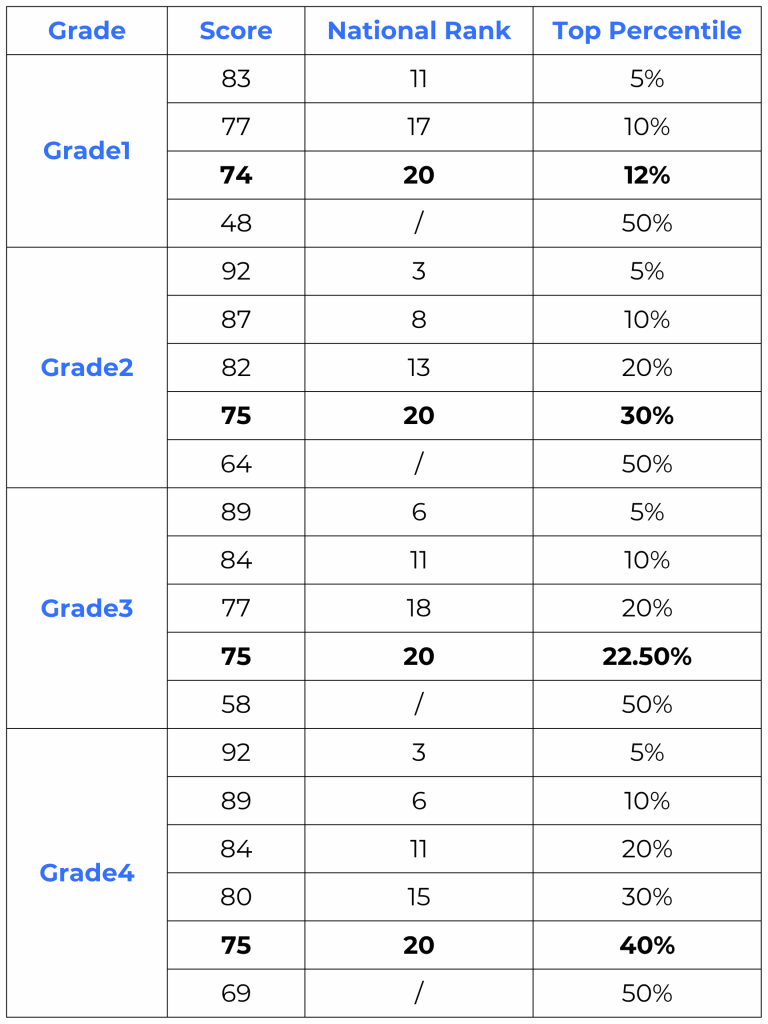
Think Academy – 2025 Math Kangaroo Results Score for Grades 1–4
Does that number feel high to you, or does it feel like a relief?
Considering the total score is 96, a target of 75 means a student can miss roughly 20 points and still rank nationally. This confirms that strategy beats perfection.
As we all know, for Level 1-4, Math Kangaroo has a 3-tier scoring system:
| 3-point questions – easy | 8 questions, total 24 points |
|---|---|
| 4-point questions – medium difficulty | 8 questions, total 32 points |
| 5-point questions – hard | 8 questions, total 40 points |
Math Kangaroo Level 1-4 Score Breakdown
The Score-Boost Map
As the test gets closer, the most effective prep strategy isn’t to “do everything”—it’s to be smart and targeted about where the points come from. Not all questions are created equal, and not all students should spend their time the same way.
To raise your child’s score efficiently, focus on the right targets:
- Secure all 3-point questions — they’re your child’s base score.
- Fix common mistakes on 4-point questions — they offer the fastest gains.
- Tackle key 5-point questions — they create the gap for top awards.
In the final weeks, quality matters more than quantity. Focused practice in each of these zones can make a real difference. Let’s take a closer look at how to prepare for each question type.
How to Solve 3-Point Questions
3-point questions are usually the most straightforward part of Math Kangaroo—but that doesn’t mean every student gets them all right. Many score drops happen here for one simple reason: students rush. The goal with 3-point questions is to build a strong base by getting them right and fast, without careless mistakes.
Understand common categories of 3-point questions
Most 3-point questions fall into a few common categories:
- Basic geometry and shapes
- Simple enumeration (counting and listing)
- Number and word problems
- Basic logic and patterns
These problems usually don’t require advanced tricks. They reward clear thinking and careful reading.
Remember the core tested abilities
3-point questions mainly test three things:
- Core understanding (recognize the topic and apply the right idea)
- Speed with accuracy (solve quickly without rushing)
- Consistency (use the same clean process every time)
If your child is aiming for awards, these points matter because they create a stable foundation before moving into 4- and 5-point questions.
Avoid common mistakes
Most 3-point misses are not “hard-math” issues. They’re process mistakes:
- Misreading the question (answering the wrong thing: total vs. difference, how many vs. how much)
- Unit mistakes (minutes vs. hours, centimeters vs. meters, dollars vs. cents)
- Simple calculation errors (sign mistakes, skipping a step, rushing mental math)
A helpful rule: if your child misses a 3-point question, it’s usually because they moved too fast, not because the problem was too hard.
Stick to an Efficient Approach
The best way to improve 3-point performance is short, timed practice plus a checking habit:
- Set a time goal: about 1–2 minutes per 3-point question
- Practice in small sets: 8–12 questions at a time (not full tests)
- Before moving on, do a quick check:
- Re-read the last sentence (What is the question asking?)
- Check units
- Do a quick estimate (Does the answer make sense?)
This is where “quality over quantity” matters most. Ten careful questions with a quick check is better than fifty rushed ones.
Practice with Examples
This question was adapted from the MK real exam and included in the October MK Lv1-2 mock exam. It is a 3-point question with a very high error rate. It requires children to mentally trace the path and constantly change orientation.
- Common mistake: Counting flags based on their visual left/right (from the page’s perspective), not the runner’s perspective.
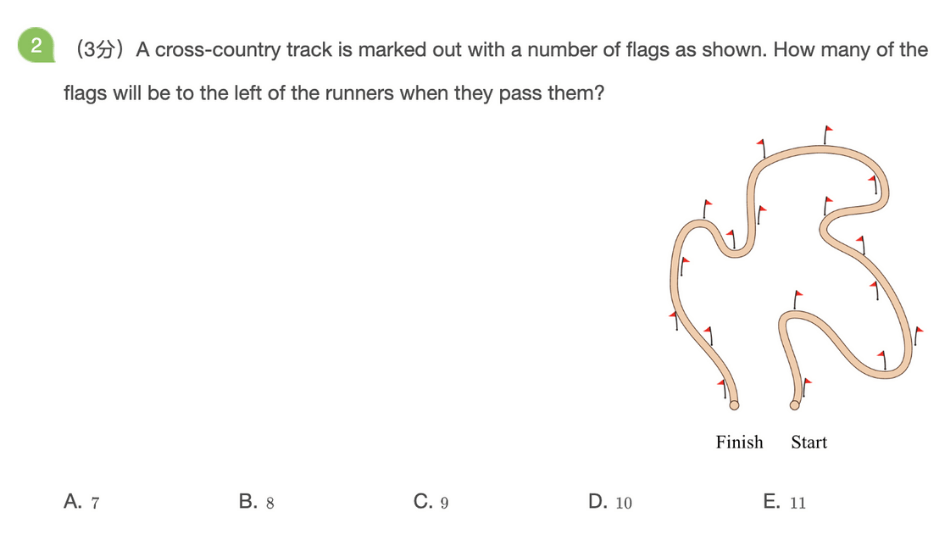
Most first and second graders can distinguish between left and right and correctly count the number of flags. However, when solving the problem, they often tend to be careless, overlooking key information in the question. The lack of focus, mental tracking, and flexible thinking leads to mistakes.
How to Solve 4-Point Questions
4-point questions are where many students lose points—even strong students. Unlike 3-point questions, these problems are more flexible. Students can’t rely on one routine method. They need to apply what they know based on a solid understanding of the concept, and choose a good approach for the situation. The good news is that 4-point questions are also one of the fastest places to raise a score, because accuracy improves quickly when students learn the right problem-solving habits.
Understand common categories of 4-point questions
Most 4-point questions are “medium difficulty,” but they often feel harder because they include more information or more steps.
- Multi-step word problems
- Geometry with hidden details
- Logic with multiple conditions
- Number operations
Remember the core tested abilities
4-point questions mainly test:
- Concept understanding: your child needs to know why a method works, not just memorize steps
- Problem-solving choices: selecting the right approach
- Accuracy with structure: keeping steps clear so small mistakes don’t happen
This is why students who do well on 3-point questions can still struggle here. They often need stronger skills in number sense, word problems, and logical reasoning—all at the same time.
Avoid common mistakes
Most 4-point misses follow a few repeatable patterns:
- Missing a key condition (at least / at most / exactly / different)
- Setting up the problem incorrectly
- Not organizing information
- Counting errors (double-counting or missing cases)
- Rushing the last step
A common sign is: “My child understood it, but still got it wrong.” That usually means the student needs better structure and checking habits on multi-step work.
Stick to an Efficient Approach
To improve 4-point accuracy, students need two things: the right problem-solving methods and a repeatable process.
Here’s an effective approach:
1.Match the problem to a method
- Word problem → Circle the key information and number in the questions
- Logic problem → can make a table or eliminate options
- Geometry → label the sides or cubes before solving
- Counting → choose a clear system (categories or organized list)
2.Train by mistake pattern (not random practice)
- Identify the top 1–2 mistake types
- Do 8–12 similar questions focused on that one skill
- Goal: make the process automatic
3.Use a short 4-point accuracy checklist
- Did I answer the exact question being asked?
- Did I use every condition?
- Did I organize the information (table/diagram/equation)?
- Does my answer make sense?
This is where “quality over quantity” really works. Focused practice builds accuracy much faster than doing large sets without reflection.
Practice with Examples
This question was adapted from the MK real exam and included in the Sep MK Lv3-4 mock exam. It is a 4-point problem with a notably high error rate, primarily focusing on understanding the properties of addition, subtraction, multiplication, and division.
- Common mistake: Testing only one or two arrangements and choosing an answer by guessing instead of comparing cases systematically.
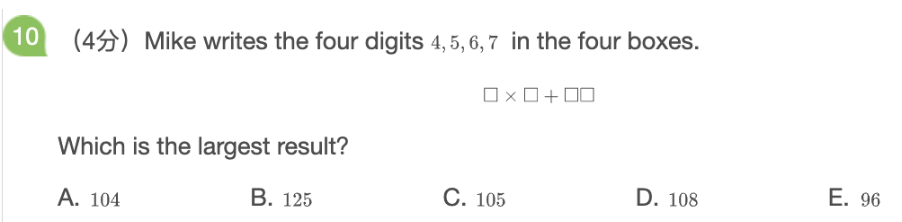
Actually, with a bit more calculation, they could get the answer, but they are still underestimating the problem.
How to Solve 5-Point Questions
5-point questions are the hardest part of Math Kangaroo. Many of these problems may feel unfamiliar to your child—and that is completely normal. The goal is not to “memorize every type,” but to learn reliable solving methods so your child knows how to start, how to stay organized, and when to move on and come back. Getting even a few 5-point questions right can make a real difference for award-level scores.
Understand common categories of 5-point questions
Most 5-point questions have one or more of these features:
- A non-routine setup (it doesn’t look like a standard worksheet problem)
- More text and more conditions (you must read carefully)
- A hidden structure (pattern, symmetry, counting system, or a key observation)
- More than one possible approach (students must choose a strategy)
Remember the core tested abilities
5-point questions test more than computation. They test how students think.
- Reading precision: understanding exactly what is being asked from long paragraphs
- Strategy choice: deciding whether to use a table, drawing, casework, a pattern, or a smart shortcut
- Reasoning and structure: keeping work organized so nothing is missed or double-counted
- Flexible thinking: trying a different path when the first idea doesn’t work
Important note for parents: some 5-point questions are not “hard math.” They are difficult because students misread the goal, miss a condition, or don’t know how to begin.
Avoid common mistakes
Here are the most common reasons students miss 5-point questions:
- Underestimating the problem and rushing in without a plan
- Not reading carefully (especially long text with multiple conditions)
- Solving the wrong question (finding an intermediate value instead of the final target)
- Not choosing a clear strategy (students feel stuck because they don’t know how to start)
- Messy work that leads to missing cases or repeating cases
- Getting locked in and spending too long on one question
A helpful mindset is: 5-point questions reward students who slow down, think clearly, and stay organized—not students who rush.
Stick to an Efficient Approach
In the final weeks, the best training is focused and method-based. Here is a simple approach that works well:
1.Use a Start Fast routine (30–60 seconds):
- Re-read the last sentence: What is the question asking for?
- List the conditions in short bullet points.
2.Build a small toolbox of high-frequency methods:
- Counting: break into cases, use an organized list, watch for double-counting
- Number sense: use parity (odd/even), divisibility, remainders, smart bounds
- Geometry: look for symmetry, equal areas, add a helpful line if needed
- Logic: make a table and eliminate step by step
3.Practice for quality (not quantity):
- Do a few 5-point problems at a time, then review deeply.
- After each problem, write one sentence:What was the key idea that unlocked it?
4.Set a time cap:
- If your child is stuck after a short time (for example, 3–4 minutes), they should mark it and move on. Coming back later often works better than forcing it.
Practice with Examples
This question was adapted from the MK real exam and included in the Oct MK Lv1-2 mock exam. It is a 5-point problem. Although it breaks children’s habitual way of solving, the method is the same.
- **Common mistake:**Forgetting about carrying; Overlooking the “the digits can be different” condition
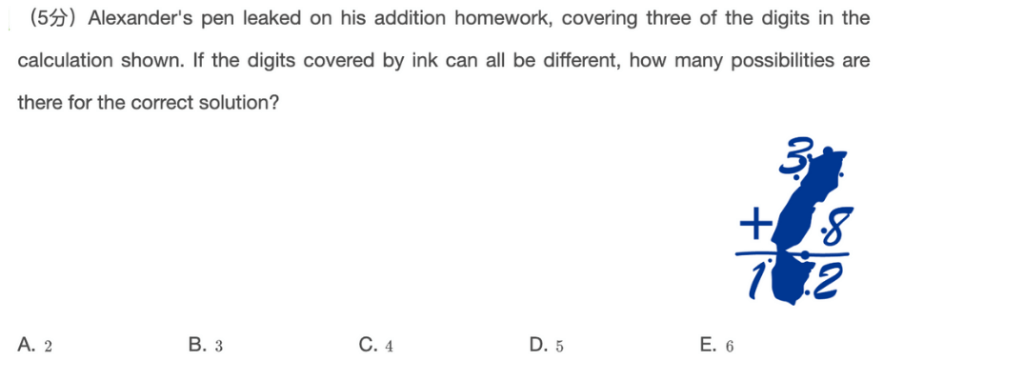
The key to solving 5-point questions is to break free from habitual thinking, clearly understand the approach for each type of question, and think deeply to identify the key solution.
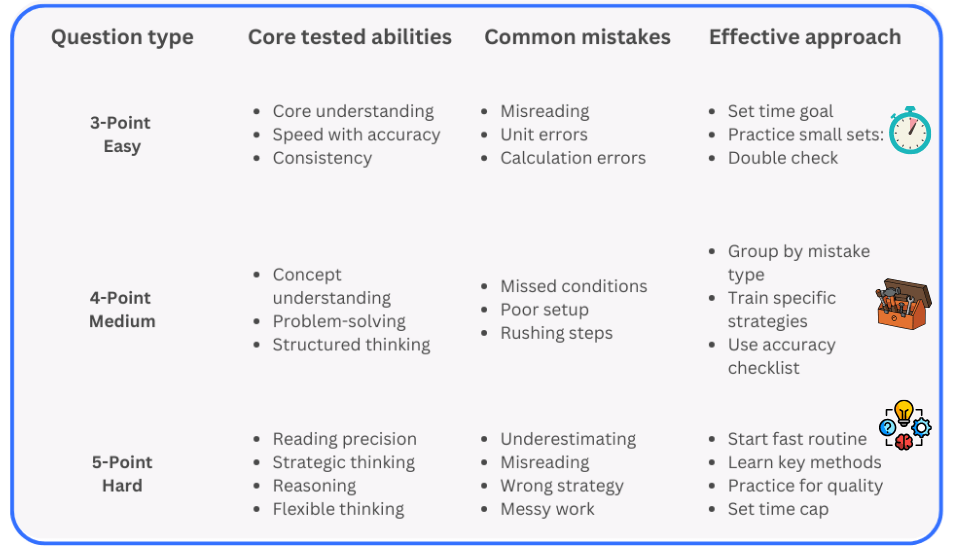
Score-Map Summary
How to Prep Based on Your Child’s Profile
In the final stretch, every student should work on both 4-point and 5-point questions—the difference is how much time to spend on each, and what the goal is. 3-point questions build the base, but most score growth comes from fixing 4-point accuracy and learning how to approach 5-point questions without getting stuck.
First-time test taker
Secure 3s, then learn 4s and try 5s the right way
If this is your child’s first Math Kangaroo, start by locking in 3-point questions. But don’t stop there—your child should still practice 4s and get exposure to 5s.
Focus on:
- 3-point: accuracy first, steady pace
- 4-point: learn basic setups (tables, equations, diagram labeling) and avoid common mistakes
- 5-point: practice “how to start” (restate, list conditions, test a small case), even if they don’t finish every one
Goal: build confidence, avoid time traps, and pick up extra points from 4s (and occasional 5s).
Has experience but not Top 20 yet
Strengthen 4s and add targeted 5s
If your child has practiced but still isn’t in award range, they usually lose points in 4-point questions they could have gotten right. At the same time, getting just a few 5-point questions correct can be a big boost.
Focus on:
- 4-point: fix repeated mistake patterns (missed conditions, counting errors, rushed last step)
- 5-point: target high-frequency types and build a small method toolbox
- Use mixed practice sets (for example: a block of 4s + a few 5s) to train switching skills under time pressure
Goal: stop leaking points on 4s, and gain extra points from selected 5s to reach Top 20.
Good score but not Top 3
Maximize 4-point accuracy and raise 5-point hit rate
At the top level, your child still can’t afford to miss many 4-point questions. A single 4-point mistake can undo the value of a hard-earned 5-pointer. Then, the difference comes from solving more 5-point questions consistently.
Focus on:
- 4-point: near-perfect accuracy with a clean, repeatable process
- 5-point: improve “start fast” skills, choose strategies quickly, and avoid getting stuck
- Practice with time limits and full review, so methods become automatic
Goal: near-perfect 4s and a stronger 5-point hit rate—this is what pushes top rankings.
A clear takeaway for parents
No matter your child’s level, 4-point questions are the fastest score gains, and 5-point questions create the award gap. In most cases, students reach Top 20 by combining two things: strong accuracy on 4-point questions and steady progress on a few key 5-point types.
Targeted Math Kangaroo Prep Online Class
Math Kangaroo scores improve fastest when practice is targeted. Our MK Sprint Course focuses on the questions that carry the most points and the mistakes that cost students the most—so your child can turn limited prep time into real score gains.
Course Focus
An intensive pre-exam program designed to reinforce high-frequency Math Kangaroo (MK) concepts and strengthen essential skills in a short period of time. The curriculum covers:
- High-value 5-point MK problem types that have appeared frequently in recent years (these questions carry the highest point value and are key to determining whether a student can earn an award).
- Common error-prone 4-point problem types, focusing on patterns students most often miss.
- Problems involving complex logical conditions, multi-step reasoning, and deeper conceptual understanding.
Course Syllabus
Full 15 lessons – Flexible Enrollment Options
You may choose the portion of the course that best fits your child’s needs:
- [Lesson 1-7]: Specifically designed for 2026 MK preparation (finish before the competition date)
- [Lesson 8-15]: For families looking beyond MK… a pathway into Think Competition ACE Track! Lesson 8-15 will be focusing on the essential concepts taught throughout this year’s ACE curriculum, preparing students for the Think Competition ACE Selection.
- or BOTH, if you would like a complete competition preparation path.
Our program also offers flexible withdrawal options, so families are welcome to let your child try the class first and continue only if it feels like the right fit.
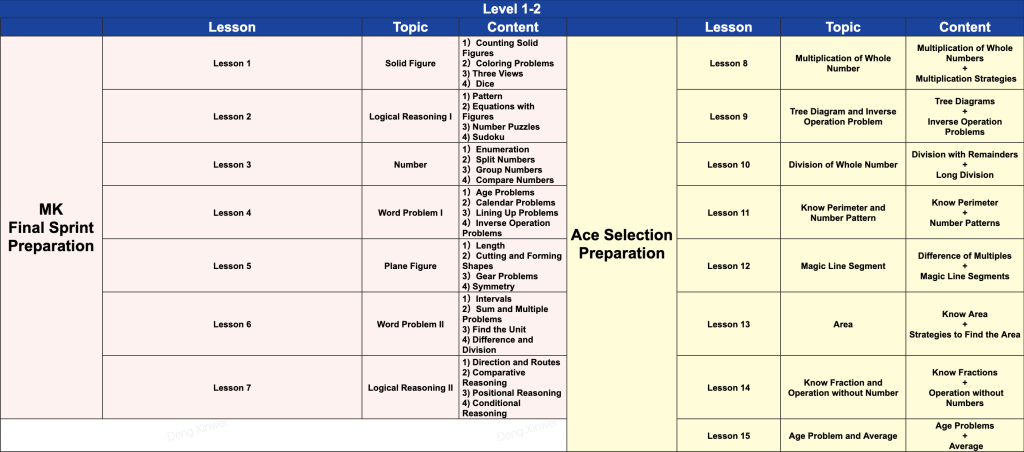
Lv1-2 Syllabus
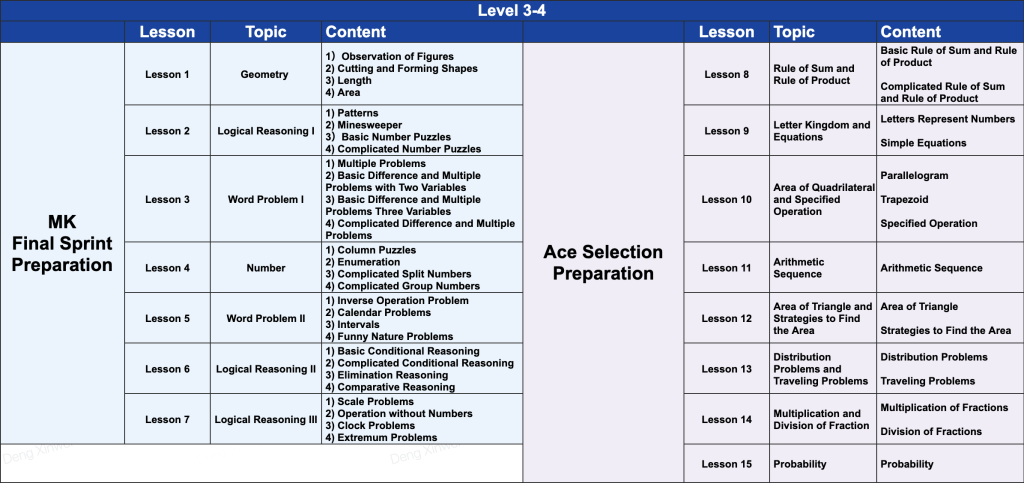
Lv3-4 Syllabus
Course Design
Progressive and Step-by-Step Learning
- Start with the fundamental logic that children can master.
- Gradually transition to questions that require deeper thinking.
- Finally incorporate appropriately challenging exercises to guide them in enhancing their problem-solving abilities step by step.
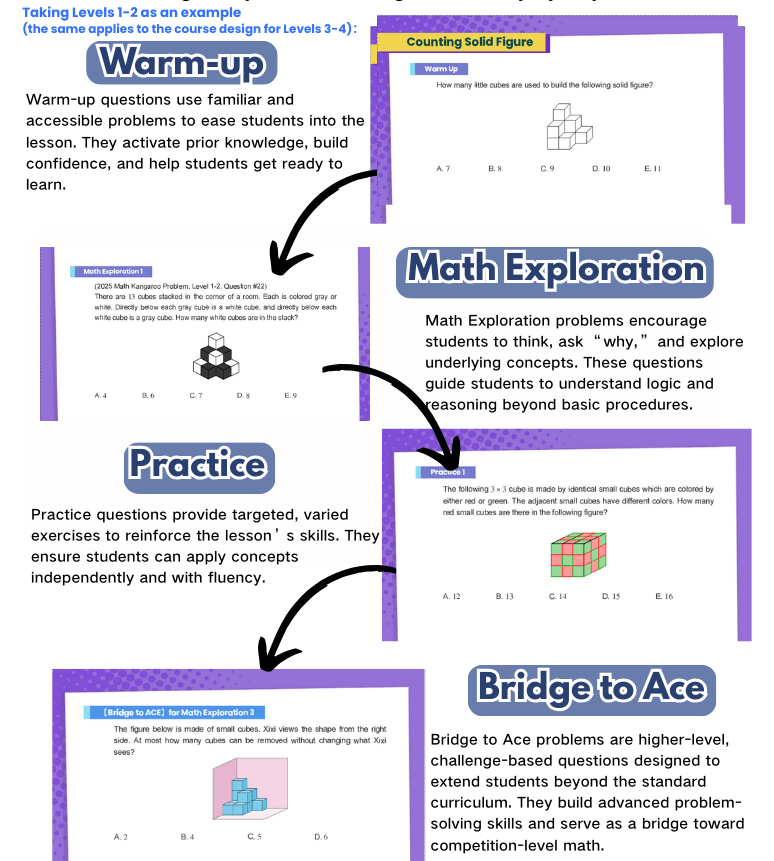
Learning Cycle
We don’t just teach — we help students absorb, practice, and reflect through a high-impact learning loop:
- Pre-class preview to activate prior knowledge
- Live, interactive lessons to guide discovery
- After-class homework with detailed video solutions
- Live Office Hours & 1on1 tutor to close gaps

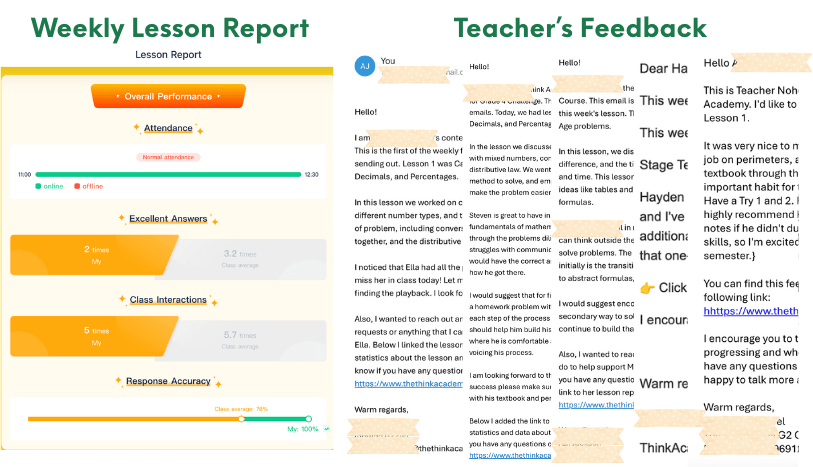
Real-time Feedback
- Our parent app keeps you connected 365 days a year — with weekly progress feedback to reach your child’s teacher anytime.
- Every class report goes beyond scores — you’ll know what your child is doing well, where they’re improving, and how you can support them at home.
Real Results, Real Impact
- 700+ award-winning students trained by Think Academy in 2025
- Perfect-score award rate: 4× the official average
- Top 3 award rate: 6× the official average
- Overall award rate: 70%, compared to the official average of 20%

Recommend Reading
- Math Kangaroo 5-Point Questions: The Most Common Types + How to Solve Them
- Math Kangaroo 4-Point Questions: The Most Common Types + How to Solve Them
- Math Kangaroo 3-Point Questions: The Most Common Types + How to Solve Them
Try Pengi AI — Smarter Math Practice for Students
Pengi AI supports K–12 learners with personalized math practice, guided explanations, and feedback designed to help them build confidence and improve steadily.