Pengi Editor's Note: This article was originally published by Think Academy. We're sharing it here for educational value. Think Academy is a leading K-12 math education provider.
Multiplication: Examples, Charts, and MK Applications
Multiplication is a key math milestone for elementary students, starting with simple 1-digit problems and progressing to multi-digit multiplication. In this guide, you'll find clear examples of both school math and math competition levels, printable multiplication charts (including 1–10, 1–12, and 1–20 tables), and strategies to help your child master multiples of 1 through 10. Whether you're reinforcing school math or exploring enrichment problems like Math Kangaroo, this resource combines visuals, logic, and practice tools for confident learning.
What Is the Multiplication?
Multiplication is one of the most essential math operations children learn in elementary school — and also one of the most challenging. While some high-achieving students are introduced to multiplication in Grade 2, most schools officially teach it in Grade 3.
Learning starts small:
- First with single-digit multiplication (e.g., 2 × 3),
- Then progresses to two-digit multiplication (e.g., 12 × 6),
- Eventually reaching multi-digit multiplication problems (e.g., 123 × 45).
It's a big step up from addition — but with the right approach, tools, and practice, your child can master it with confidence.
School-Level Multiplication Problem Examples
In elementary school, students are introduced to multiplication through problems that increase in complexity. Here are three examples of how multi-digit multiplication is solved using grade-appropriate strategies.
Multiplication Example 1
Problem
6 × 12
Solution
This is a 1-digit by 2-digit multiplication problem.
Students often break it down by place value:
- Ones place: 6 × 2 = 12 → write down 2, carry over 1
- Tens place: 6 × 1 = 6, plus 1 carried over = 7
Answer
6 × 12 = 72
Multiplication Example 2
Problem
12 × 8
Solution
This is a 2-digit by 1-digit multiplication problem.
Students can use the distributive property:
12 × 8
= (10 × 8) + (2 × 8)
= 80 + 16
= 96
Answer
12 × 8 = 96
Multiplication Example 3
Problem
12 × 12
Solution
This is a 2-digit by 2-digit multiplication problem.
One approach is to use expanded form:
12 × 12
= (10 + 2) × 12
= (10 × 12) + (2 × 12)
= 120 + 24
= 144
Answer
12 × 12 = 144
These examples show two different strategies commonly taught in schools:
- Breaking numbers into place values (partial products)
- Applying the distributive property
To improve speed and accuracy, students also practice with multiplication charts, especially the 1–12 multiplication table. These visual tools reinforce core facts and make it easier to solve more complex problems.
Math Kangaroo-Style Application of Multiplication
Take a look at these Math Kangaroo-style problems, where students must apply multi-digit multiplication to figure out patterns, areas, or quantities in more complex settings.
Multiplication Example 4
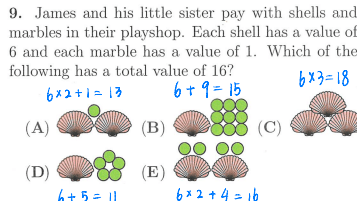
Problem (2025 Math Kangaroo Level 3-4 Question 9)
Solution
The total value of each group are calculated with shell = 6, marble = 1
Option A: 2 shells and 1 marble
6 x 2 + 1 = 13
Option B: 1 shell and 9 marbles
6 + 9 x 1 = 15
Option C: 3 shells
6 x 3 = 18
Option D: 1 shell and 5 marbles
6 x 1 + 5 x 1 = 11
Option E: 2 shells and 4 marbles
6 x 2 + 4 x 1 = 16
Answer
E has a total value of 16
Multiplication Example 5
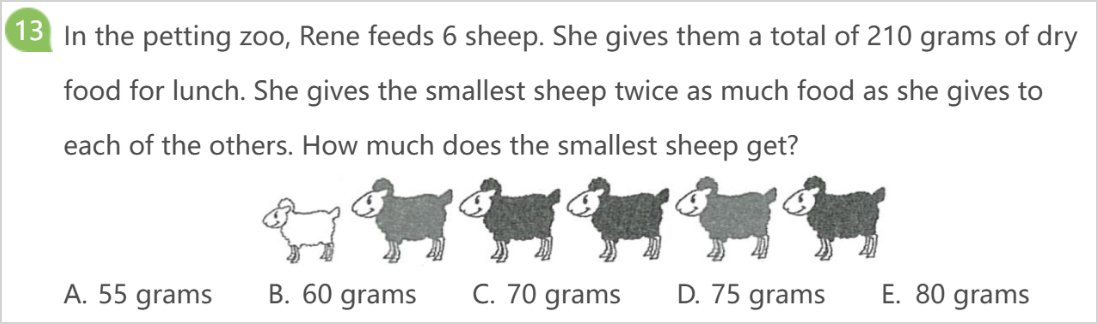
Problem (2025 Math Kangaroo Level 3-4 Question 13)
Solution
The smallest sheep eats twice as much as each of the other 5 sheep.
So, the 5 regular sheep each eat 1 portion, and the smallest sheep eats 2 portions.
That means the total food is divided into:
5 × 1 + 1 × 2 = 7 portions
If the total amount of food is 210 grams, then each portion is:
210 ÷ 7 = 30 grams
The smallest sheep gets 2 portions, so:
30 × 2 = 60 grams
Answer
B. 60 grams
Difference Between School Math vs. Math Kangaroo Application
In the classroom, multi-digit multiplication problems are usually:
- Straightforward
- Focused on computation accuracy
- Practiced in familiar formats
In contrast, math contests like Math Kangaroo feature:
- Multi-step problem-solving
- Pattern recognition
- Applying multiplication in unfamiliar contexts
- Require careful reading and logical thinking — misreading the question often leads to mistakes, even if the math is correct.
This transition from school math to enrichment math challenges students to think beyond the arithmetic.
How to Learn Multiplication Step by Step
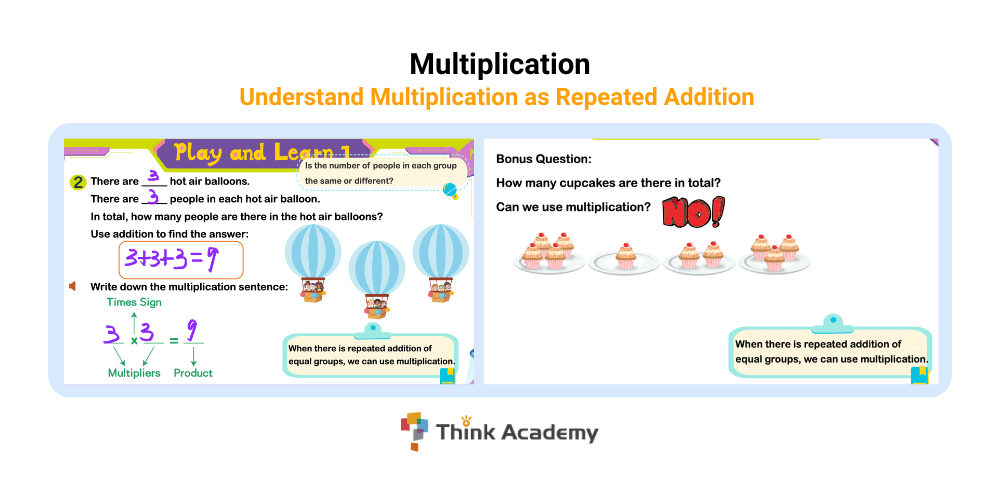
Step 1: Understand Multiplication as Repeated Addition
At its core, multiplication is just adding equal groups.
In simple terms: Number of groups × Number in each group = Total (also called the product).
Step 2: Explore Multiplication Properties Visually
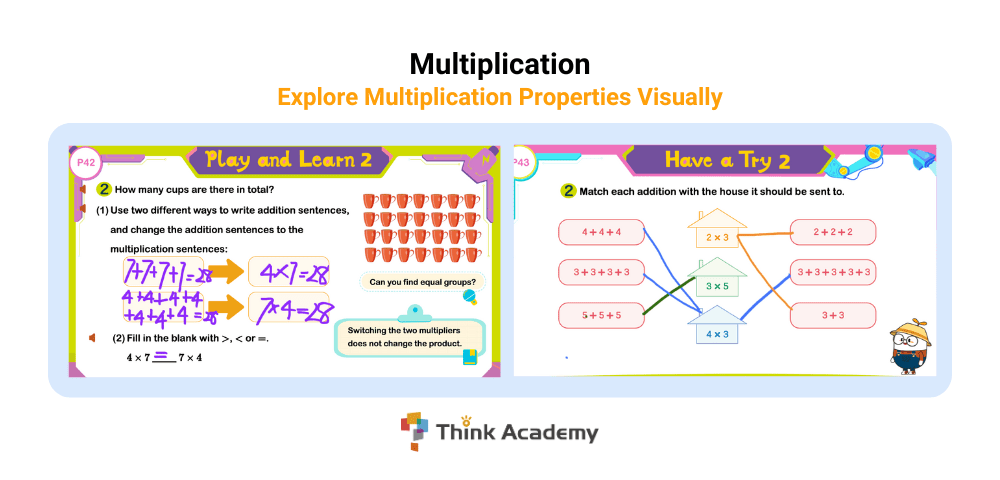
Multiplication has some special properties that make solving problems easier — and they're best learned through visual models.
Use objects, number lines, or arrays to show this in action. A strong visual and structural understanding helps children grasp multiplication beyond just memorizing tables.
Step 3: Memorize the Multiplication Table by Recognizing Patterns
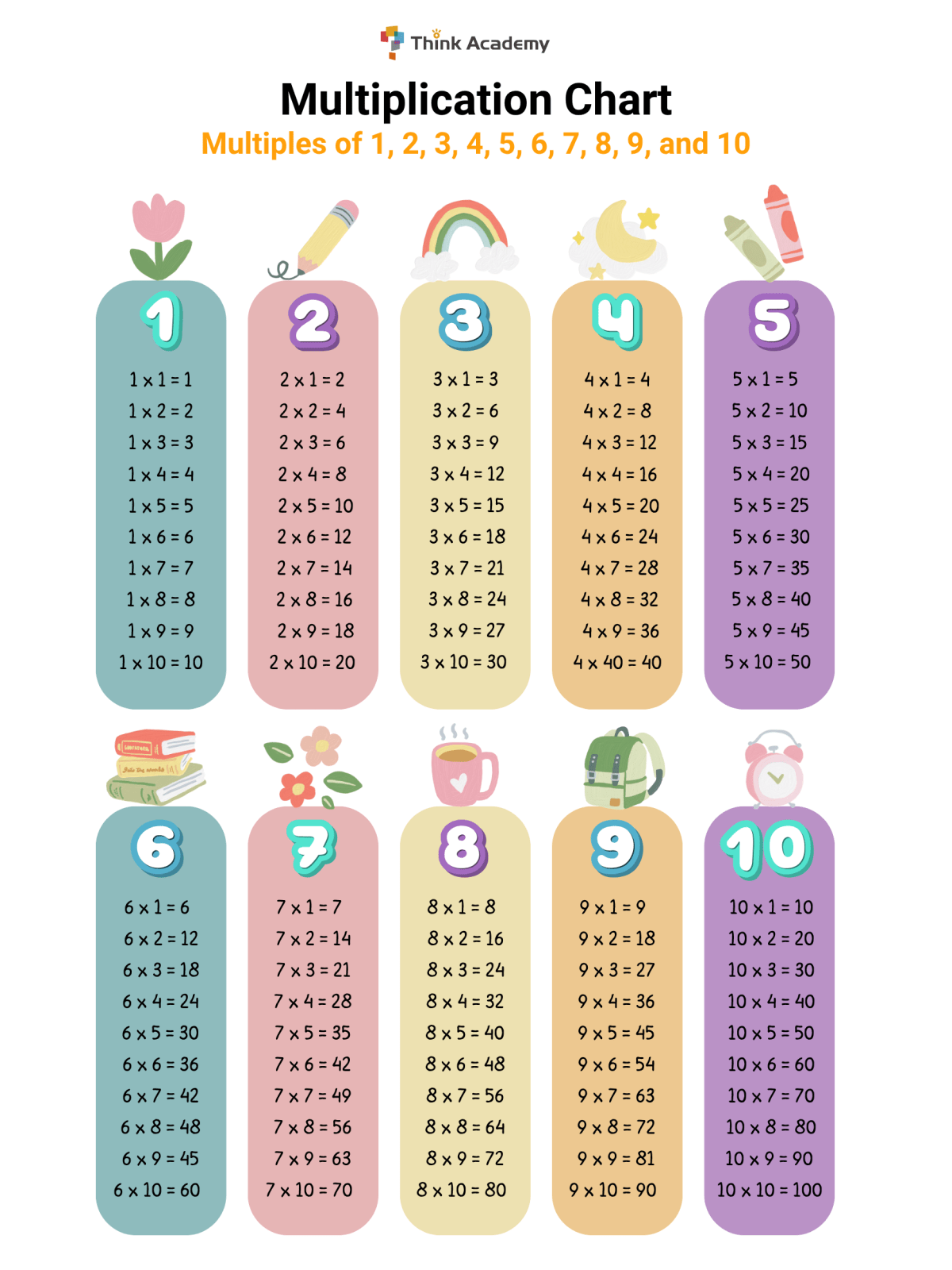
Once the concept is clear, the next step is fluency. Instead of memorizing blindly, teach your child to spot patterns — it makes learning faster and more meaningful.
Here are some key patterns:
- 1 × any number = the number itself
- 2 × any number = always even
- 5 × any number = ends in 0 or 5
- 10 × any number = ends in 0
- …
Recognizing these patterns not only boosts confidence but also builds strong number sense, making it easier to solve multi-digit multiplication problems later on.
Effective Tools for Learning Multiplication
Don't underestimate the power of the right resources. To help your child stay motivated and engaged, try:
Online Multiplication Games
Gamified learning keeps things fun while reinforcing skills:
- For Grades 2: Multiplication Crush – on Math Playground »
- For Grades 2–3: Hit the Meteor – Multiplication Challenge »
These games reinforce the 1 and 2 digits multiplication while encouraging faster recall and real-time application.
Printable Multiplication Charts
- Separate worksheets for practicing multiples of 1, 2, 3, 4, 5…to 10.
- Available in 1-9, 1–10, 1–12, 1–20 versions
- Includes objects and examples to help early learners visualize
Try Pengi AI — Smarter Math Practice for Students
Pengi AI supports K–12 learners with personalized math practice, guided explanations, and feedback designed to help them build confidence and improve steadily.