Pengi Editor's Note: This article was originally published by Think Academy. We're sharing it here for educational value. Think Academy is a leading K-12 math education provider.
Problem Solving for Kids: What Parents Can Do
What is Problem Solving?
Problem solving is a mindset. We are raising children in a world where artificial intelligence can solve complex math equations in seconds. This massive shift means the definition of problem solving for kids has completely changed.
Because of this new reality, true problem solving is the ability to build a clear logical structure in your mind so you can confidently tackle unknown challenges. Ultimately, it is the ability to face a difficult situation, try a solution, and bravely bounce back to try again if that first attempt completely fails.
For example, it is the ability for a child to look at a tangled shoelace, a tricky math equation, or a disagreement with a friend, and simply not panic.
You can clearly see this difference in a math classroom. If a child lacks a problem-solving mindset, they often freeze when they see an unfamiliar word problem. They might complain, “I have never seen this before, so I cannot do it,” or “I saw this once, but I forgot the formula.” However, a child with strong problem-solving skills reacts completely differently. Even though the question is brand new, they do not give up. They will pause and ask themselves logical questions. They will wonder, “What is this problem really asking? What information do I already have? What methods can I try to build a path to the answer?”
This process of trying, failing, learning, and trying again builds incredible emotional resilience. When children learn to tackle obstacles rather than giving up, they build a growth mindset. This is an essential trait that can—and absolutely should—be cultivated long before they ever sit down for a difficult math test in school.
Problem Solving Doesn’t Happen in a Vacuum (The 4 Cs)
Developing problem solving for kids is deeply interconnected with other essential developmental traits. We often refer to these as the “4 Cs” ( Collaboration, Communication, Creativity, and Critical Thinking ).
- **Critical Thinking:**This is the analytical engine behind finding solutions. Before a child can solve a problem, they need to understand it. Critical thinking is the ability to pause, ask “why” or “how,” and evaluate a situation logically rather than reacting purely out of frustration. (Check out our full guide on critical thinking for more)
- **Collaboration:**Rarely are problems solved in total isolation. Whether they are figuring out how to build a massive LEGO tower with a sibling or working on a group math project, kids need to learn how to listen to others’ ideas, share the workload, and find mutual fixes without arguing.
- **Communication:**You cannot fix a problem if you cannot explain what is wrong! This is the ability to accurately articulate the issue. Instead of just crying and saying “It’s ruined!”, effective communication is a child learning to say, “I am frustrated because this puzzle piece won’t fit here.”
- **Creativity:**Math and life are not always black and white. Creativity is brainstorming out-of-the-box, unconventional solutions when the standard approach doesn’t work.
Avoiding the Biggest Pitfall
Biggest Pitfall: Parents directly solve the problem for kids.
To save time or avoid a meltdown, many parents usually swoop in and fix the problem or give them the exact answer to the homework question. This is actually counterproductive. If your kids never have to solve a problem, they will never learn how. Parents’ role should be to guide and support, rather than doing the work for your kids. By stepping back, parents should empower your kids to develop their own independent strategies.
A Simple 5-Step Problem-Solving Framework for Families
When a crisis hits, like a spilled glass of milk or a frustrating school project, having a clear plan helps. Here is a memorable and actionable process you can use:
1. Allow the Emotion (Normalize the Struggle): Before you fix anything, make space for their feelings. Tell them that problems are a normal everyday occurrence. It is perfectly okay to feel sad, frustrated, or down. The crucial step is accepting that the problem happened and recognizing that they have the power to fix it.
2. Identify the Problem (Name It): Get clear on what exactly is wrong and why it might have happened. Have them put the issue into their own words.
3. Brainstorm (No Bad Ideas): Ask them, “How should we solve this?” Let them decide if they can do it alone or if they need help from a parent or friend. Come up with a few possible solutions together. Encourage both conventional fixes and wild, creative ideas!
4. Try & Evaluate (Embrace Trial & Error): Pick one solution and try it. If it fails, celebrate the failure! Say, “Great, we crossed one wrong answer off the list!” If it succeeds, take a moment to imagine if there could have been an even more creative way to do it.
5. Repeat and Internalize (Practice the Logic): This logical thinking process requires consistent repetition. Even though guiding them through these steps might feel time-consuming at first compared to just giving them a quick shortcut, you should stick with it. As they practice this mindset repeatedly, they will become much faster. Once they fully master these steps, they will seamlessly apply this underlying logic to solve almost any challenge they face in school or in life.
Age-by-Age Guide: What to Expect and How to Help
As children grow, the types of challenges they face naturally evolve. Effective problem solving for kids looks very different for a kindergartener than it does for a middle schooler. Here is a quick breakdown of what to expect at each stage and how you can adapt your approach to best support them.
Ages 4-6: Physical Boundaries & Emotional Basics
- What it looks like: At this stage, little problems cause massive frustrations. You will often see meltdowns over physical limitations—like a block tower repeatedly falling over—or watch them freeze when overwhelmed by simple daily choices.
- How to help: Focus on “narration.” Young children often don’t have the words for what went wrong. Say out loud, “I see the tower fell down. That is so frustrating! What if we make the bottom wider?” Instead of telling them exactly what to do, offer simple A/B choices (“Do you want to use the red block or the blue block next?”). This helps them build their decision-making muscles without feeling overwhelmed.
Ages 7-9: Social Rules & Logic
- What it looks like: Welcome to the age of “fairness”! You will notice peer conflicts on the playground, disputes over board game rules, and their first real encounters with basic logic puzzles at school.
- How to help: It is time to take a half-step back. Instead of jumping in immediately to settle a sibling argument or fix a mistake, start asking, “What do you think we should do?” Let them practice negotiating game rules with their friends before you intervene. This is a critical window for teaching them how to collaborate and compromise.
Ages 8-12: Independence & Academic Challenges
- What it looks like: The stakes begin to feel higher for them. Expect to see real homework frustration (especially when math starts introducing complex word problems!) alongside increasingly complicated friend dynamics.
- How to help: Teach them the superpower of “breaking it down.” When a math worksheet or a big science project feels completely impossible, they will want to give up. Show them how to turn one giant, overwhelming problem into three small, manageable steps. Crossing off that first small step builds massive academic confidence.
Ages 13+: Complex Life Navigation
- What it looks like: Teenagers are suddenly juggling serious time management, heavier academic stress, and deep social issues, all while craving independence.
- How to help: Shift your parenting role entirely from “manager” to “sounding board.” Resist the urge to give them the answers or fix their schedules. Instead, ask guiding questions—like “What is your biggest worry about this situation?” or *”What are your top two options right now?”*—that help them discover their own solutions while knowing you are there as a safety net.
Top Activities and Books That Boost Problem Solving for Kids
One of the best ways to practice problem solving for kids is through reading and play from early ages. Here are parent-approved resources that naturally build these skills:
Best Books for Problem Solvers
| Book / Series | Best For | Why Kids Love It |
|---|---|---|
| Encyclopedia Brown (Donald J. Sobol) | Ages 8-12 | Each chapter has clues to solve a mystery, with the solution in the back. Read it together, solve it together, and eventually, they will do it alone. |
| The Panda Problem & What Do You Do With a Problem? | Ages 3-8 | Story-driven picture books that beautifully illustrate how to approach and visualize problems without fear. |
| The Most Magnificent Thing (Ashley Spires) | Ages 3-7 | A wonderful story about perseverance, dealing with frustration, and the messy process of prototyping. |
| A to Z Mysteries & Boxcar Children | Ages 6-10 | Great for early readers. Kids work together to solve mysteries entirely without adult intervention. |
| Pegasus Princesses (Emily Bliss) | Ages 6-8 | “The problems are simple, but the setup and payoff structure is solid. My kids were inspired to lean into a problem-solving mindset in their own play!” – Real Parent Review |
Best Activities for Problem Solvers
| Activity | How to Play |
|---|---|
| DIY Scavenger Hunt | Hide clues around the house where the answer to one clue leads to the location of the next. |
| Board Games | Games that require players to plan steps ahead and adjust their strategy when they get blocked, e.g.,Rush Hour, Blokus, Chess, or even classic Tangrams. |
| “Bad Art” Night | Use recycled materials to build the “ugliest” or “most useless” invention. It completely removes the fear of making a mistake! |
| What Would You Do? Table Scenarios | During dinner, pitch a hypothetical scenario. “You are at school, and you realize you forgot your lunchbox. What do you do?” or “You and your friend both want to play with the exact same toy. How do we solve this fairly?” |
From the Living Room to the Math Classroom
Building problem solving for kids is a long-term journey. As children grow, many parents look to mathematics to cultivate this trait because math is the fundamental root of so many subjects, especially in STEM.
However, advanced problem-solving isn’t built by simply telling kids to “think harder.” It’s built through the right kind of guidance, practice, repeated over time—where children learn to stay curious, ask smart questions, test ideas, and revise their thinking.
That’s exactly what we aim to do in Think Academy classes.
Think Academy is a top-rated EdTech platform specializing in systematic math enrichment and competition training for Grades PreK–12. Rather than offering random, band-aid tutoring, we provide an interactive online math class known for energetic teachers and a complete, proven learning cycle. We excel at preparing students for math competitions (like Math Kangaroo and AMC 8) while building a rock-solid foundation for long-term academic success.
And most importantly: We don’t just teach math. We teach students how to become elite problem solvers.
We Teach the Reasoning Process, Not Just Answers
A big part of problem solving is learning how to analyze information before jumping to a solution. In Think Academy lessons, students practice working with different kinds of information: word problems (text), geometric figures (visual reasoning), and charts (data thinking).
Instead of simply telling students what to do, our teachers use open-ended questions to guide step-by-step reasoning:
- “What do you know for sure?”
- “What is the question really asking?”
- “What strategy could work here—and why?”
We guide them to actively break the problem apart on their own. They learn how to filter out the extra noise, draw their own structures, and find the hidden clues. This process helps them face the unknown without panicking.
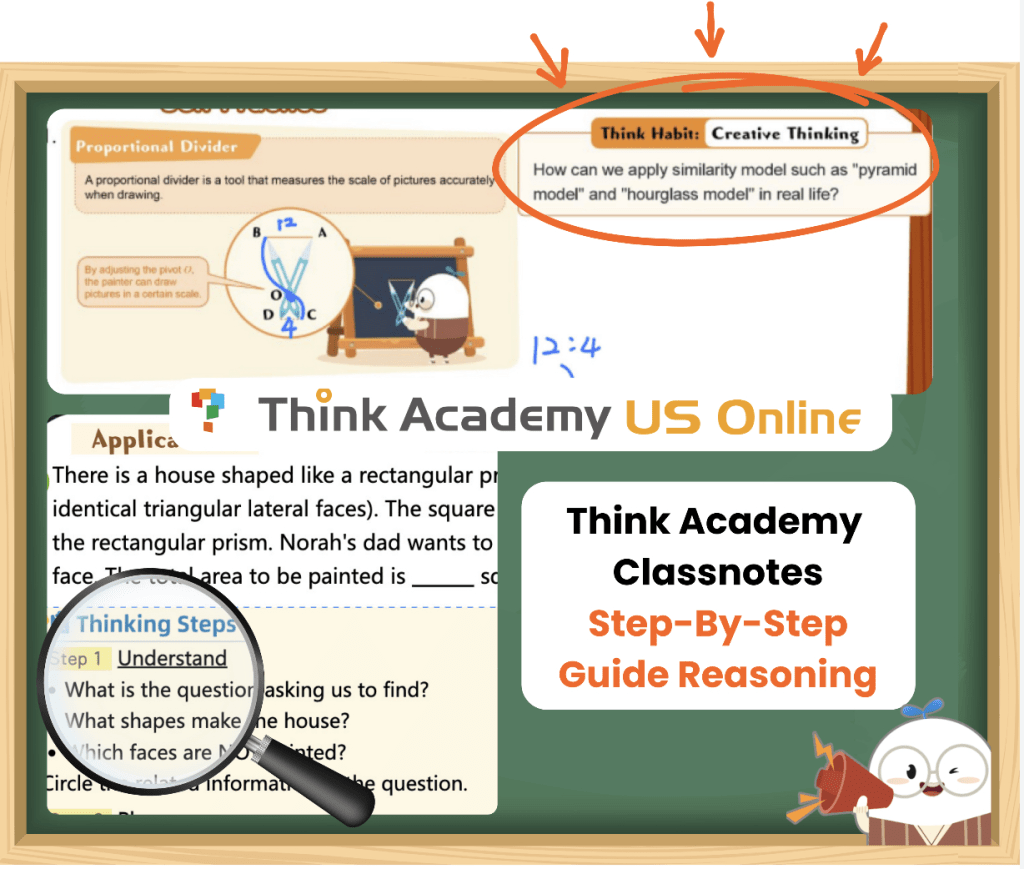
Think Academy Classnote Highlight
We Make Thinking Visible Through Discussion
Great problem solving isn’t only about being “right.” It’s also about understanding different approaches. In our welcoming classrooms, students are encouraged to explain their own ideas and hear different viewpoints from classmates. This ability to communicate complex thoughts is a core leadership trait that top universities and future employers highly value. And Teachers also model how to compare methods and check reasoning, which supports thoughtful evaluation—a skill that matters in math and in life.
We Build Independent Thinkers Through Long-Term Growth
Problem-solving is not a one-week skill. It’s something children develop through consistent, meaningful challenge. Through long-term math enrichment—steady effort, feedback, and reflection—students naturally become more resilient when problems get hard, confident in their reasoning, and independent in their decision-making.
Ready to Support Your Child’s Problem-Solving Journey?
If you’re interested in math enrichment that strengthens both academic skills and lifelong thinking habits, we recommend starting with an evaluation first.
Start a Free Evaluation with Think Academy Today
How It Works: The Think Academy Approach
At the heart of Think Academy is a cohesive, immersive learning cycle driven by cutting-edge technology and expert teaching. The entire experience challenges advanced learners while keeping them engaged and supported every step of the way.
- Step 1: Evaluate & Personalize
It starts with a Free 1-on-1 Evaluation. We pinpoint your child’s exact math level and map out a customized learning pathway just for them. - Step 2: Interactive, Live Teaching
No boring, passive videos! Our expert teachers use game-based, scenario-driven lessons to help kids discover the “why” behind the math. - Step 3: Collaborative Peer Learning
Students learn in a live virtual classroom where they can raise hands, discuss ideas, and solve problems alongside motivated peers. - Step 4: The Complete Learning Loop
Mastery takes practice. We combine pre-class prep, engaging homework, step-by-step video solutions, and 1-on-1 Office Hours so no question goes unanswered. - Step 5: Total Parent Visibility
You are never left in the dark. Our parent app provides detailed post-class performance reports and data, so you always know exactly how your child is growing.
Take Action: Not sure where your child currently stands? Let us help you find out.
Start a Free Evaluation with Think Academy Today
Try Pengi AI — Smarter Math Practice for Students
Pengi AI supports K–12 learners with personalized math practice, guided explanations, and feedback designed to help them build confidence and improve steadily.