
Pengi Editor's Note: This article was originally published by Think Academy. We're sharing it here for educational value. Think Academy is a leading K-12 math education provider.
Properties of Equality: Applying the Commutative, Associative, and Distributive
In mathematics, certain rules always hold true no matter which numbers we use. These rules, called properties of equality, describe how numbers can be rearranged, grouped, or expanded without changing their value. The three most common are the commutative, associative, and distributive properties. They are the foundation for simplifying expressions and solving equations in arithmetic and algebra.
Commutative Property
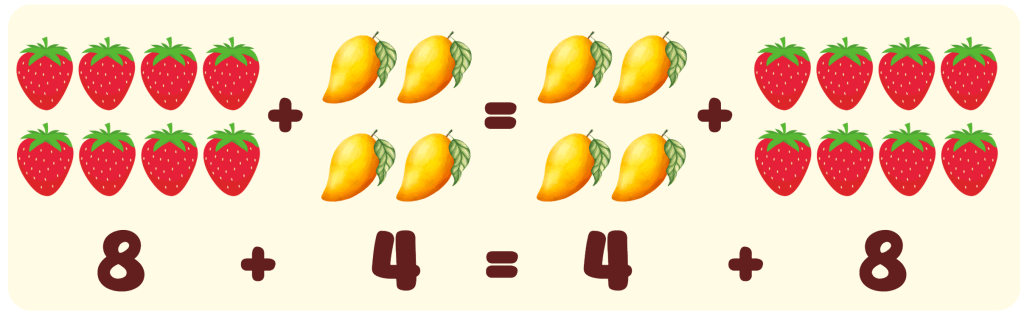
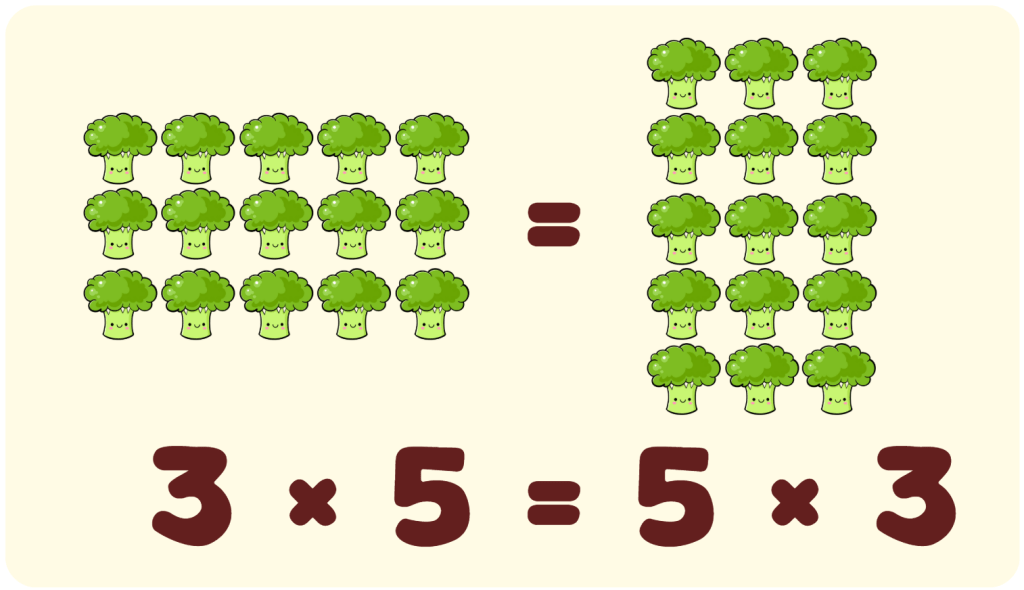
We can swap the order of numbers in addition or multiplication without changing the result.
Commutative Property of Addition
𝑎 + 𝑏 = 𝑏 + 𝑎
Example:
Commutative Property of Multiplication
𝑎 × 𝑏 = 𝑏 × 𝑎
Example:
Subtraction has NO Commutative Property
𝑎 − 𝑏 ≠ 𝑏 − 𝑎
Example:
10 − 6 = 4 , but 6 − 10 ≠ −4
Division has NO Commutative Property
𝑎 ÷ 𝑏 ≠ 𝑏 ÷ 𝑎
Example:
10 ÷ 5 = 2,
but
\[\small 5 \div 10 = \frac{5}{10} = \frac{1}{2} = 0.5 \ne 2\]
Associative Property
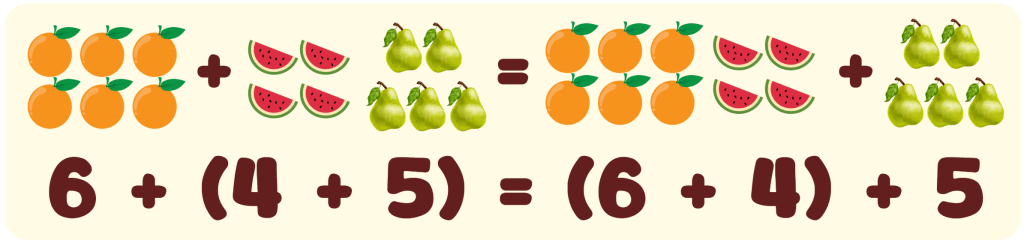
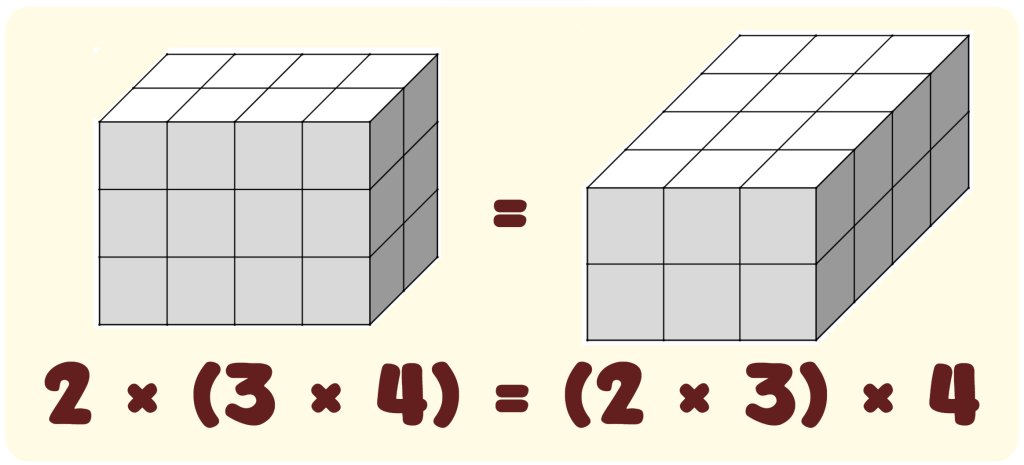
When we add or multiply numbers, the way we group them with parentheses does not change the result.
Associative Property of Addition
𝑎 + (𝑏 + 𝑐) = (𝑎 + 𝑏) + 𝑐
Example:
Associative Property of Multiplication
𝑎 × (𝑏 × 𝑐) = (𝑎 × 𝑏) × 𝑐
Example:
Subtraction has NO Associative Property
𝑎 − (𝑏 − 𝑐) ≠ (𝑎 − 𝑏) − 𝑐
Example:
10 − (5 − 3) = 10 − 2 = 8
(10 − 5) − 3 = 5 − 3 = 2
Since 8 ≠ 2, 10 − (5 − 3) ≠ (10 − 5) − 3.
Division has NO Associative Property
𝑎 ÷ (𝑏 ÷ 𝑐) ≠ (𝑎 ÷ 𝑏) ÷ 𝑐
Example:
40 ÷ (10 ÷ 2) = 40 ÷5 = 8
(40 ÷ 10) ÷ 2 = 4 ÷ 2 = 2
Since 8 ≠ 2, 40 ÷ (10 ÷ 2) ≠ (40 ÷ 10) ÷ 2.
Distributive Property
It connects two operations. It allows us to distribute one operation over another. The most common type is multiplication over addition or subtraction, but there are also cases where division works in a distributive way.
Distributive Property of Multiplication over Addition
Left-Distributivity (number outside on the left)
𝑎 × (𝑏 + 𝑐) = (𝑎 × 𝑏) + (𝑎 × 𝑐)
Example:
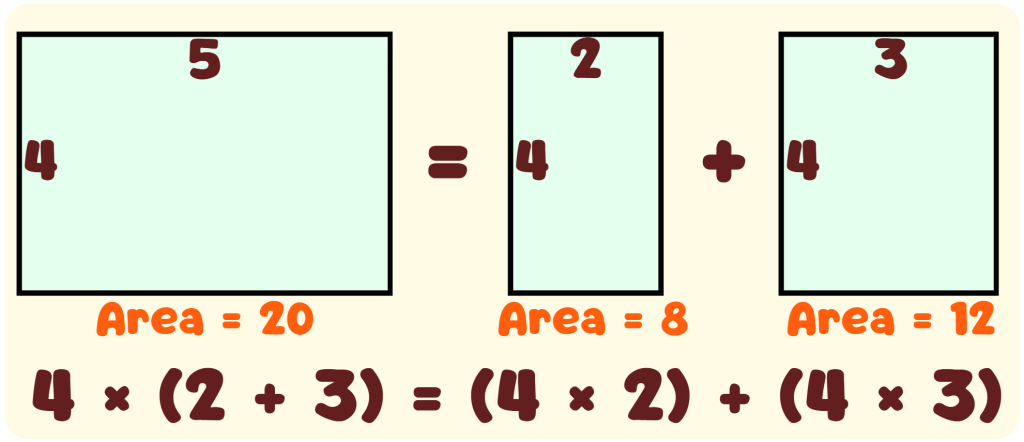
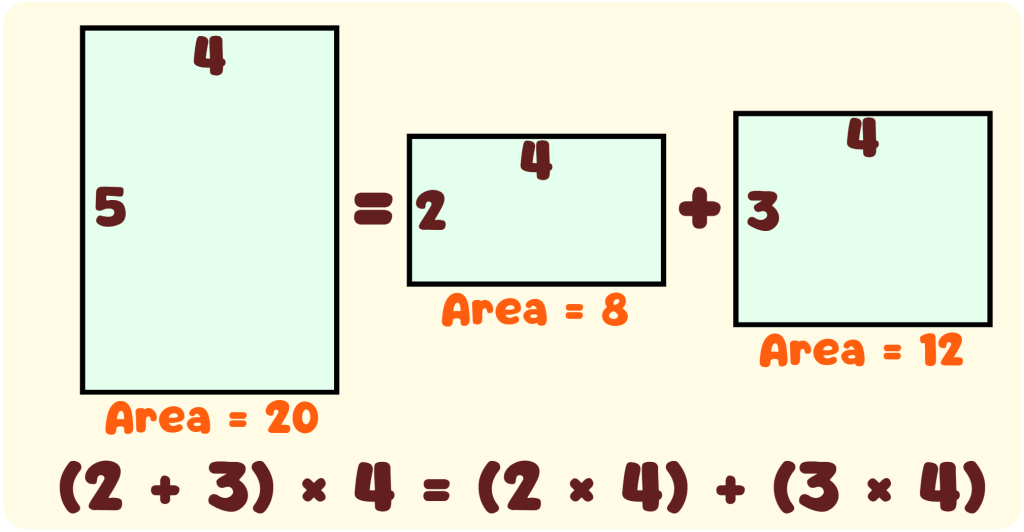
Right-Distributivity (number outside on the right)
(𝑏 + 𝑐) × 𝑎 = (𝑏 × 𝑎) + (𝑐 × 𝑎)
Example:
Distributive Property of Multiplication over Subtraction
Left-Distributivity (number outside on the left)
𝑎 × (𝑏 − 𝑐) = (𝑎 × 𝑏) − (𝑎 × 𝑐)
Example:
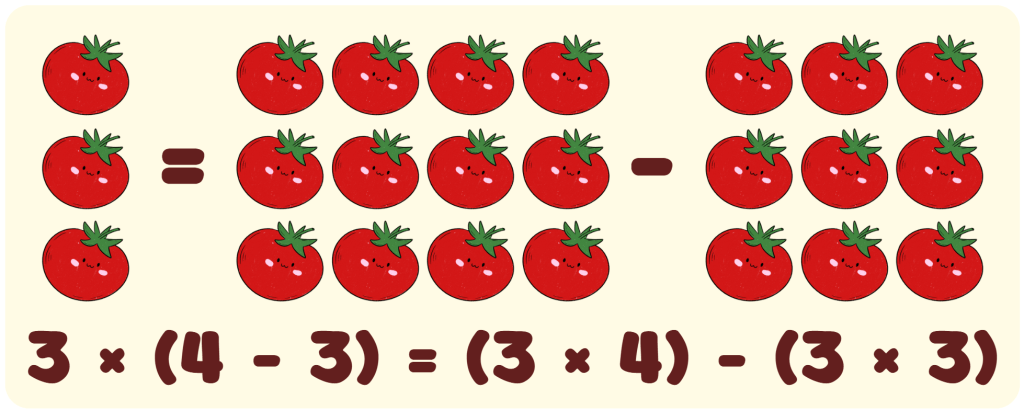
Right-Distributivity (number outside on the right)
(𝑏 − 𝑐) × 𝑎 = (𝑏 × 𝑎) − (𝑐 × 𝑎)
Example:
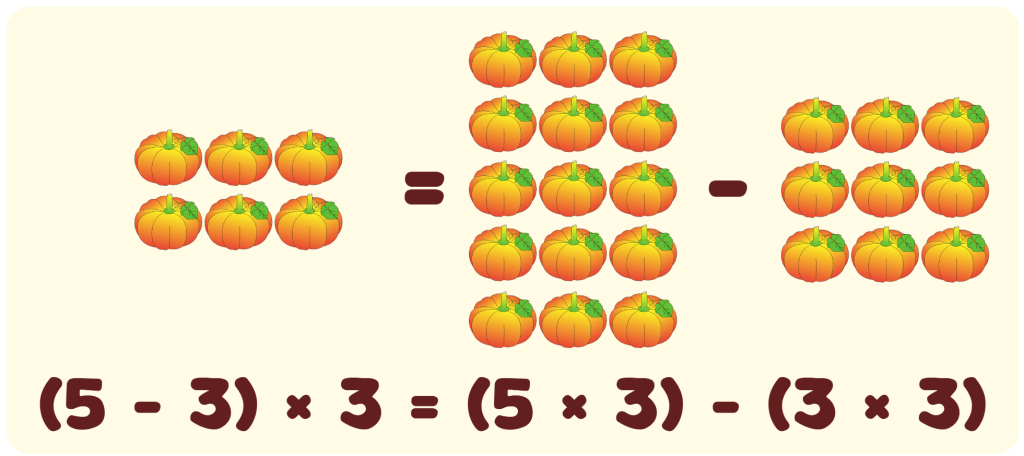
Summary
𝑎 × (𝑏 ± 𝑐) = (𝑎 × 𝑏) ± (𝑎 × 𝑐) (𝑏 ± 𝑐) × 𝑎 = (𝑏 × 𝑎) ± (𝑐 × 𝑎)
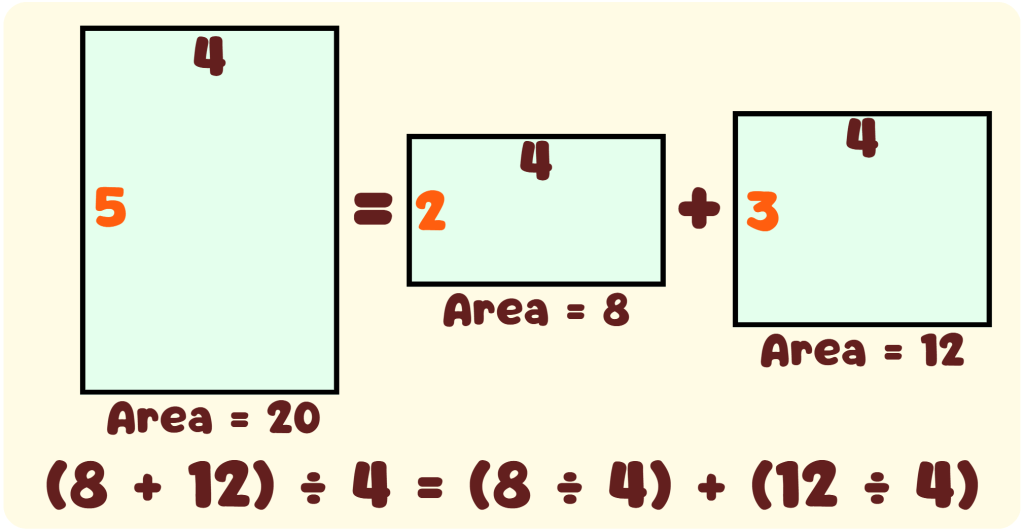
Distributive Property of Division over Addition
Right-Distributivity
(𝑏 + 𝑐) ÷ 𝑎 = (𝑏 ÷ 𝑎) + (𝑐 ÷ 𝑎)
Example:
Division over Addition has NO Left-Distributive Property
𝑎 ÷ (𝑏 + 𝑐) ≠ (𝑎 ÷ 𝑏) + (𝑎 ÷ 𝑐)
Example:
24 ÷ (2 + 4) = 24 ÷ 6 = 4
24 ÷ 2 + 24 ÷ 4 = 12 + 6 = 18 ≠ 4
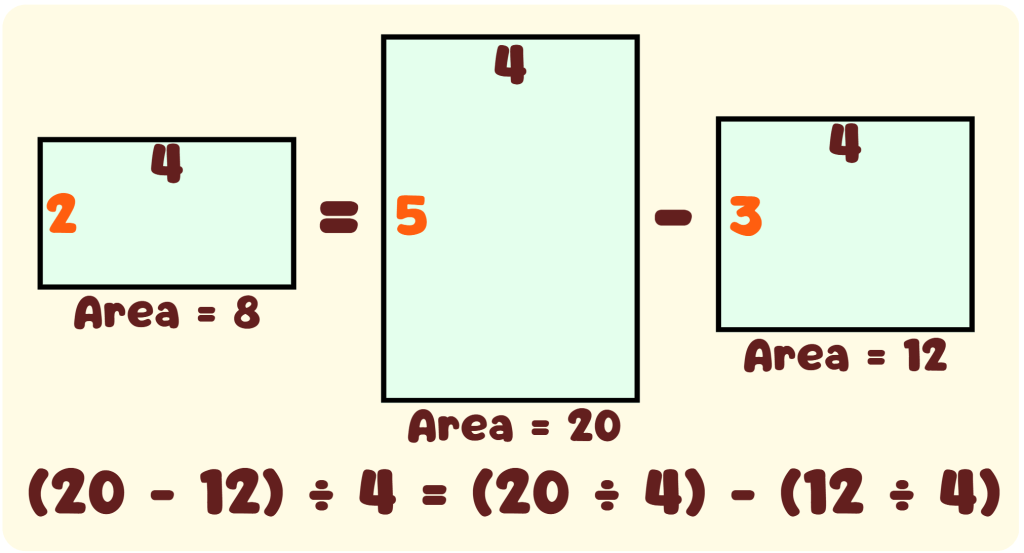
Distributive Property of Division over Subtraction
Right-Distributivity
(𝑏 − 𝑐) ÷ 𝑎 = (𝑏 ÷ 𝑎) − (𝑐 ÷ 𝑎)
Example:
Division over Subtraction has NO Left-Distributive Property
𝑎 ÷ (𝑏 − 𝑐) ≠ (𝑎 ÷ 𝑏) − (𝑎 ÷ 𝑐)
Example:
24 ÷ (4 − 2) = 24 ÷ 2 = 12
24 ÷ 4 − 24 ÷ 2 = 6 − 12 ≠ 12
Summary
(𝑏 ± 𝑐) ÷ 𝑎 = (𝑏 ÷ 𝑎) ± (𝑐 ÷ 𝑎)
Example Problems: Commutative, Associative, and Distributive Property
Example 1
Use the Distributive Property to calculate 19 × 8 + 19 × 2.
Solution:
Distributive Property of Multiplication over Addition: 𝑎 × (𝑏 + 𝑐) = (𝑎 × 𝑏) + (𝑎 × 𝑐)
∴ 19 × 8 + 19 × 2 = 19 × (8 + 2) = 19 × 10 = 190
The final result is 190
Example 2
Which expression is equivalent to (4·𝑚) + 7 ?
A. 7(4·𝑚)
B. 7 + (𝑚·4)
C. 4 + 7·𝑚
D. 4(𝑚 + 7)
Solution:
Commutative property of multiplication: 𝑎 × 𝑏 = 𝑏 × 𝑎
∴ 4·𝑚 = 𝑚·4
Commutative property of addition: 𝑎 + 𝑏 = 𝑏 + 𝑎
∴ (4·𝑚) + 7 = 7 + (4·𝑚)
The answer is B
Summary: Commutative, Associative, and Distributive Property.
- Commutative Property
- 𝑎 + 𝑏 = 𝑏 + 𝑎
- 𝑎 × 𝑏 = 𝑏 × 𝑎
- Associative Property
- 𝑎 + (𝑏 + 𝑐) = (𝑎 + 𝑏) + 𝑐
- 𝑎 × (𝑏 × 𝑐) = (𝑎 × 𝑏) × 𝑐
- Distributive Property
- 𝑎 × (𝑏 ± 𝑐) = (𝑎 × 𝑏) ± (𝑎 × 𝑐)
- (𝑏 ± 𝑐) × 𝑎 = (𝑏 × 𝑎) ± (𝑐 × 𝑎)
- (𝑏 ± 𝑐) ÷ 𝑎 = (𝑏 ÷ 𝑎) ± (𝑐 ÷ 𝑎)
Additional Math Topics Grade 6 – with Free Worksheets
Want more printable practice?
Download Grade 6 Free Worksheets
More Middle School Algebra Resources Ready for You
We’ve created a full library of printable resources — from foundational math to logic-based challenges — organized by grade to support every stage of your child’s journey.
Explore the K–12 Worksheets Hub
More related articles
Think Academy Math Program
If you’re looking to build on math strengths or close math gaps, we offer comprehensive K–12 math programs designed to:
- Catch up: Fill in gaps and strengthen foundational skills
- Stay ahead: Maintain a competitive edge and accelerate math progress
- Go further: Take on challenge math competitions, Math kangaroo, AMC competitions
Next Step: Take a personalized evaluation to understand your child’s current math progress and get a tailored roadmap for courses, pacing, and goals.
Try Pengi AI — Smarter Math Practice for Students
Pengi AI supports K–12 learners with personalized math practice, guided explanations, and feedback designed to help them build confidence and improve steadily.