Pengi Editor's Note: This article was originally published by Think Academy. We're sharing it here for educational value. Think Academy is a leading K-12 math education provider.
Pythagorean Theorem: Formulas, School and AMC Examples
The Pythagorean Theorem is one of the most important formulas in middle school math, used to solve right triangles by relating the lengths of their sides. It’s a core skill in geometry and shows up frequently in advanced math competitions like AMC 8 and AMC 10. In this guide, you’ll learn how to apply the Pythagorean Theorem formula through clear explanations and step-by-step examples. Plus, we’ve included free worksheets and a diagnostic assessment to help your child master this concept with confidence.
What Is the Pythagorean Theorem?
The Pythagorean Theorem is a key concept in middle school geometry, taught primarily in Grade 8 and sometimes earlier in advanced Grade 7 math classes. It applies specifically to right-angled triangles—triangles with one 90-degree angle—and shows how the three side lengths are mathematically related.
More than just a formula, the Pythagorean Theorem helps students connect algebra with spatial reasoning. It’s one of the first big ideas that bridges shapes and numbers, and it plays a major role in both school math and real-world problem-solving.
Pythagorean Theorem Formula
The Pythagorean Theorem equation is:
a² + b² = c²
Where:
- a and b are the lengths of the two legs (the shorter sides)
- c is the hypotenuse, the side opposite the right angle and the longest side in the triangle
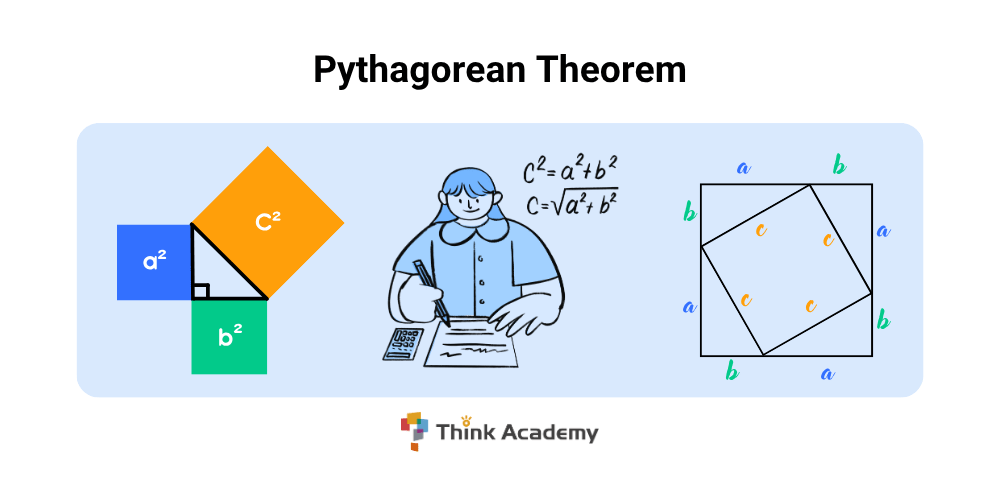
Think Academy – What is Pythagorean Theorem
How to Use Pythagorean Theorem
School-Level Examples
Let’s look at how this formula is used in school math problems. These examples are typical in Grade 7 or 8 textbooks and worksheets.
Pythagorean Theorem Example 1: Find the Hypotenuse
Problem
A right triangle has legs of length 6 cm and 8 cm. What is the length of the hypotenuse?
Solution
a² + b² = c²
6² + 8² = c²
36 + 64 = c²
c² = 100
c = √100 = 10
Answer
The hypotenuse is 10 cm.
Pythagorean Theorem Example 2: Find a Missing Leg
Problem
A triangle has one leg of 9 m and a hypotenuse of 15 m. What is the length of the other leg?
Solution
a² + b² = c²
9² + b² = 15²
81 + b² = 225
b² = 144
b = √144 = 12
Answer
The missing leg is 12 meters.
These types of problems are often included in Pythagorean Theorem worksheets to build fluency with identifying triangle parts and using square roots.
AMC 8 & 10-Style Application of Pythagorean Theorem
In math contests like AMC 8 and 10, problems involving the Pythagorean Theorem are more advanced. They often integrate the formula into layered scenarios or require a mix of skills, such as spatial reasoning or coordinate geometry.
Pythagorean Theorem Example 3
Problem (2020 AMC 8 Problem 18)
Rectangle ABCD is inscribed in a semicircle with diameter FE. Let DA = 16, and let FD = AE = 9. What is the area of rectangle ABCD?
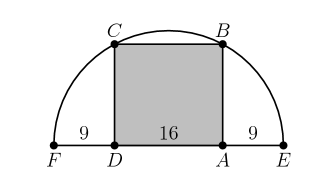
(A) 240 (B) 248 (C) 256 (D) 264 (E) 272
Solution
Let O be the center of the semicircle.
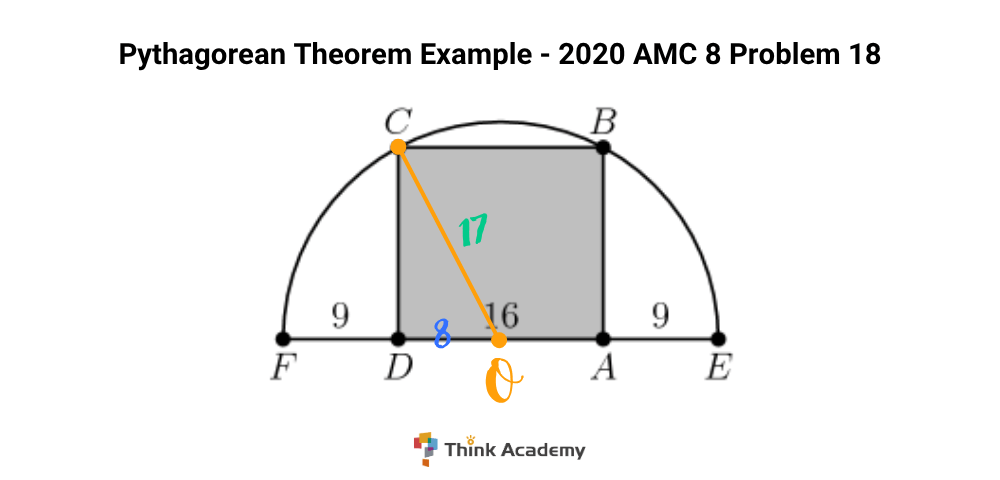
- Diameter FE = FD + DA + AE = 9 + 16 + 9 = 34
- Radius OC = 17
- Since O is the midpoint of DA, we have OD = OA = 16/2 = 8
Now apply the Pythagorean Theorem in triangle ODC:
OC² = OD² + CD²
289 = 64 + CD²
CD² = 225 → CD = 15
Area of rectangle ABCD = CD x DA = 16 × 15 = 240
Answer
(A) 240
Pythagorean Theorem Example 4: Diagonal in a Rectangle
Problem (2023 AMC 10A Problem 11)
A square of area 2 is inscribed in a square of area 3, creating four congruent triangles, as shown below. What is the ratio of the shorter leg to the longer leg in the shaded right triangle?
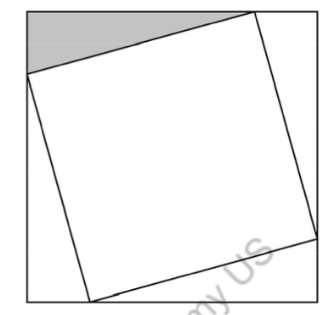
(A) 1/5 (B) 1/4 (C) 2 – √3 (D) √3 – √2 (E) √2 – 1
Solution
This is a symmetric chord geometry problem.
- Side length of the large square = √3
- Side length of the small square = √2
The four triangles formed are congruent. Assume the shorter leg of the shaded right triangle is x.
Then, the longer leg is √3 – x, and the hypotenuse is √2.
Using the Pythagorean Theorem:
x² + (√3 – x)² = (√2)²
Expand and simplify:
x² + (√3 – x)² = 2
x² + (3 – 2√3·x + x²) = 2
2x² – 2√3·x + 3 = 2
2x² – 2√3·x + 1 = 0
Solve using the quadratic formula:
x = [√3 ± √( (√3)² – 4·1·0.5 )] / 2
x = [√3 ± √(3 – 2)] / 2
x = (√3 ± 1) / 2
Since x is the shorter leg and must be less than √3 / 2, we take the smaller root:
x = (√3 – 1) / 2
Then the longer leg = √3 – x = √3 – (√3 – 1)/2 = (√3 + 1)/2
Now compute the ratio:
(shorter leg) / (longer leg)
= [(√3 – 1)/2] ÷ [(√3 + 1)/2]
= (√3 – 1) / (√3 + 1)
Rationalize:
Multiply by the conjugate
[(√3 – 1) / (√3 + 1)] × [(√3 – 1) / (√3 – 1)]
= (√3 – 1)² / ( (√3 + 1)(√3 – 1) )
= (3 – 2√3 + 1) / (3 – 1)
= (4 – 2√3) / 2
= 2 – √3
Answer
(C) 2 – √3
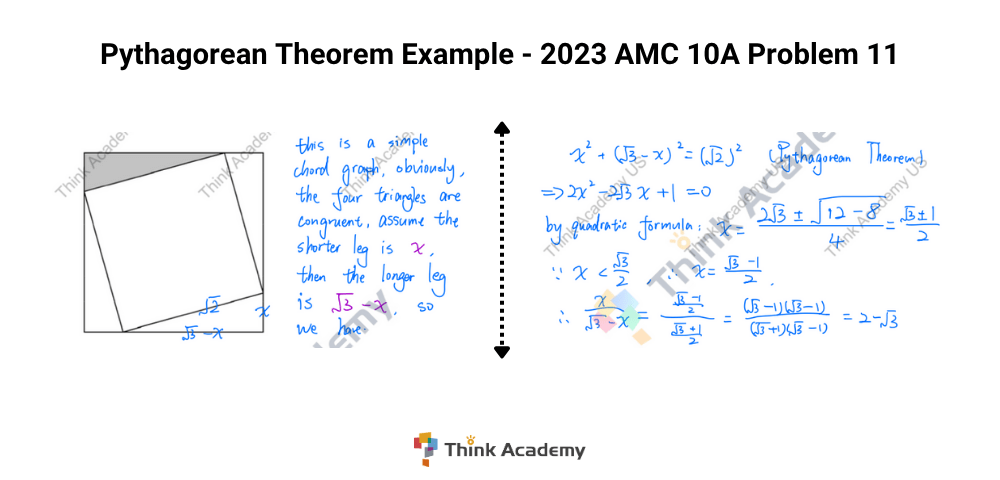
Think Academy – Pythagorean Theorem School Math Example 4
Difference Between School Math and AMC Application
In traditional school math, Pythagorean Theorem problems tend to be:
- Direct and formula-based
- Easy to identify from diagrams
- Focus on procedural fluency and accurate calculation
In contrast, enrichment programs like AMC use this concept in more challenging ways. Problems often:
- The triangle may be hidden within a complex figure or context
- Involves irrational numbers, estimation, or multiple steps
- Requires reasoning, pattern recognition, and flexible problem-solving
In competitions, reading carefully is just as important as knowing the formula. Students need to not only apply the Pythagorean Theorem but also think critically about how and when to use it.
Ready to Practice?
🎯 Download your Pythagorean Theorem practice worksheets. Go to the [G6 and above] Tab, and find the Geometry worksheets.
✅ Score 100%? Take the Think Academy Geometry Assessment for personalized 1-on-1 feedback.
Take Free Geometry Evaluation Test
Try Pengi AI — Smarter Math Practice for Students
Pengi AI supports K–12 learners with personalized math practice, guided explanations, and feedback designed to help them build confidence and improve steadily.