Pengi Editor's Note: This article was originally published by Think Academy. We're sharing it here for educational value. Think Academy is a leading K-12 math education provider.
SAT FAQs: Ultimate Guide for First-Time Takers
Getting ready for your first SAT? You’re not alone—and you’re in the right place.
The SAT can feel overwhelming, especially with recent changes like the shift to a fully digital format. But understanding the basics early helps reduce anxiety and gives you a solid start.
This guide answers the most common questions first-time SAT test takers will ask. From test format and timing to how to register, what to bring, and how scores are sent—here’s everything you need to know, in plain English.
What Is the SAT?
The SAT is a standardized test used by most U.S. colleges to evaluate students’ college readiness. It covers core academic skills, especially in math, reading, and writing.
As of 2024, the SAT is fully digital and includes two scored sections:
- Reading and Writing (ERW, Evidence-Based Reading and Writing)
- Math
Wondering what SAT originally stood for? It used to mean Scholastic Aptitude Test, but today, it’s simply called “the SAT.”
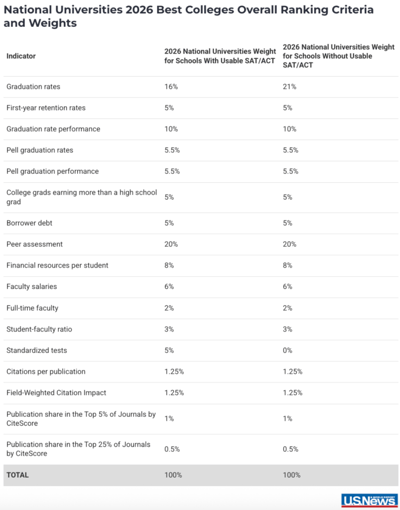
Why SAT Scores Still Matter
Many colleges are now test-optional, but optional doesn’t mean irrelevant.
Schools like Yale encourage students to submit SAT or ACT scores to help demonstrate academic ability—especially alongside GPA and coursework.
Some schools are even reinstating test requirements. For example, Dartmouth (starting with the Class of 2029), along with:
- MIT
- Georgetown
- University of Florida
- University of Georgia
- Georgia Tech
- Purdue
- West Point
In short: SAT scores are still a powerful way to stand out—especially if you’re applying to competitive schools or aiming for scholarships.
Standardized Tests are the only factors that can be improved over a short period of time.
What Is on the SAT?
The SAT measures the academic skills most important for college readiness. It focuses on content students typically learn by the end of 11th grade.
The test is divided into two main sections:
Reading and Writing
This section focuses on reading comprehension, vocabulary in context, grammar, and writing mechanics. You’ll be asked to:
- Interpret short literary and nonfiction passages
- Understand the meaning of words based on context
- Analyze sentence structure, transitions, and tone
- Revise text for clarity, grammar, and logic
- Use evidence to support conclusions and arguments
Math
This section covers core topics in algebra, advanced math, problem-solving, and data analysis, with some geometry and trigonometry. You’ll be expected to:
- Solve equations and inequalities
- Analyze graphs, charts, and tables
- Apply algebraic and geometric reasoning
- Interpret statistics and percentages in real-world scenarios
- Use formulas to model and solve word problems
Both sections are adaptive, meaning your performance in the first module determines the difficulty of the second. The goal is to measure your current skill level more accurately in less time.
How Many Questions Are on the SAT?
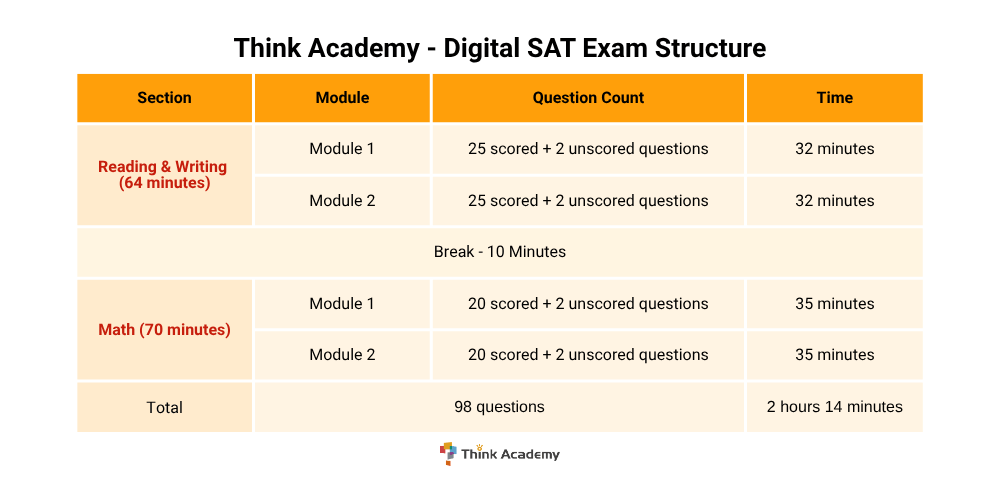
The digital SAT includes 98 scored questions:
| Section | Module 1 | Module 2 | Total (Scored) |
|---|---|---|---|
| Reading & Writing | 25 scored + 2 unscored | 25 scored + 2 unscored | 50 |
| Math | 20 scored + 2 unscored | 20 scored + 2 unscored | 40 |
Unscored questions are included for testing purposes but are not labeled—treat every question like it counts.
Total Scores of SAT
The SAT is scored on a 1600-point scale, combining two section scores:
- Reading and Writing: 200–800
- Math: 200–800
Each correct SAT answer adds one point to your raw score. There’s no penalty for wrong answers. Raw scores are then scaled from 200 to 800 per section, and the two section scores combine for a total score out of 1600.
The highest possible SAT score is 1600, and the lowest is 400.
Colleges may also look at:
- Percentile rank: how your score compares to other students
- Superscore: the best section scores from different test dates (if allowed)
To learn how SAT scores align with college admissions, see our full guide: What Is a Good SAT Score?
How Long Is the SAT?
The full digital SAT takes 2 hours and 14 minutes, including a 10-minute break between sections. That’s shorter than both the old paper SAT and the ACT.
| Section | Time |
|---|---|
| Reading & Writing | 64 minutes |
| Break | 10 minutes |
| Math | 70 minutes |
| Total | 2h 14m |
This shorter format is especially helpful for students who struggle with test fatigue or timing pressure.
The table below summarizes the SAT test duration and number of questions.
When Can You Take the SAT?
There’s no official minimum or maximum grade requirement to take the SAT. Students can technically take it as early as 8th or 9th grade, depending on their learning progress. However, most students take the SAT for the first time in 10th or 11th grade.
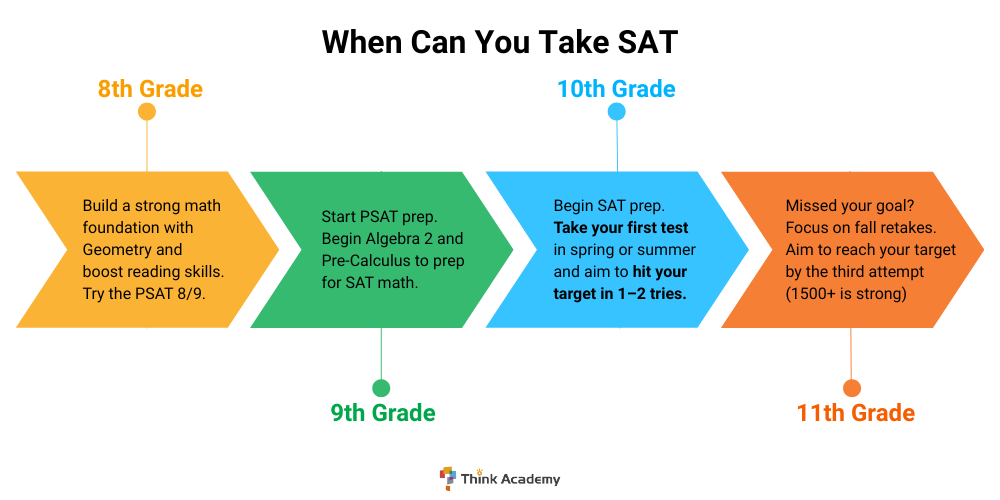
The SAT is offered multiple times a year, typically in: March, May, June, August, October, and December
First-timers often benefit from taking the SAT in spring of 10th grade or early 11th grade, giving enough time for a retake.
SAT School Day vs. SAT Weekend: What’s the Difference?
Here’s how SAT School Day and SAT Weekend compare:
| Category | SAT School Day | SAT Weekend |
|---|---|---|
| Who Registers | Your school registers you | You register yourself via your College Board account |
| Where It Happens | At your school during class time | At a public test center on a Saturday |
| Test Dates | March–April or October (school-selected days) | Fixed national dates (Aug, Oct, Nov, Dec, Mar, May, Jun) |
| Score Release | 3–4 weeks after test; scores sent to schools first | About 2 weeks after test day; viewable in your account |
| Retake Options | School-based retest if there’s a test-day issue | Makeup or refund available if irregularity occurs |
| Score Sends | Choose free score sends during test setup or within 3 days | Choose free score sends when you register or up to 9 days after |
| Cancellation | Request cancellation through your school within 5 days | Cancel through your account within 1 week |
If your school offers SAT School Day, it can be a convenient and stress-free option. If not, SAT Weekend gives you more flexibility in scheduling.
For more details, check this page.
How to Register for the Weekend SAT
Registering is simple and done online at collegeboard.org. Here’s how:
- Create a College Board Account Use your full name and accurate personal info.
- Go to “Register for the SAT” Find this under the “My SAT” dashboard.
- Choose Your Test Date and Location Use your ZIP code to find nearby test centers.
- Upload a Photo This must meet College Board’s ID guidelines.
- Pay and Confirm Standard fee is $68, with fee waivers available.
- Print Your Admission Ticket You’ll need it on test day (printed preferred).
Don’t wait too long—test centers can fill up quickly, especially in popular months.
How Much Does the SAT Cost?
| Fee Type | Amount |
|---|---|
| SAT Registration | $68 |
| Late Registration | $38 |
| Change Test Center | $29 |
| Cancel by Change Deadline | $34 |
| Cancel After Deadline | $44 |
Fee waivers are available to eligible students and cover up to 2 free SATs, plus score reports and more.
For more details, visit this page
What to Bring to the SAT
Required:
- Fully charged device with Bluebook app installed
- Photo ID (matching your registration info)
- Printed admission ticket
- Approved calculator (or use the digital one)
- Pencils or pens for scratch work
Nice to have:
- Charger or power bank
- Watch (without alarm)
- Snacks and water
- Backup device (if possible)
Do NOT bring phones, smartwatches, or anything that makes noise.
Test Day Tips
- Doors open at 7:45 AM, and close at 8:00AM. The test usually starts between 8:15–8:45 AM
- Make sure to bubble in answers properly—only bubbled answers are scored
- Guess when needed—there’s no penalty for wrong answers
- Pace yourself—don’t get stuck too long on any one question
When do SAT scores come out?
SAT scores are typically released within 2-4 weeks after your test date.
Here’s a timeline breakdown:
| Test Type | Score Release Timeline |
|---|---|
| Weekend SAT | About 2 weeks after the test date (usually on a Friday) |
| SAT School Day | Typically 3–4 weeks after the in-school test date |
| Digital SAT | Most students receive scores around 2 weeks after test day |
| College Delivery | Colleges usually receive scores within 1 week after student release |
You’ll get an email when your scores are ready. Log in to your College Board account to access and send them.
How Many Times Can You Take the SAT?
There’s no limit to how many times you can take the SAT, but most students take it 2–3 times.
How to Send SAT Scores to Colleges
You can send your SAT scores directly to colleges through your College Board account. This can be done at the time of registration or after you’ve received your scores.
Step-by-Step: How to Send Scores
- Sign in to your College Board account at collegeboard.org
- Navigate to the “Send SAT Scores” section
- Search for colleges by name or code (see BigFuture College Codes)
- Select your recipients and decide whether to send:
- All scores, or
- Scores from specific test dates (Note: You cannot mix and match Math and Reading/Writing scores across test dates)
- Review the colleges’ score policies shown during selection to make sure you meet their requirements
- Review and pay (if applicable), then confirm your order
Free Score Sends
- When you register for a Weekend SAT, you can send scores to up to 4 colleges for free
- For SAT School Day, free score sends must be selected during test setup or within 3 days after the test via the Bluebook app, up to 4 colleges for free.
- You can add, remove, or change those colleges until 9 days after test day
- After that deadline, sending scores costs $14 per report, and $31 for rush delivery (if eligible)
How Long Does It Take to Send Scores?
| Delivery Type | Processing Time |
|---|---|
| Standard Delivery | 5–10 business days after order or test day |
| Rush Reporting | 1–4 business days (only for released scores) |
| College Receipt Time | Colleges typically receive scores within 1 week of release |
Top FAQ: Should I submit a low SAT Score when applying to a Test-optional school?
Answer:
- If your score is below the median score of the school you apply to, you shouldn’t submit the score.
- When to submit a low SAT score: Only you have a reason for the low score (poor neighborhood, minority, etc.)
SAT vs. ACT: What’s the Difference?
Both tests are widely accepted, but they have some differences:
| Feature | SAT | ACT |
|---|---|---|
| Format | Digital only | Paper or digital |
| Sections | Reading/Writing, Math | English, Math, Reading, ScienceWriting (Optional) |
| Score Range | 400–1600 | 1–36 |
| Science Section | No | Yes |
| Test Duration | 2h 14m | 2h 55m (3h 35m with writing section) |
| Calculator Use | Allowed throughout | One section with calculator, one without |
How to choose between SAT and ACT – Key Highlights
English Section
- SAT uses short, varied passages—easier for most students to manage.
- ACT uses long, fixed passages—better for fast readers with strong focus.
Math Section
- SAT focuses on fewer algebra-heavy topics. Math is half the total score, so strong math students can reach 800 more easily.
- ACT covers more topics with longer word problems. Math counts for just one-fourth of the total score.
Science Section
- SAT has no Science section. Students strong in Algebra 2 and math reasoning often do better.
- ACT has a separate Science section with 6–7 passages. It suits students with broad science knowledge.
Scoring & Format
- ACT is scored out of 36 across 4 sections; harder to ace due to more questions.
- SAT is out of 1600 with fewer questions—small mistakes impact more at high score levels.
Timing & Strategy
- SAT gives more time per question—good for careful thinkers.
- ACT moves fast—best for confident, quick test-takers.
To summarize:
- SAT is better for students strong in algebra and who prefer shorter, focused sections.
- ACT suits students with wide subject knowledge and strong time management skills.
Try a practice test for both and choose the one that fits your strengths best.
How to Raise Your SAT Score: Math Acceleration That Works
One of the best ways to boost your SAT score is through math acceleration. The SAT draws from Algebra 1, Algebra 2, Geometry, and Precalculus—so the earlier you reach these courses, the more time you’ll have to master them before test day.
- Start early: Complete Algebra 2 by 9th or 10th grade.
- Master each step: Don’t rush—solidify Algebra and functions to avoid gaps.
- Practice smart: Use official SAT problems to connect coursework with test-style questions.
- Stay structured: A clear plan or mentor helps target weaknesses and aim for 750+ in Math.
In short: moving ahead in math—and mastering each stage—gives students a major edge for 1400–1500+ SAT scores.
to get 1-on-1 feedback on your progress and a customized study plan.
Planning Ahead in Lower Grades?
Early preparation builds the skills needed for accelerated math tracks and stronger readiness for advanced academic choices such as AP courses and the SAT. Consistent, well-structured practice helps students progress with confidence over time.
Access Think Academy’s free math worksheets for PreK through Grade 10, organized by grade and topic to support long-term skill development.
Recommended Readings
- 2025 Digital SAT Prep: Scores, Study Plans & Practices
- What’s a Good SAT Score in 2025? Understand, Compare, and Aim for Your Best
Try Pengi AI — Smarter Math Practice for Students
Pengi AI supports K–12 learners with personalized math practice, guided explanations, and feedback designed to help them build confidence and improve steadily.