Pengi Editor's Note: This article was originally published by Think Academy. We're sharing it here for educational value. Think Academy is a leading K-12 math education provider.
Types of Summer School and How to Choose the Right One
Summer school is a broad term that can mean very different things depending on a student’s grade level and learning goals. In the U.S., families consider summer school to help children catch up academically, recover credits, get ahead in core subjects, or prepare for more advanced programs, while others look for enrichment or specialized learning experiences. This guide explains what summer school really is, how it differs from summer camp, and how to choose the right type of summer program based on grade level, academic progress, and long-term goals—so parents can make confident, informed decisions.
What Is Summer School?
Summer school is a structured academic program offered during the summer months, designed to support students’ learning outside the regular school year. In the U.S., summer school is most commonly used from upper elementary through high school and focuses on clear academic goals such as reinforcing core skills, recovering credits, preparing for advanced coursework, or maintaining learning momentum during a long break.
Unlike the regular school year, summer school typically runs for a shorter, concentrated period and covers fewer subjects at a time, allowing students to focus more deeply on specific areas. Programs may be offered by public school districts, private education providers, or universities, and can take place in person, online, or in hybrid formats.
It’s important to distinguish summer school from summer camp. Summer school is academically driven and teacher-led, while summer camps focus more on recreation, social development, or skill-based activities such as sports or the arts. Understanding this difference helps families choose the option that best matches their child’s needs and goals.
Types of Summer School by Learning Goal
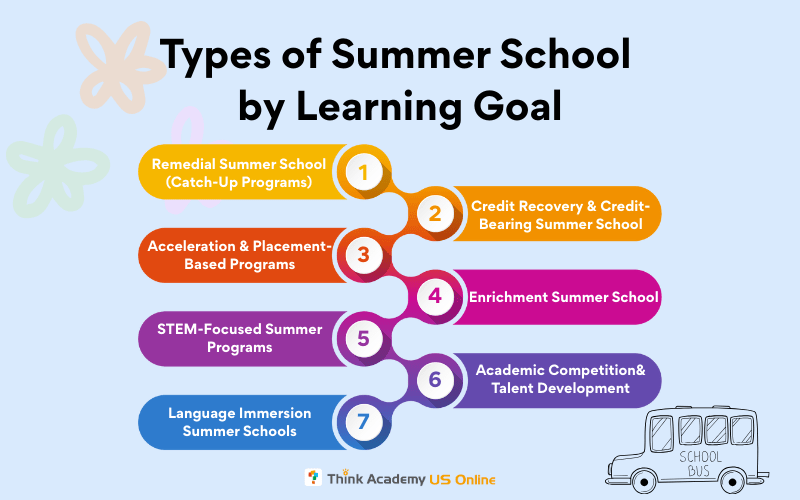
1. Remedial Summer School (Catch-Up Programs)
Remedial summer school supports students who need to strengthen core academic skills before moving on to the next grade. These programs usually focus on subjects such as math, reading, or English and are often short, targeted, and skills-based. They are commonly offered by public school systems or learning centers and are especially important for maintaining grade-level readiness.
2. Credit Recovery and Credit-Bearing Summer School
Credit recovery is a structured academic option most often used by middle and high school students. It allows students to retake courses they did not pass or did not complete. The goal is to help students stay on track and graduate on time. Credit recovery programs are credit-bearing. This means students earn official academic credit after successful completion. The course appears on the student’s transcript, is graded, and counts toward graduation requirements. Because of this, credit recovery programs must follow school- or district-approved curricula.
Credit-bearing summer school commonly serves students who need to meet curriculum requirements. Public school districts often offer both remedial support and credit recovery during the summer. These programs help students catch up in core subjects and avoid repeating a full academic year.
Some public school districts also offer acceleration and enrichment summer programs, especially in higher-performing districts. These programs are designed for students who want to get ahead or extend their abilities beyond grade-level expectations. For example, districts such as Pleasanton Unified School District provide summer options focused on recovery and readiness, while districts like Palo Alto Unified School Districtalso offer summer programs for academic acceleration and enrichment.
3. Acceleration and Placement-Based Programs
Acceleration and placement-based summer programs are designed for students who are ready to move ahead academically or prepare for higher-level placement in specific subjects. Unlike enrichment programs, which emphasize exploration, these programs follow a defined academic sequence and are often used to complete future coursework early, qualify for advanced tracks, or build readiness for more rigorous study during the school year.
A well-known example isJohns Hopkins Center for Talented Youth (CTY), a nonprofit academic center of Johns Hopkins University that serves advanced learners in Grades 2–12. Founded in 1979, CTY offers accredited, high-level coursework through day programs, residential programs, and online formats. Courses frequently go beyond standard school curricula and span areas such as advanced mathematics, science and engineering, language arts, and humanities.
CTY summer programs typically run in three-week sessions with structured daily schedules that emphasize depth, independent thinking, and sustained academic engagement. Enrollment is selective, requiring students to qualify through CTY’s identification process to ensure appropriate placement. Tuition varies by program format, with online options generally more affordable than residential programs, and financial aid is available. Overall, acceleration programs like CTY are best suited for students who are academically advanced, highly motivated, and seeking meaningful academic progression, rather than general enrichment or credit recovery.
4. Enrichment Summer School
Enrichment programs focus on exploration, creativity, and intellectual curiosity, rather than remediation or formal acceleration. They often rely on project-based learning and open-ended inquiry, making them appealing to families who want meaningful academic engagement without the pressure of grades or credit requirements.
The Harker School Summer Programs are largely enrichment-driven, with selective acceleration options available for older students. Programs serve students from Kindergarten through Grade 12, beginning with school-readiness and confidence-building enrichment in the early grades and progressing to more academically intensive offerings in middle school. At the upper school level (Grades 9–12), Harker’s Summer Institute includes rigorous, for-credit high school courses alongside non-credit enrichment, representing the program’s most clearly accelerated pathway. Overall, Harker’s summer programs are best suited for families seeking high-quality enrichment with thoughtfully designed opportunities for acceleration, rather than remediation or credit recovery. Registration for lower-grade programs is currently open, while upper-grade programs will open in February.
5. STEM-Focused Summer Programs
STEM-focused summer programs concentrate on science, technology, engineering, and mathematics, often through hands-on experiments, coding projects, or research-style learning. These programs are well suited for students who enjoy analytical thinking, problem-solving, and exploring how concepts are applied in real-world or research settings.
A well-known example is MIT Summer Programs, which include a group of highly selective STEM enrichment programs designed primarily for high school students, most commonly in Grades 9–11, with a particular emphasis on Grade 11. Rather than offering open-enrollment courses, MIT hosts and supports a small number of selective, independently run STEM programs that meet its academic standards and are held on or near the MIT campus.
Most MIT-affiliated high school programs run for two to six weeks during the summer and follow full-day schedules that resemble the pace and expectations of college study. These programs emphasize depth over breadth, challenging students to engage deeply with advanced STEM concepts. Fees vary by program: several flagship offerings are free of charge or provide generous need-based financial aid, while others may charge tuition depending on format and housing. Overall, MIT summer programs are best suited for students seeking intensive academic challenge and early exposure to advanced STEM learning, rather than general summer school or credit recovery.
6. Academic Competition and Talent Development Programs
These programs are designed for students with demonstrated strength or deep interest in a specific subject. They prioritize rigor, depth, and peer-level discussion, rather than broad exposure or introductory learning.
A representative example is the Ross Mathematics Program, a highly selective, six-week residential summer program for motivated pre-college students with a strong interest in mathematics. Ross immerses students in deep mathematical thinking, with a curriculum centered on problem-solving and proof-based exploration rather than standard coursework. The program emphasizes learning how to think mathematically—encouraging curiosity, logical reasoning, and persistence within a focused, supportive community. Sessions typically run from mid-June through late July at U.S. university campuses, and admission is based primarily on challenging application problems, not grades alone. Overall, Ross is best suited for students seeking intensive mathematical immersion and intellectual rigor, rather than general enrichment or credit-bearing study.
7. Language Immersion Summer Schools
Language immersion summer schools focus on intensive language use, often paired with cultural exposure, to accelerate fluency. Instruction is delivered primarily in the target language, encouraging students to think, speak, and interact naturally rather than rely on translation.
Well-known examples include Middlebury Language Schools, which offers full-immersion programs where students commit to using only the target language, and Concordia Language Villages, which combines language learning with cultural activities in immersive “village” settings. These programs are best suited for students seeking rapid language development rather than casual exposure.
Types of Summer School by Format and Location
Summer school programs can also be distinguished by how and where learning takes place. Options include:
- In-Person: Traditional classroom or campus-based
- Online (Virtual): Fully digital, synchronous or asynchronous
- Hybrid: Combination of online and in-person
- Day Programs: Students return home daily
- Boarding Programs: Residential, immersive experience
- Study Abroad Programs: Academic learning combined with cultural immersion
Types of Summer School by Institution
Local and District-Run Summer School Programs
Local and district-run summer school programs are typically organized by public school systems and are closely aligned with state standards and school requirements. These programs most often focus on remedial instruction, grade-level readiness, or credit recovery, particularly for middle and high school students.
Because they follow official curricula, district programs may award grades or academic credit and are sometimes required rather than optional. Class schedules, pacing, and expectations tend to resemble the regular school year, making these programs a practical choice for families who need continuity and formal academic recognition.
Independent Summer School Programs
Independent summer school programs are run by private organizations, learning centers, or education companies. These programs often emphasize flexibility and specialization, offering a wide range of formats, including in-person, online, and hybrid options.
Unlike district programs, independent summer schools are usually not bound by school calendars or credit requirements. This allows them to focus on skill-building, enrichment, acceleration, or targeted support. Families often choose independent programs when they want customized pacing, smaller class sizes, or subject-specific learning that complements, rather than replaces, school-based instruction.
University-Affiliated Summer Schools
University-affiliated summer schools are hosted by colleges and universities and are generally designed for older students, typically in middle or high school. These programs tend to be more academically intensive and are often recognized for their strong learning environments and access to university resources.
Courses may be taught by university faculty or experienced instructors and often mirror college-style instruction, with greater emphasis on independent learning and discussion. While not all programs offer academic credit, university-affiliated summer schools are widely viewed as opportunities for academic exploration, advanced study, and early exposure to higher education settings.
How to Choose the Right Summer School
Choosing a summer school works best when families start with clarity of purpose, rather than searching for a single “best” or most well-known program. Summer schools serve different roles, and the right choice depends on what a student needs most at this stage of their learning.
A helpful first step is to identify the primary goal. Some students benefit from academic support to reinforce core skills or recover credits. Others are ready for acceleration or advanced placement, while some may thrive in enrichment or exploratory programs that deepen interest without academic pressure. Matching the program type to the goal is more important than the program’s name.
Next, consider the student’s grade level and readiness. Younger students usually do best in shorter, skill-focused programs, while middle and high school students may be ready for more intensive, structured coursework. It’s also important to assess whether the program’s pace, expectations, and level of independence are appropriate for the student.
Program quality matters as well. Strong summer schools have clear learning objectives, experienced instructors, meaningful feedback, and appropriate selectivity for their purpose. Programs that simply offer access without clear standards often provide less long-term value.
Finally, practical fit should not be overlooked. Format (in-person, online, or hybrid), daily schedule, workload, and student support all affect whether a program will be productive and sustainable over the summer. When a summer school aligns with both a student’s academic needs and learning style, it is far more likely to result in meaningful progress and a positive experience.
Preparing for an Academic Summer—and What Comes Next
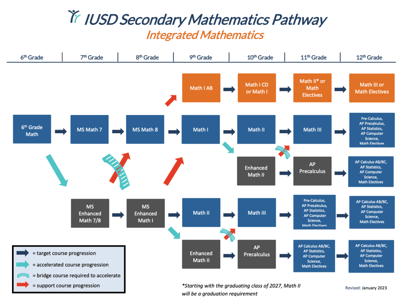
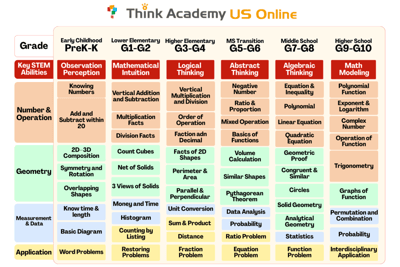
For families considering acceleration, advanced math pathways, or academic competition programs, summer can be a powerful time to build momentum. The key is understanding where a student is now—and what type of challenge will help them grow next.
At Think Academy, our summer math programs focus on systematic acceleration and competition readiness, helping students strengthen foundations while preparing for advanced coursework and contests such as AMC 8, AMC 10 and beyond.
Before choosing a summer program, we recommend starting with clarity. Our free math evaluation helps diagnose your child’s current level, identify gaps and strengths, and determine whether acceleration, enrichment, or competition preparation is the right fit. Based on the results, families receive personalized feedback and a clear learning plan—for the summer and for the upcoming school year.
Start the Free Math Evaluation
to prepare for a meaningful summer and build a confident, goal-aligned math pathway.
Try Pengi AI — Smarter Math Practice for Students
Pengi AI supports K–12 learners with personalized math practice, guided explanations, and feedback designed to help them build confidence and improve steadily.