Pengi Editor's Note: This article was originally published by Think Academy. We're sharing it here for educational value. Think Academy is a leading K-12 math education provider.
Unlock Middle School Math Success: Best Time to Start Pre-Algebra
Each spring and summer, thousands of parents ask the same questions:
- Is my child ready for Pre-Algebra?
- Is summer the right time to start?
- What if my school hasn’t mentioned this yet?
You’re not alone. As more school districts implement math placement tests in Grades 5–7, and as top-tier high school and college paths demand earlier math acceleration, the idea of starting Pre-Algebra early—especially during summer—has become more than a trend. It’s a strategic move.
What Is Pre-Algebra? And Why It’s a Big Deal
Pre-Algebra is the bridge between elementary math and the more abstract thinking required in Algebra 1. It helps students move beyond basic arithmetic into concepts like variables, equations, and proportional reasoning.
In the Common Core math curriculum, Pre-Algebra typically spans Math 7 and Math 8, covering topics like:
- Integers and the number line
- Order of operations and expressions
- Ratios, proportions, and percentages
- Inequalities and basic equations
- Coordinate graphs
- Introductory statistics: range, median, mode, outlier
- Reciprocal reasoning and simple functions
Mastering these concepts is essential for success in high school math and standardized tests.
For example, when students are asked, “If 4x = 20, what is x?” they might first guess or try random numbers. But in Pre-Algebra, they learn to reason:
“If 4 times something equals 20, then dividing both sides by 4 makes sense.”
That step—from guessing to generalizing a method—is what reasoning looks like.
Instructors often see a shift at this stage: students begin to look for patterns, ask “what if” questions, and justify their steps. It’s the foundation of all future math learning—from Algebra I to AP Calculus and beyond.
Ready for Pre-Algebra? Download free worksheets or take the readiness quiz now with Think Academy
When Do Students Learn Pre-Algebra?
There’s no universal answer to “When should students start Pre-Algebra?”—and that’s precisely why so many families fall behind the curve without realizing it.
Across the U.S., Pre-Algebra typically begins between Grade 6 and Grade 8—but the timing depends on school district, placement track, and even parental awareness.
In public schools, Pre-Algebra is sometimes embedded into Math 6 or 7. But here’s the catch: many districts use placement exams in Grade 5 or 6 to decide whether a student can skip ahead into Algebra 1 by Grade 7. T hese math placement test are almost entirely Pre-Algebra-based.
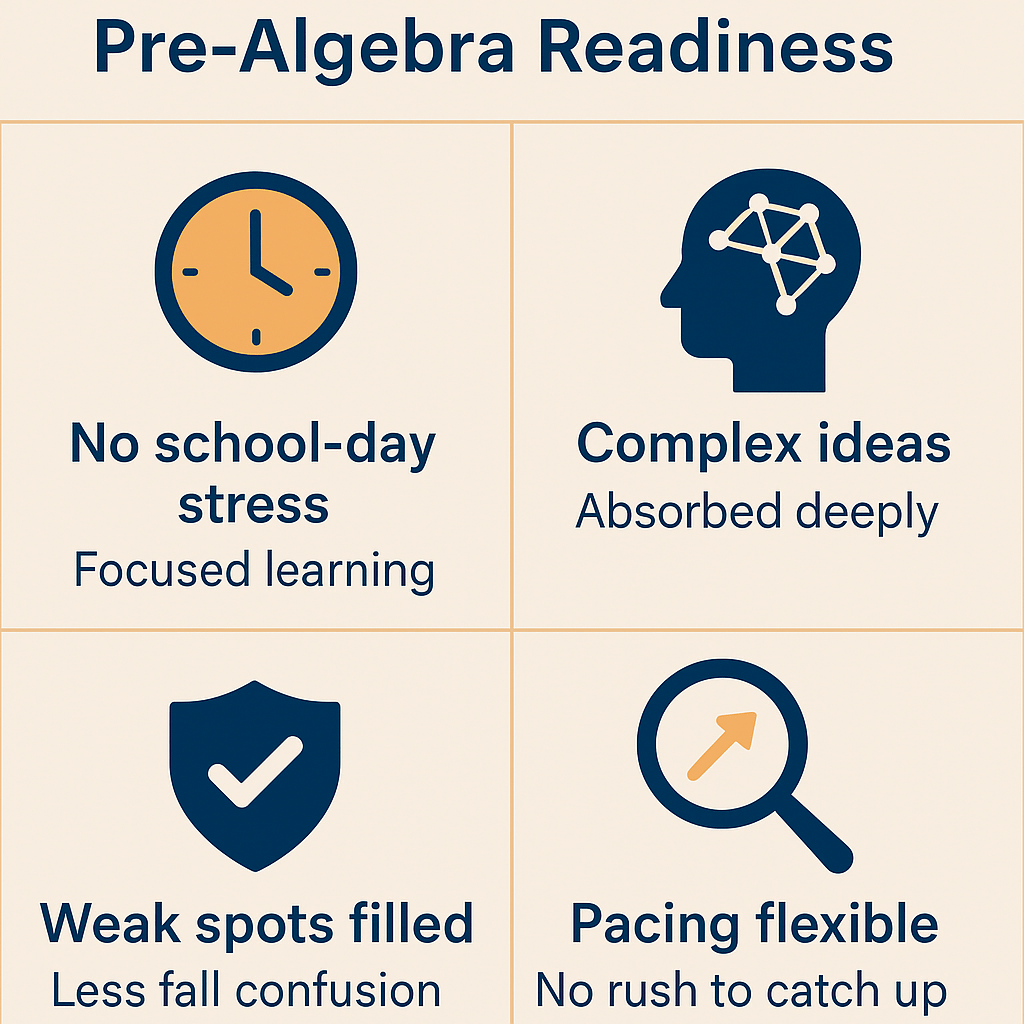
Think Academy – Why Summer Is the Best Time for Pre-Algebra Readiness
We often hear from families that their child was fine with arithmetic but “froze up” when faced with equations or unknowns. In summer, without the pressure of grades or deadlines, that anxiety drops—and understanding rises.
🗣 A parent recently told us: “He never had time to slow down during the school year. But this summer, for the first time, he actually asked questions—and answered them himself.”
Whether your child is preparing for a placement test, recovering from a tough math year, or simply wants to start middle school with confidence, summer provides a rare window to get it right—not just fast.
Real Pre-Algebra Examples to Try at Home
Here are a few sample problems students might encounter in a typical Pre-Algebra course:
1. Reciprocal
What is the reciprocal of 3/4?
Answer: 4/3 (To find a reciprocal, flip the numerator and denominator.)
2. Integer Comparison
Which is greater: –5 or –2?
Answer: –2 is greater. (It’s closer to zero on the number line.)
3. Outlier in Data
What’s the outlier in the following set: 3, 4, 5, 6, 42?
Answer: 42 is the outlier—it’s significantly different from the rest.
4. Inequality
Solve the inequality: 2x+3<112x + 3 < 112x+3<11
Answer: Subtract 3 → 2x<82x < 82x<8, divide by 2 → x<4x < 4x<4
5. Coordinate Plane
Plot the point (–2, 3). What quadrant is it in?
Answer: It’s in Quadrant II.
Want more Pre-Algebra problems?
Start the Pre-Algebra Readiness Quiz Now
*Sign-up required to access results and personalized insights.
💬 “I didn’t realize my daughter wasn’t confident with negative numbers until she took this quiz.” — A Think Academy Parent
What Makes a Strong Summer Pre-Algebra Program?
Whether you enroll your child in a live class or use at-home resources, what matters is not the format—but the structure.
Here’s what to look for in a high-quality Pre-Algebra summer program:
| Must-Have Feature | Why It Matters |
|---|---|
| Structured curriculum | Covers all essential topics (integers, variables, data, etc.) with a clear sequence—not random worksheets |
| Well-designed class pace | With varied goals and abilities, students benefit from preview materials, warm-ups, live sessions, and homework that support reinforcement and flexible pacing. |
| Logical progression | Helps students build understanding layer by layer, rather than jumping between disconnected drills |
| Real instructor feedback | Personalized input ensures mistakes are caught early and understanding sticks |
| Application opportunities | Good programs use puzzles, modeling, and problem-solving—not just rote formulas |
What Think Academy’s Pre-Algebra Program Covers
Think Academy’s Pre-Algebra curriculum is designed to go far beyond surface-level practice. Each module builds on a carefully sequenced knowledge map, ensuring students not only learn how to solve, but understand why the solution works.
Here’s a sample of what students will learn:
| Concept Area | Core Learning Targets |
|---|---|
| Arithmetic Foundations | Integer operations, absolute value, opposites, properties of operations |
| Exponents | Fractional bases, power rules, negative and zero exponents, real and irrational number operations |
| Algebraic Expressions | Polynomial simplification, combining like terms, distributive law, factoring, square difference formula |
| Equations & Inequalities | Linear equations, systems in two variables, substitution & elimination methods |
| Functions | Coordinate plane, slope-intercept form, graphs of linear functions, domain & range, word problems |
| Ratios & Proportions | Multi-way ratios, cross product, speed problems, real-life applications |
| Data & Statistics | Range, median, mode, outlier, interpreting data sets |
| Percents & Square Roots | Percent word problems, percent change, estimation with roots, square root simplification |
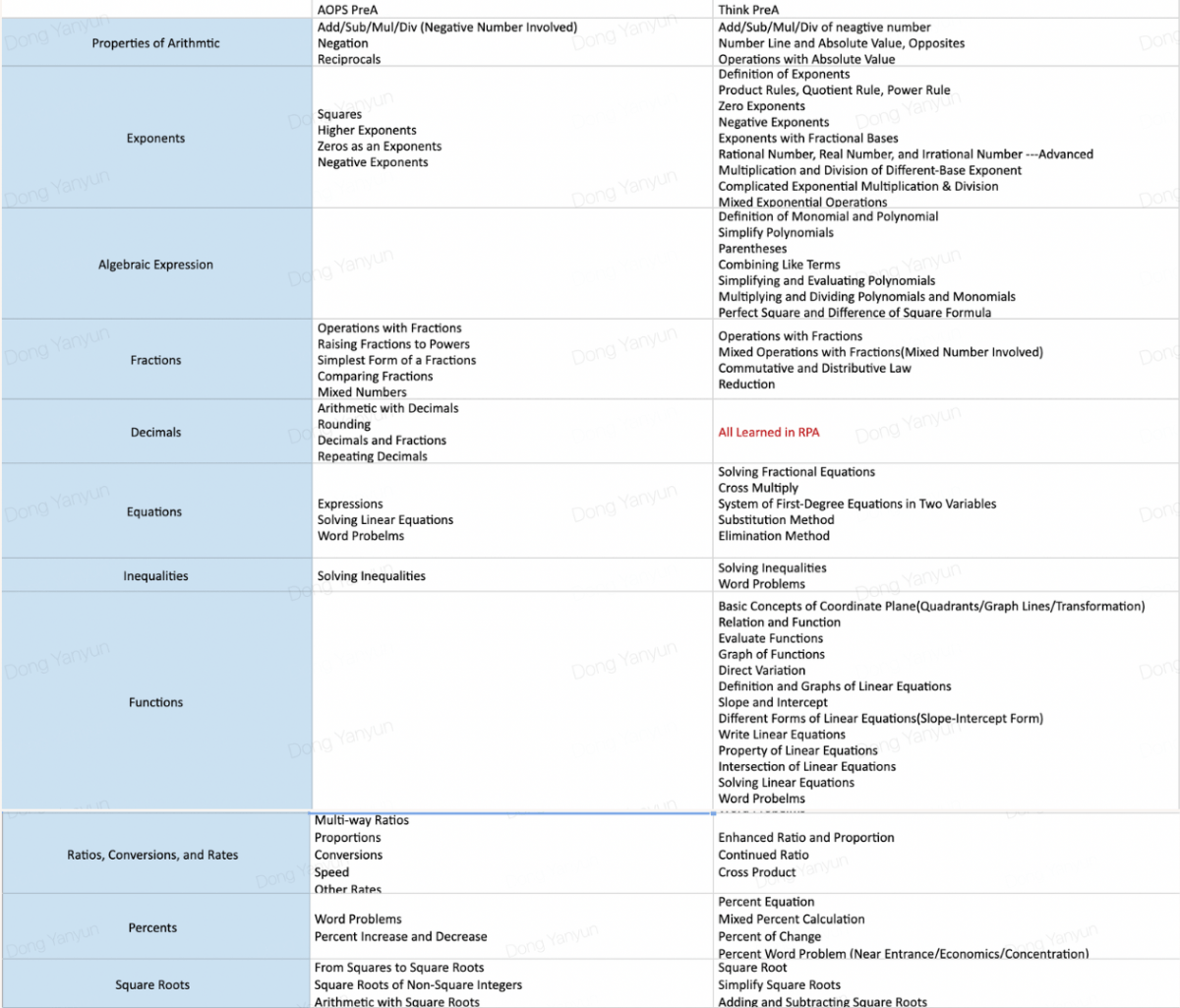
Think Academy Pre-Algebra course scope including exponents, expressions, systems of equations, functions, and proportions.
These topics are selected not only for school success, but for placement test readiness and long-term critical thinking.
“What impressed me most was how the teacher explained not just how to solve problems, but why it works.” — Parent from Palo Alto
Common Parent Misconceptions (FAQ)
Q1: When Do You Learn Pre-Algebra?
- In U.S. public schools (standard pathway): Most students start Pre-Algebra in Grade 7 (CC Math 7). Some schools introduce it earlier in Grade 6, especially for students on advanced tracks.
- In accelerated or honors pathways: High-achieving students may begin Pre-Algebra in Grade 5 or 6 to prepare for Algebra 1 by middle school.
- At Think Academy: We recommend starting Pre-Algebra when students have a solid grasp of operations with fractions, decimals, and basic ratios—typically in Grades 5–7.
Q2: Will this be repeated in school?
Some of it might—but the difference is in how it’s taught. Many schools move quickly, offering limited depth and little individual feedback. A strong summer course helps students truly understand concepts before they’re rushed through in class—especially before placement tests.
Q3: What if my child already feels confident in math?
That’s great! But arithmetic fluency doesn’t always mean they’re ready for algebraic thinking. We often see students who do well on school tests but freeze when faced with variables or open-ended problems.
Pre-Algebra strengthens logical reasoning—not just number skills.
Q4: Will summer math feel like more schoolwork?
Not if it’s done right. When students focus on one subject with no other academic pressure, learning feels calm and focused. Many kids say it’s the first time math has actually made sense.
Ready to Take the Next Step?
If you’re wondering where to begin—start with one small action today:
🎁 Option 1: Download Our Free Pre-Algebra Practice
Inside, you’ll find:
- Key concepts every student should know before Algebra 1
- 100 questions for pre-algebra practice
Pre-Algebra Practice
Download Now
Parent's Email Address: *
Zip Code *
Phone Number (Optional)
Student's First Name *
Student's Last Name *
Student’s Grade *
Pre-K3Pre-K4KindergartenGrade 1Grade 2Grade 3Grade 4Grade 5Grade 6Grade 7Grade 8Grade 9Grade 10Grade 11Grade 12
By submitting the form, you'll join our mailing list for free math worksheets, educational trends, event updates, and more. You can unsubscribe anytime.
Submit
After submission, the download link is in the confirmation message on this page.
Success! Your download is ready.
×
Oops! Something went wrong. Please try again later.
×
🧠 Option 2: Let Your Child Try the Pre-Algebra Readiness Quiz
- 5 classroom-style questions. Personalized feedback.
- Ideal for students in Grades 5–7 who are exploring summer learning or placement test prep.
Start the Pre-Algebra Readiness Quiz Now
*Sign-up required to receive detailed results and expert recommendations.
Try Pengi AI — Smarter Math Practice for Students
Pengi AI supports K–12 learners with personalized math practice, guided explanations, and feedback designed to help them build confidence and improve steadily.