Pengi Editor's Note: This article was originally published by Think Academy. We're sharing it here for educational value. Think Academy is a leading K-12 math education provider.
What Is a Good Math Kangaroo Score? A Complete Parent Guide
Every year, when Math Kangaroo results are released, parents ask the same question:
What is a good Math Kangaroo score?
Is it about the raw number? Percentile? National ranking? Awards?
The answer is more nuanced than a single number. A “good” score depends on:
- The scoring structure
- How rankings are calculated
- Your child’s percentile
- And most importantly — your goal
In this guide, we’ll explain how to interpret Math Kangaroo results clearly and thoughtfully, with detailed examples for Grades 1–4.
Understanding the Math Kangaroo Scoring System (Grades 1–12)
Before defining “good,” it’s essential to understand how Math Kangaroo scoring works.
The structure is consistent across all grade levels, with two score scales.
Grades 1–4
- 24 questions
- Maximum score: 96 points
Grades 5–12
- 30 questions
- Maximum score: 120 points
Each test is evenly divided by difficulty:
The student’s final score is simply the total points earned. There is no penalty for incorrect answers, which encourages students to attempt every problem. Because the maximum score is limited (96 or 120), even missing a single 5-point question can significantly affect percentile and ranking.
How to Read a Math Kangaroo Score Report
Understanding your child’s Math Kangaroo score report becomes much easier once you know what each column represents.
Let’s use the example shown in the image.
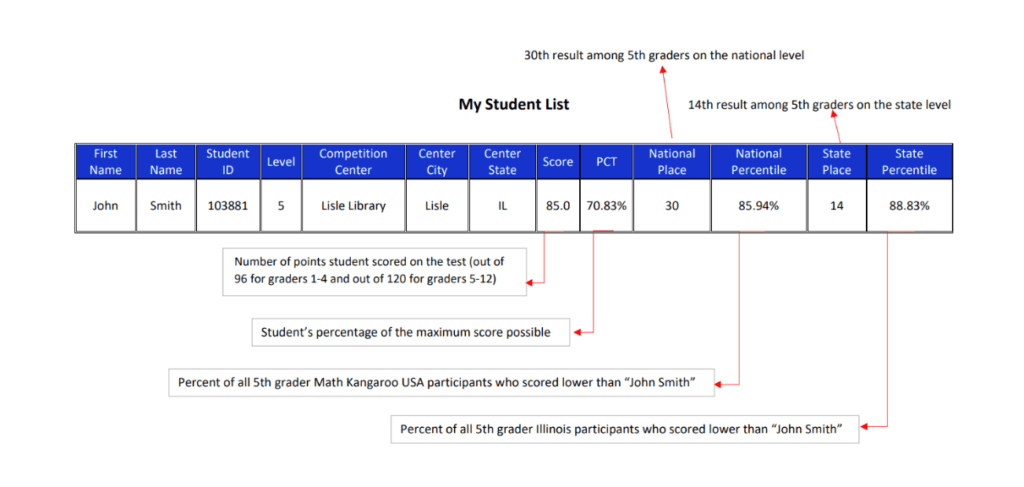
Math Kangaroo Score Report Example
The Metrics
1. Raw Score
The Score (85.0) is the total number of points earned on the test.
- For Grades 1–4, the maximum possible score is 96.
- For Grades 5–12, the maximum is 120.
In this example, the student is in Grade 5, so 85 out of 120 points were earned.
2. PCT (Percentage of Maximum Score)
The PCT (70.83%) shows the student’s percentage of the total possible score.
It simply answers:
What percentage of the full test score did the student earn?
This reflects accuracy, but it does not show how the student compares to others.
3. National Place & National Percentile
- National Place 30: The student ranked 30th among all Grade 5 participants nationwide.
- National Percentile 85.94%: The student performed better than approximately 85.94% of Grade 5 students across the United States.
This percentile gives broader context than rank because it shows relative standing among all participants.
4. State Place & State Percentile
- State Place 14: The student ranked 14th among Grade 5 students within their state (Illinois).
- State Percentile 88.83%: The student scored higher than approximately 88.83% of Grade 5 students in Illinois.
State percentile may differ from national percentile depending on the competitiveness of that state.
Putting It All Together
In this example:
- The student scored 85/120.
- Ranked 30th nationally.
- Ranked 14th in their state.
- Performed better than about 86% of students nationwide.
This report shows not just raw performance, but relative standing both nationally and locally, helping families understand where their child fits within the broader competition landscape.
Find Out If Your Child Is Ready to Compete,
Take a Free Math Kangaroo Evaluation
How Math Kangaroo Percentiles Are Calculated
Percentile is different from rank. While rank shows position among top performers, percentile measures relative standing among all participants.
Math Kangaroo calculates percentile using the standard formula:
Percentile = [(M + (0.5 × R)) / Y] × 100
Where:
- M = Number of students who scored below the student
- R = Number of students who scored exactly the same
- Y = Total number of students in the same grade (nationally or within the state)
This calculation ensures:
- Students with the same score receive the same percentile
- National percentile includes all U.S. participants
- State percentile includes only students within that state
For example:
If 200 students took the test in a state,
- 120 scored lower than a student,
- 10 scored the same,
Percentile = [(120 + 0.5 × 10) / 200] × 100 = 62.5
That means the student performed better than approximately 62.5% of participants in that grade in that state.
What Does Percentile Mean?
Percentile is often more informative than rank.
A percentile indicates:
The percentage of students who scored lower than your child in that grade.
For example:
- 85th percentile means your child scored higher than 85% of participants.
- 90th percentile means your child outperformed 90% of students nationwide.
Percentile provides context across the entire participant pool — not just the top 20.
How National and State Rankings Work
Beyond raw score, Math Kangaroo recognizes top performers nationally and by state.
National Awards
For each grade level nationwide:
- The top 20 highest scores receive National Rank.
- Rankings are listed from 1 through 20.
- Ties are possible — multiple students can share the same rank.
The top three receive gold, silver, and bronze medals.
Because of the limited total score, national rankings are often separated by just a few points.
State Awards
Within each state:
- The top three scores per grade receive State Rank 1, 2, and 3.
- Students may receive both national and state awards.
State-level thresholds vary depending on participation density.
A Good Score for Awards: What Did National Winners Actually Score?
For many families, a “good” Math Kangaroo score means earning National recognition. Instead of guessing, let’s look at the actual 2025 National Top 20 cutoffs for Grades 1–4 (maximum score: 96).
2025 National Award Score Benchmarks (Grades 1–4)
Based on the official 2025 National Winner data (maximum score: 96), here are the verified performance thresholds:
| Grade | Top 1 (Rank 1) | Top 3 Range | Top 20 Cutoff |
|---|---|---|---|
| Grade 1 | 96 | 92–96 | 74 |
| Grade 2 | 96 | 92–96 | 75 |
| Grade 3 | 96 | 92–96 | 75 |
| Grade 4 | 96 | 91–96 | 75 |
Download the full list of national ranking data
What These Numbers Mean
Across Grades 1–4:
- 75 points was sufficient to enter National Top 20.
- 92–96 points typically placed students within National Top 3.
- 96 points was a perfect score and often shared by multiple Rank 1 students.
Because the total possible score is only 96:
- Missing one 5-point question reduces the total score by more than 5%.
- A difference of just 2–3 questions can shift a student from Top 3 range down toward the Top 20 range.
National awards at this level reflect:
- High accuracy across all difficulty tiers
- Strong control of 5-point problems
- Consistency under time pressure
For many elementary students, earning recognition in the 75+ range already represents strong national-level performance and can be a meaningful confidence milestone.
Math Evaluation to see if your child ready for awards
Beyond Awards: Four Ways to Define a “Good” Score
Awards are one definition of success — but not the only one.
A good Math Kangaroo score can be understood from four perspectives.
a. Recognition: Building Confidence
If a student scores:
- 75+ → National Top 20 range
- 85+ → National Top 10 range
- 90+ → Medal-level range
that achievement can build a strong sense of accomplishment. For younger students especially, confidence often fuels long-term academic identity.
b. Competition Potential: Identifying Readiness
Students consistently scoring in the Top 10% (often mid-80s and above in Grades 1–4) typically demonstrate:
- Strong non-routine problem solving
- Logical flexibility
- Comfort with 5-point questions
- Strategic thinking under time pressure
This may indicate readiness for more advanced competition pathways such as AMC 8 in later grades. Here, a “good” score signals potential — not just performance.
c. Progress: Measuring Growth Year Over Year
Sometimes the most meaningful “good” score is improvement.
For example:
- Moving from 65 to 80
- Moving from 70 to 75
- Reducing errors on 5-point questions
Because the total score range is small, even a 5–10 point improvement is significant.
Progress demonstrates:
- Better time control
- Stronger reasoning structure
- Increased mathematical maturity
Growth trajectory often matters more than a single ranking.
d. Ability Extension: Thinking Beyond School Math
Math Kangaroo does not primarily test school curriculum.
It evaluates:
- Pattern recognition
- Multi-step reasoning
- Logical deduction
- Creative problem solving
A student scoring 60–70 in Grades 1–4 may not earn awards but may still demonstrate strong analytical thinking beyond grade-level expectations. That ability extension is itself a meaningful indicator.
So, What Is a Good Math Kangaroo Score?
Putting everything together:
For Grades 1–4 (Max 96):
- 60–70 → Developing logical reasoning
- 70–75 → Solid mathematical foundation
- 75–90 → Strong performance (approaching Top 20%)
- 91–96 → Elite-level precision
But the most important question is not:
“Is this score high enough?”
It is:
“What does this score reveal?”
Does it show:
- Confidence?
- Growth?
- Competition potential?
- Logical maturity beyond school math?
Because Math Kangaroo is not just about medals. It is a diagnostic window into your child’s reasoning development. And small score gaps are often strategic — not innate. With structured preparation, accuracy training, and exposure to 5-point problem types, meaningful improvement is absolutely achievable.
How Think Academy Can Help Your Child Achieve a “Good” Math Kangaroo Score (Grades 1–4)
Whether your goal is National Top 20, Top 3, or simply stronger logical thinking, the key is clarity and structured preparation.
At Think Academy, we support families at every stage — from readiness assessment to long-term competition growth.
1️⃣ Start with a Free Math Kangaroo Readiness Evaluation
Before enrolling in any program, it’s important to understand:
- Is your child comfortable with 5-point logic problems?
- Are mistakes conceptual or strategic?
- Is time management the issue?
- Is your child currently in the 70s, 80s, or 90s range?
Our free evaluation helps identify:
- Strengths
- Gaps
- Competition readiness level
After the evaluation, our academic consultant provides a personalized learning recommendation — not a one-size-fits-all plan.
2️⃣ Try a Math Kangaroo Trial Class
Not every class fits every student.
Our Math Kangaroo trial class allows families to:
- Experience our structured problem-solving approach
- See how we teach 3-point, 4-point, and 5-point questions
- Observe your child’s engagement and comfort level
This is a practical way to determine whether our Level 1–4 program is the right match for your kids.
Enroll In Math Kangaroo Trial Class
3️⃣ Mock Exam + Live Explanation Class (Before-Exam Sprint)
For families preparing close to competition season, we offer:
- Mock exams designed specifically for Grades 1–2 and Grades 3–4
- Live explanation sessions reviewing high-value problem types
- Strategic error analysis and time-management guidance
At $35 per session, this is an effective short-term prep option before the official test.
4️⃣ Long-Term Preparation for Next Year’s Competition
If your goal is sustained growth — not just a single score — long-term preparation makes the biggest difference.
After your child completes the evaluation, our consultant may recommend:
- Structured weekly competition classes
- Tiered Level 1–4 progression
- 5-point problem mastery training
- Logical reasoning extension beyond school math
Long-term training focuses on:
- Building accuracy
- Increasing percentile year over year
- Moving from 70s → 80s → 90s range
- Developing true competition confidence
Because in Math Kangaroo, a difference of just 2–3 questions can separate Top 3 from Top 20 — and strategy matters.
A “good” Math Kangaroo score is not just a number — it is a reflection of reasoning ability, precision, growth, and confidence. Whether your child is aiming for National Top 20, building toward Top 3, or simply strengthening logical thinking beyond school math, what matters most is understanding where they stand and what the next step should be. With the right evaluation and structured preparation, small improvements can lead to meaningful breakthroughs — and sometimes, just one or two questions make all the difference.
Try Pengi AI — Smarter Math Practice for Students
Pengi AI supports K–12 learners with personalized math practice, guided explanations, and feedback designed to help them build confidence and improve steadily.