
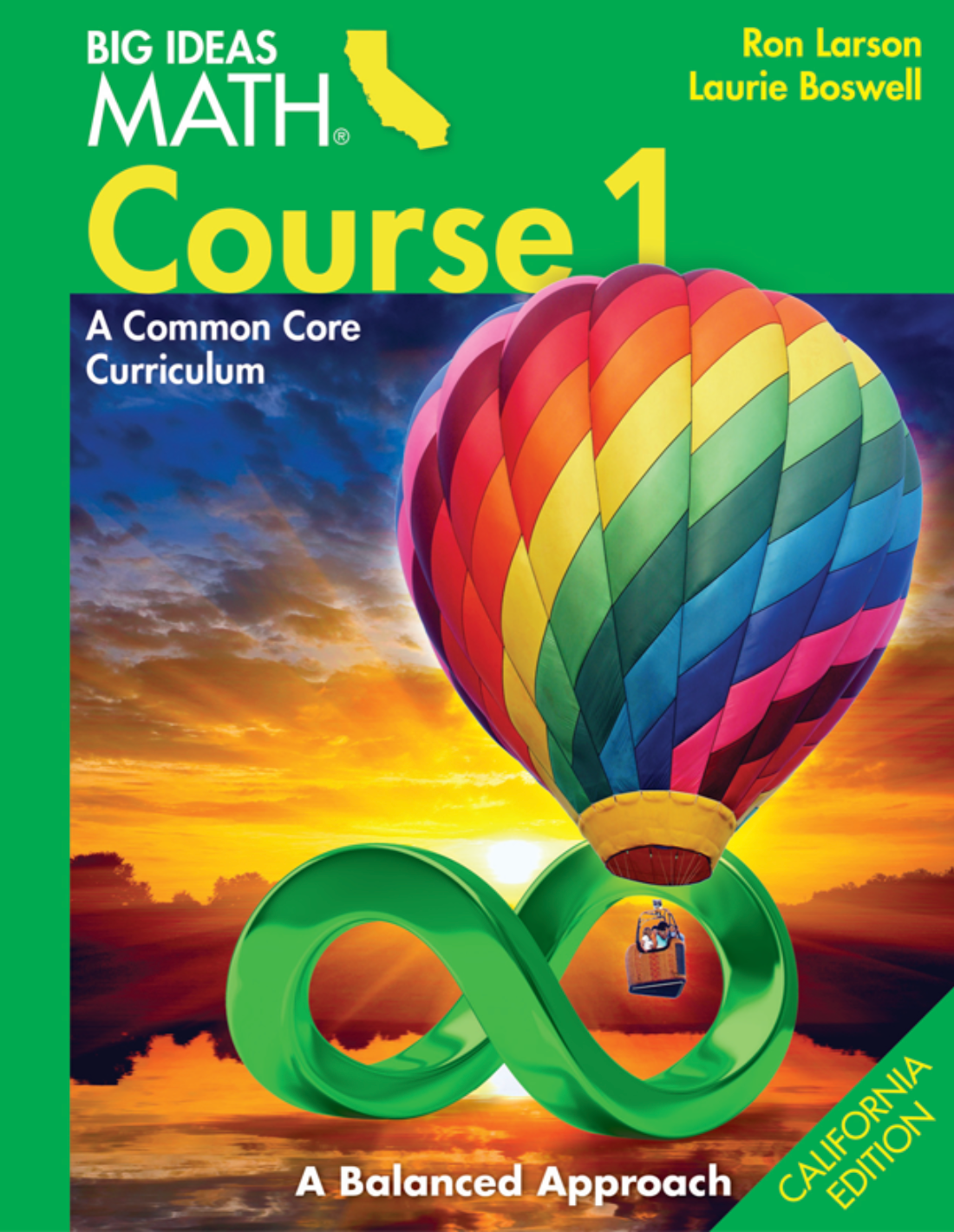
Big Ideas Math, Course 1
Grade 6Math0 chapters, 0 lessons
Big Ideas Math, Course 1 is a Grade 6 mathematics textbook published by Big Ideas Learning that covers foundational middle school math concepts. The curriculum spans numerical expressions and factors, fractions and decimals, algebraic expressions, ratios and rates, integers and the coordinate plane, equations and inequalities, geometry topics including areas of polygons and surface area and volume, and data analysis through statistical measures and data displays. It is designed to build students' conceptual understanding and problem-solving skills in preparation for more advanced pre-algebra and algebra coursework.
Chapters & Lessons
Frequently Asked Questions
- Is Big Ideas Math Course 1 the right textbook for my sixth grader?
- Big Ideas Math Course 1 is one of the most widely adopted Grade 6 math textbooks in the U.S., and it is a solid choice for students entering middle school math. It covers the full range of sixth-grade Common Core topics - numerical expressions, fractions, decimals, ratios, integers, algebraic expressions, equations, geometry, and data analysis. Compared to enVision Math or Reveal Math, it has a straightforward, practice-heavy approach that works well for students who learn by doing many problems. If your child's school uses it, it is well-aligned to what they need. It is also a good homeschool option.
- Which chapters in Big Ideas Math Course 1 are hardest for sixth graders?
- Chapter 4 on ratios and rates is where many students first get stuck - the concepts of unit rate, equivalent ratios, and proportional reasoning are new and abstract. Chapter 6 on equations and inequalities is another major hurdle because students often confuse expression simplification with equation solving. Chapter 7 on area of polygons - especially triangles and composite figures - and Chapter 8 on surface area and volume challenge students whose spatial visualization is not yet strong. Chapter 9 on statistical measures trips up students who struggle with mean, median, mode, and interpreting data displays.
- My child is struggling with ratios and rates. Where in this textbook should they start?
- Go back to Chapter 1 first to verify that your child has solid fluency with multiplication, division, and fractions - ratios only click when those are automatic. Then start Chapter 4 at Lesson 1 on writing and comparing ratios before moving to Lesson 2 on rates and unit rates. The most common mistake is rushing to cross-multiplication without truly understanding what a unit rate means. Use grocery store prices and sports statistics as real-world anchors. Do not proceed to Chapter 5 on percent until unit rates feel completely comfortable.
- My child just finished Big Ideas Math Course 1. What should they study next?
- The natural next step is Big Ideas Math Course 2 (Grade 7), which extends ratios into proportional relationships, introduces negative number operations more deeply, covers probability and statistics more rigorously, and begins geometric transformations. If your child did exceptionally well and the school offers it, Big Ideas Math Accelerated compresses Grade 7 and Grade 8 content for students who are ready to reach Algebra 1 early. Building fluency with integers and proportional reasoning over the summer is the best preparation for Course 2.
- How can Pengi help my child with Big Ideas Math Course 1?
- Pengi is especially helpful for the problem types in this textbook where students get stuck mid-problem and have nobody to ask. If your child is lost on a ratio table problem from Chapter 4 or confused about how to find surface area in Chapter 8, Pengi can walk through the specific problem step by step, explain where the thinking went wrong, and generate similar practice problems. Pengi is also useful for checking whether your child truly understands a concept versus just memorizing a procedure - it can ask follow-up questions that expose gaps before the test.
Ready to start learning?
Jump into your first lesson for Big Ideas Math, Course 1. Free, no account required.
Start Learning