
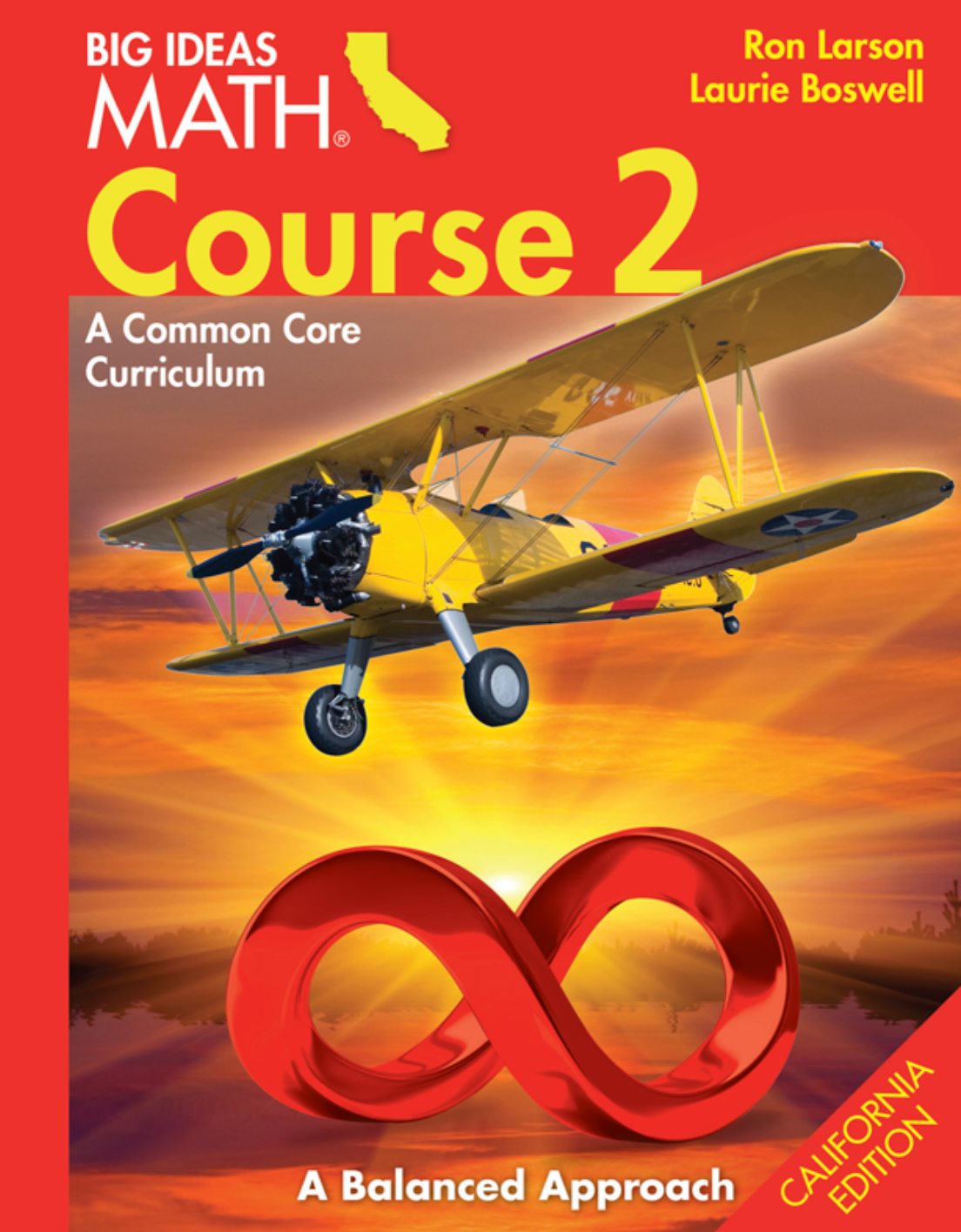
Big Ideas Math, Course 2
Grade 7Math0 chapters, 0 lessons
Big Ideas Math, Course 2, published by Big Ideas Learning LLC, is a Grade 7 mathematics textbook designed to build core middle school math skills through a rigorous, balanced approach. The curriculum covers a broad range of topics including integers, rational numbers, expressions and equations, inequalities, ratios and proportions, percents, constructions and scale drawings, circles and area, surface area and volume, and probability and statistics. Aligned with Common Core standards, the program emphasizes conceptual understanding, procedural fluency, and real-world problem-solving to prepare seventh-grade students for advanced mathematics.
Chapters & Lessons
Frequently Asked Questions
- Is Big Ideas Math Course 2 the right textbook for my 7th grader?
- Big Ideas Math Course 2 is a solid, Common Core-aligned Grade 7 math textbook that covers all the essential middle school topics: integers, rational numbers, expressions and equations, inequalities, ratios and proportions, percents, geometry, and probability. It takes a balanced approach between conceptual understanding and procedural fluency. If your child is on a standard 7th-grade math track, this book covers exactly what they need. It is also widely used in Florida and other states, so tutoring resources and teacher materials are readily available. Students targeting accelerated tracks should confirm their school uses Course 2 specifically, as Course 3 covers 8th-grade material.
- Which chapters in Big Ideas Math Course 2 are hardest for 7th graders?
- Chapter 4 (Inequalities) and Chapter 5 (Ratios and Proportions) are where many students struggle. In Chapter 4, the rule about reversing the inequality sign when multiplying or dividing by a negative number is frequently forgotten or misapplied. Chapter 5's Lesson 5 on slope and Lesson 6 on direct variation introduce graphing concepts that feel abstract compared to earlier arithmetic. Chapter 6 (Percents) also trips up students with its percent equation, percent of increase and decrease, and simple interest formula - all requiring multi-step setups that students mix up under test pressure.
- My child struggles with integers and negative numbers - where should they start in this book?
- Start at Chapter 1, Lesson 1 (Integers and Absolute Value), and work through all five lessons in sequence without skipping. The rules for adding, subtracting, multiplying, and dividing integers in Lessons 2-5 build on each other, and gaps here will cause cascading errors in Chapter 2 (Rational Numbers) and beyond. Make sure your child can explain why the rules work, not just recite them - for example, why multiplying two negatives gives a positive. Once Chapter 1 feels solid, Chapter 2's rational number operations follow the same sign rules, so the transition becomes much smoother.
- What should my child study after completing Big Ideas Math Course 2?
- After Course 2, students move to Big Ideas Math Course 3 (Grade 8), which covers linear equations, functions, systems of equations, the Pythagorean theorem, and an introduction to transformations - all direct extensions of Course 2 content. The Chapter 5 work on slope and proportions in Course 2 leads directly into Course 3's focus on linear functions and graphing. Students who excelled in Course 2 may be candidates for an accelerated path into Algebra 1 in 8th grade. Check with your child's school counselor about whether Course 3 or Algebra 1 is the right next step.
- How can Pengi help my child with Big Ideas Math Course 2?
- Pengi can provide targeted, on-demand help for any chapter in Big Ideas Math Course 2. If your child is tangled in the percent equation from Chapter 6, confused by direct variation graphs in Chapter 5, or unsure how to set up a two-step inequality in Chapter 4, Pengi walks through the exact problem type with step-by-step explanations. Pengi also helps with real-world application problems - the type that appear frequently in this textbook - by breaking down what the problem is asking before setting up the equation. Consistent Pengi practice between chapters helps prevent the skill gaps that compound in 7th-grade math.
Ready to start learning?
Jump into your first lesson for Big Ideas Math, Course 2. Free, no account required.
Start Learning