
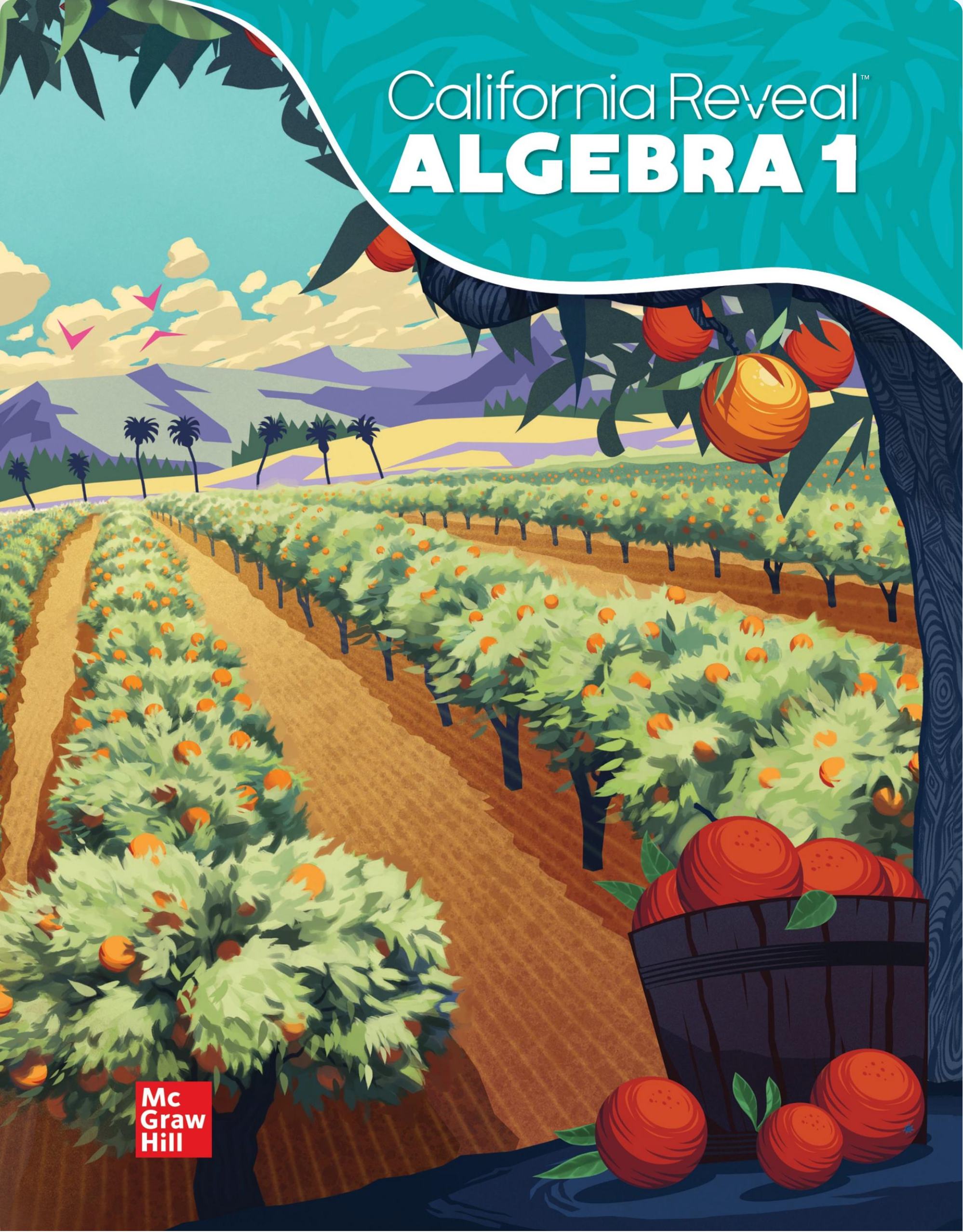
California Reveal Math, Algebra 1
California Reveal Math, Algebra 1 is a Grade 9 mathematics textbook designed for California students, covering the full scope of first-year algebra concepts. The course spans eleven units that take students from foundational expressions and equations through relations and functions, linear and nonlinear functions, linear equations and inequalities, systems of equations and inequalities, exponents and roots, exponential functions, and polynomials, culminating in quadratic functions and introductory statistics. Built to align with California's math standards, it gives ninth graders a rigorous, concept-driven foundation in algebraic reasoning and data analysis.
Chapters & Lessons
Frequently Asked Questions
- Is California Reveal Math Algebra 1 right for my ninth grader?
- California Reveal Math Algebra 1 is designed specifically for California standards and works well for ninth graders taking Algebra 1 for the first time or students transitioning from an accelerated middle school path. The course organizes 11 units that move logically from expressions and equations through functions, linear and quadratic relationships, and statistics. It emphasizes conceptual understanding alongside procedural fluency, which suits students who learn better when they understand the why behind a method. If your child's school uses Big Ideas or CPM instead, the core topics are similar, but Reveal Math's visual models and California-specific framing make it a natural fit for CA public school students.
- Which units in California Reveal Math Algebra 1 are hardest for students?
- Unit 10 on Quadratic Functions is where most students hit a wall—graphing parabolas, identifying the vertex and axis of symmetry, and connecting the three forms of a quadratic equation demand fluency with multiple representations at once. Unit 6 (Systems of Linear Equations and Inequalities) is also consistently difficult because students must coordinate graphing, substitution, and elimination methods and know when to apply each. Unit 9 (Polynomials) trips up students who are not yet fluent with the distributive property and signed number operations. Units 7 and 8 on exponents and exponential functions introduce new conceptual territory—growth and decay modeling—that most ninth graders encounter for the first time.
- My child is weak on functions—where should they start in this textbook?
- Start with Unit 2 (Relations and Functions), which introduces domain, range, function notation, and the vertical line test. Work through every lesson there before moving to Unit 3, which distinguishes linear from nonlinear functions and introduces rate of change as slope. If your child struggles with the graphing in Unit 3, return to Unit 1 to confirm that equation-solving and expression evaluation are solid—those are prerequisites. The function concept then reappears in Units 8 and 10, so a strong Unit 2 foundation pays dividends throughout the course. Pengi can help identify which specific definition or notation is causing the confusion.
- What should my child study after finishing California Reveal Math Algebra 1?
- The standard California pathway continues with Geometry, followed by Algebra 2. Students who finish Algebra 1 with strong performance in Units 6, 9, and 10 are well-positioned for Geometry since proof and reasoning skills transfer directly. If your child is on an accelerated track aiming for AP Calculus by senior year, mastering the exponential and quadratic work in Units 8 through 10 is critical before moving forward. Summer work that reinforces factoring polynomials, solving quadratic equations by multiple methods, and graphing linear and exponential functions will make the transition to Geometry much smoother.
- How can Pengi help my child with California Reveal Math Algebra 1?
- Pengi can walk your child through any unit in Reveal Math with step-by-step explanations tailored to their current level. For the notorious trouble spots—factoring in Unit 9, graphing parabolas in Unit 10, or setting up systems of equations in Unit 6—Pengi can generate similar practice problems, explain where a specific solution went wrong, and offer alternative methods when the standard approach is not clicking. Students preparing for California state assessments can use Pengi to review the statistics unit and practice interpreting data displays. Pengi is available late at night before a test, which is exactly when students need help most.
Ready to start learning?
Jump into your first lesson for California Reveal Math, Algebra 1. Free, no account required.
Start Learning