
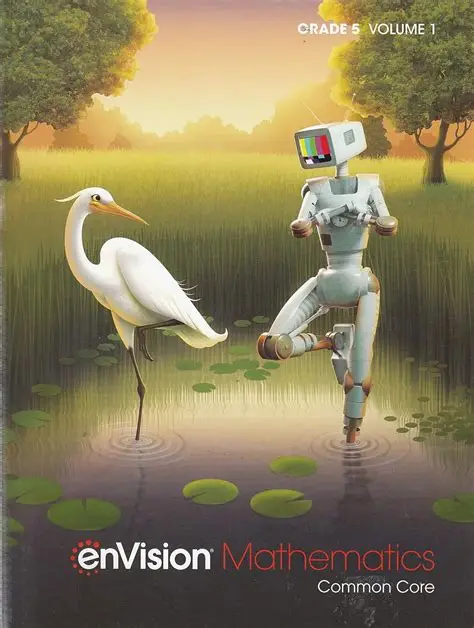
enVision, Mathematics, Grade 5
Grade 5Math0 chapters, 0 lessons
enVision Mathematics Grade 5, published by Savvas Learning Company (formerly Pearson), is a comprehensive fifth-grade math program designed to build deep conceptual understanding alongside procedural fluency. The curriculum covers a wide range of topics including place value, multi-digit multiplication and division, operations with decimals and fractions, measurement conversion, volume, and data interpretation. Students also explore foundational algebra concepts such as numerical expressions, patterns, relationships, and graphing points on the coordinate plane, preparing them for middle school mathematics.
Chapters & Lessons
Frequently Asked Questions
- Is enVision Mathematics Grade 5 right for my fifth grader?
- enVision Mathematics Grade 5 is a widely adopted, visually rich curriculum that balances conceptual understanding with procedural practice. Its 16 chapters cover the full fifth-grade scope: place value, decimal operations, multi-digit multiplication and division, fractions, volume, measurement, data, coordinate graphing, and geometry. The curriculum uses visual models—number lines, area models, tape diagrams—extensively, making it a good fit for students who understand math better when they can see it. enVision is used broadly in public schools, so if your child's teacher assigns it, this is the right resource. If you are comparing it to Eureka Math, enVision tends to be more student-friendly in presentation while covering the same standards.
- Which chapters in enVision Mathematics Grade 5 are hardest for fifth graders?
- Chapters 8 and 9 on multiplying and dividing fractions are consistently the most difficult—students must reason about what it means to take a fraction of a fraction, which has no obvious real-world parallel they can picture intuitively. Chapter 6 (Dividing Decimals) comes close behind, especially when dividing by a decimal rather than a whole number. Chapter 7 (Adding and Subtracting Fractions) trips up students who do not yet fluently find common denominators with unlike fractions. Chapters 14 and 15 on coordinate graphing and pattern analysis are conceptually new territory for most fifth graders and require careful sequencing. Chapter 4 (Multiplying Decimals) also produces consistent errors around decimal point placement.
- My child is weak on fractions—where should they start in enVision Mathematics Grade 5?
- Start with Chapter 7 (Use Equivalent Fractions to Add and Subtract Fractions), which reviews how to find common denominators before adding and subtracting. Make sure your child can do this reliably with unlike denominators before moving to Chapter 8 (Multiply Fractions) or Chapter 9 (Divide Fractions). If Chapter 7 feels too hard, the gap is likely in equivalent fraction fluency from fourth grade—Pengi can help bridge that quickly. Once addition and subtraction of fractions are solid, the multiplication model in Chapter 8 makes much more sense because students can visualize multiplying as repeated addition before the algorithm is introduced.
- What should my child study after finishing enVision Mathematics Grade 5?
- The standard next course is sixth-grade math, which typically covers ratios and proportional reasoning, negative numbers, expressions and equations, area and surface area, and statistics. Concepts from enVision Grade 5 that appear most heavily in sixth grade are fraction operations (Chapters 7 through 9), coordinate graphing (Chapter 14), and writing and interpreting numerical expressions (Chapter 13). A student who finished enVision Grade 5 with strong performance in those chapters is well prepared for the jump to sixth-grade math. If their school uses a middle school transition program like Reveal Math 6 or Big Ideas Math Course 1, both draw directly on the fraction and expression work done in fifth grade.
- How can Pengi help my child with enVision Mathematics Grade 5?
- Pengi can explain any enVision concept using additional visual models and plain-language descriptions when the textbook's approach is not landing. For fraction division in Chapter 9—one of the most counterintuitive concepts in fifth-grade math—Pengi can walk through the keep-change-flip method step by step, show why it works using a number line model, and generate practice problems at a controlled difficulty level. When your child has a worksheet due and gets stuck partway through, Pengi can diagnose the specific misunderstanding rather than just providing the answer. Pengi is also useful for reviewing coordinate graphing in Chapter 14, which students often need explained more than once to visualize correctly.
Ready to start learning?
Jump into your first lesson for enVision, Mathematics, Grade 5. Free, no account required.
Start Learning