
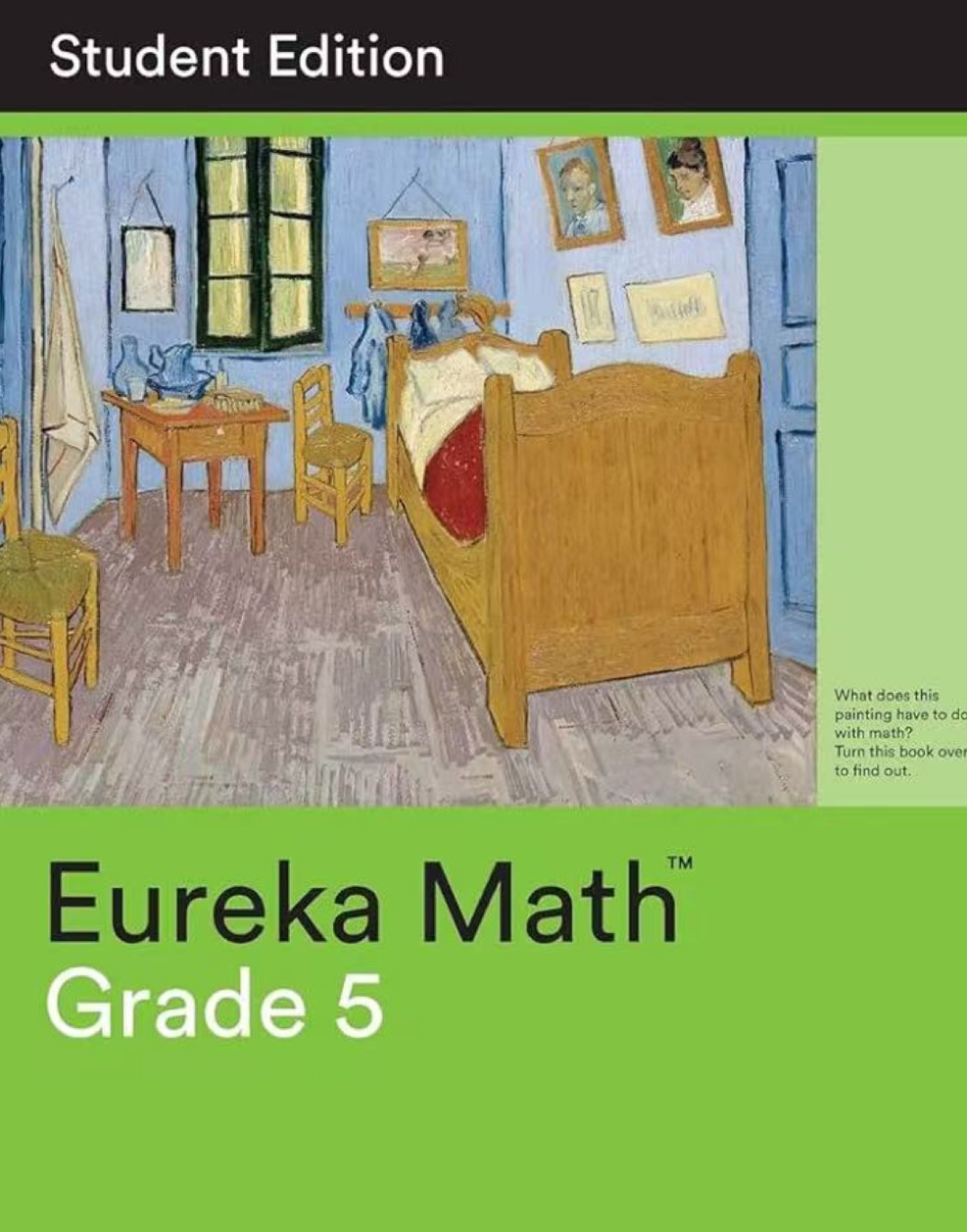
Eureka Math, Grade 5
Eureka Math Grade 5, published by Great Minds, is a rigorous fifth-grade mathematics curriculum that builds deep number sense and problem-solving fluency across core topics including multi-digit whole number and decimal multiplication and division, fractions, and measurement. Students explore place value patterns, operations with decimals, fraction equivalence, multiplication and division of fractions, and foundational geometry concepts such as coordinate systems, two-dimensional shapes, and volume. The program also introduces algebraic thinking through numerical expressions, scaling, and graphing patterns in the coordinate plane, preparing students for the transition to middle school mathematics.
Chapters & Lessons
Frequently Asked Questions
- Is Eureka Math Grade 5 right for my fifth grader?
- Eureka Math Grade 5 is a rigorous, conceptually deep curriculum that is widely used in US public schools. Its 26 chapters are organized as modules and progress from place value and decimal operations through multi-digit multiplication and division, fractions, and coordinate geometry. Eureka emphasizes mathematical reasoning and models—tape diagrams, number bonds, area models—over algorithm-first instruction, which can feel unfamiliar to parents who learned math traditionally. It is an excellent program for students who will ultimately take advanced math, but the depth means students need to keep up weekly—falling behind in the early decimal and place value chapters makes the fraction chapters much harder. Compare it to enVision or Go Math if you prefer a more visually guided format.
- Which chapters in Eureka Math Grade 5 are hardest for students?
- Chapters 21 through 25 on fraction multiplication and division are where most students struggle—particularly Chapter 23 (Multiplication of a Fraction by a Fraction), which requires understanding the area model for fraction multiplication before the algorithm makes intuitive sense. Chapter 25 (Division of Fractions and Decimal Fractions) is the course's most demanding topic. The early decimal chapters—Chapters 5 and 6 on multiplying and dividing decimals—are also sources of persistent errors, especially around decimal point placement. Chapters 7 through 14 on multi-digit multiplication and division can overwhelm students who have not yet achieved fact fluency, since the algorithms require holding intermediate results accurately across multiple steps.
- My child is weak on decimals—where should they start in Eureka Math Grade 5?
- Start with Chapters 1 and 2 (Place Value and Decimal Fractions), which establish the conceptual foundation—understanding that tenths and hundredths extend the base-10 system. If those chapters feel shaky, the gap is likely in fourth-grade place value work, and spending a week reviewing Chapter 1 is worth the investment. Then work through Chapters 3 and 4 (Rounding and Adding/Subtracting Decimals) in sequence before attempting multiplication or division of decimals in Chapters 5 and 6. A student who understands why moving the decimal point is equivalent to multiplying by a power of 10—a key insight from Chapter 1—will find Chapters 5 and 6 much more manageable than one who memorizes the procedure without the underlying logic.
- What should my child study after finishing Eureka Math Grade 5?
- Eureka Math Grade 6 is the direct continuation, which extends into ratios, proportional reasoning, integers, expressions, equations, and statistics. The fraction and decimal fluency developed in Eureka Grade 5—especially the fraction division work in Chapter 25—is directly prerequisite for sixth-grade ratio and proportion. Students who completed Grade 5 with strong performance in the fraction modules are well prepared for the algebraic thinking introduced in sixth grade. Over the summer, practicing multi-digit computation fluency and reviewing fraction-to-decimal conversions will keep the skills sharp. The transition from arithmetic to algebra in sixth grade goes smoothly when decimal and fraction operations are automatic.
- How can Pengi help my child with Eureka Math Grade 5?
- Pengi is especially valuable for Eureka Math because the curriculum's deep conceptual approach sometimes leaves students confused when a model doesn't click—and teachers move on before every student is ready. When your child is stuck on the tape diagram model in fraction chapters or doesn't understand why the decimal algorithm works, Pengi can re-explain the concept from a different angle without judgment or time pressure. For the demanding fraction multiplication and division chapters 21 through 25, Pengi can generate parallel problems at a slightly easier level to build confidence before returning to grade-level complexity. Pengi can also help parents understand Eureka's models well enough to coach their child at home.
Ready to start learning?
Jump into your first lesson for Eureka Math, Grade 5. Free, no account required.
Start Learning