
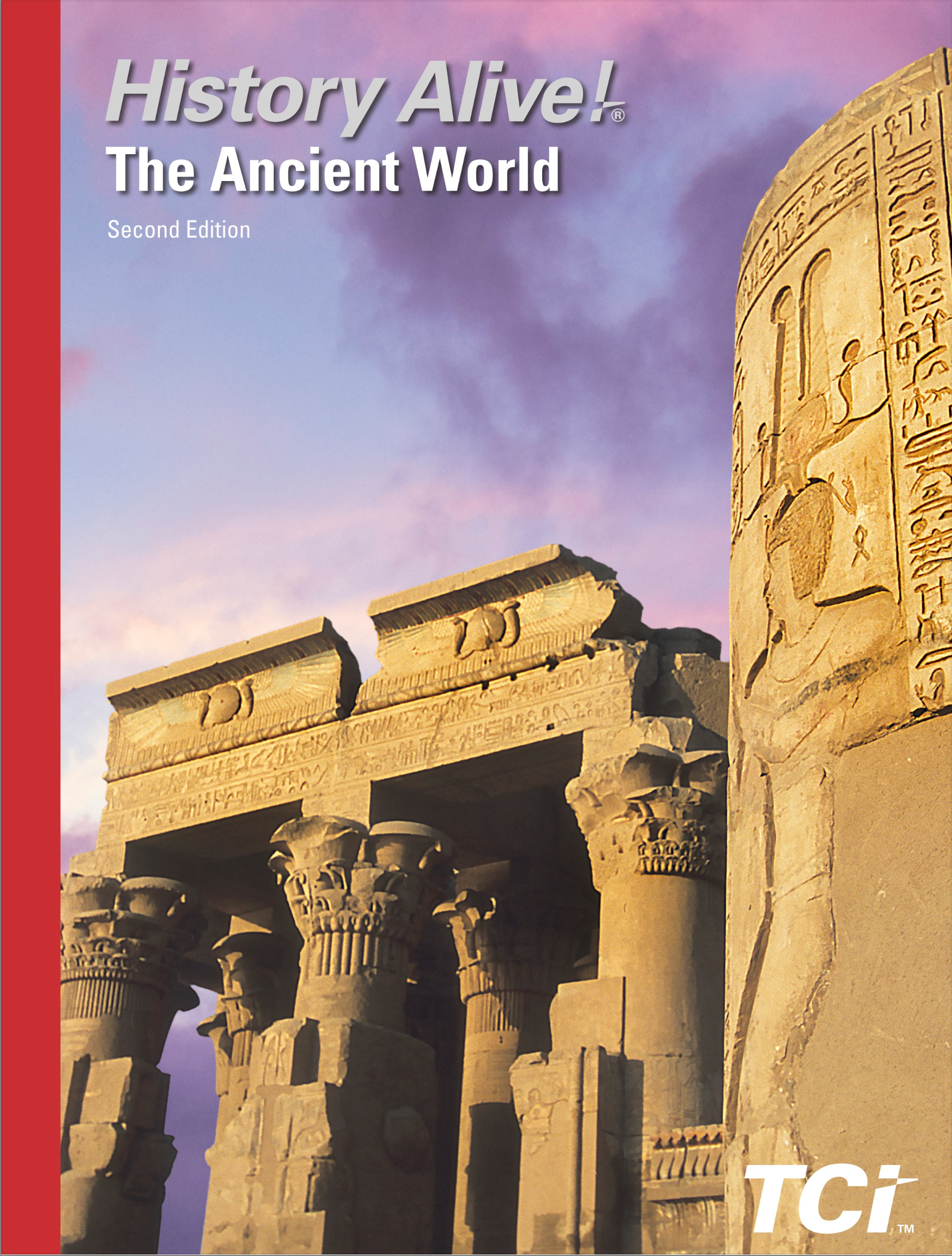
History Alive! The Ancient World
History Alive! The Ancient World, published by Teachers' Curriculum Institute (TCI), is a Grade 6 history textbook that takes students on a comprehensive journey through the origins and development of human civilization. The textbook covers six major units spanning early humans and the rise of civilization, Ancient Egypt and the Middle East, Ancient India, Ancient China, Ancient Greece, and Ancient Rome, exploring topics such as geography, government, culture, religion, and daily life in each society. Known for its interactive, student-centered approach, it helps sixth graders build foundational knowledge of the ancient world through engaging activities, primary sources, and vivid visuals.
Chapters & Lessons
Frequently Asked Questions
- Is History Alive! The Ancient World right for my sixth grader?
- History Alive! The Ancient World is one of the most popular sixth-grade world history programs in the US, published by Teachers Curriculum Institute. Its six chapters cover early humans, ancient Egypt, India, China, Greece, and Rome in a coherent sequence that aligns directly with most sixth-grade social studies standards. The curriculum emphasizes interactive learning—students analyze primary sources, complete graphic organizers, and engage in structured academic controversies—making it more engaging than a traditional read-and-answer textbook. If your child's school uses this program, it is the right resource. Compare it to IMPACT California Social Studies Grade 6, which covers similar civilizations with California-specific framing, if your child's school uses that edition instead.
- Which chapters in History Alive! The Ancient World are hardest for sixth graders?
- Chapter 3 (Ancient India) and Chapter 5 (Ancient Greece) are consistently the most challenging. Chapter 3 requires students to understand the caste system, dharma, and karma as interconnected concepts that shape social structure—abstract ideas without strong Western parallels. Chapter 5 covers democratic government, philosophy, the Persian Wars, and Alexander the Great in a single chapter, which is a lot of conceptual territory. Chapter 6 (Ancient Rome) spans the Republic, Empire, and fall of Rome, requiring students to track political transformation over centuries. Chapter 1 (Early Humans) is conceptually accessible but requires reasoning about timelines spanning hundreds of thousands of years, which challenges students who struggle with scale.
- My child is struggling with ancient civilizations—where should they start?
- Chapter 1 is the essential entry point—it establishes the framework of how historians study the past, introduces primary and secondary sources, and explains the shift from hunter-gatherer to agricultural societies that underpins every subsequent chapter. From there, Chapter 2 (Ancient Egypt) is the most concrete and visually engaging—students can anchor on the Nile, pyramids, and pharaohs before moving to less familiar civilizations. If your child is specifically confused about India in Chapter 3, a few extra days on the geography map—understanding the Indus Valley location and monsoon patterns—often unlocks the chapter content, since the geography directly caused the civilization's patterns.
- What should my child study after finishing History Alive! The Ancient World?
- The natural follow-on is History Alive! The Medieval World and Beyond (Grade 7), which picks up where this book leaves off and covers medieval Europe, Islam, Africa, the Americas, and Asia through the early modern period. Students who have a strong grasp of Ancient Rome from Chapter 6 will find the Medieval Europe chapter in the next book much more coherent, since the fall of Rome is the starting point for medieval history. For students who want to go deeper on any civilization covered here, Pengi has additional textbooks and resources on ancient Egypt, Greece, and Rome that can extend this foundation before seventh grade.
- How can Pengi help my child with History Alive! The Ancient World?
- Pengi can make the interactive components of History Alive more effective by helping students prepare for structured academic controversies and socratic discussions. Before your child's class debates whether Alexander the Great deserves to be called 'the Great,' Pengi can help them research arguments from both sides using Chapter 5 content. For primary source analysis—examining Egyptian hieroglyphs, excerpts from the Code of Hammurabi, or Confucian texts—Pengi can explain the historical context and walk students through how to analyze a document. Pengi also helps with the geographic component: if your child is confused about where the Mauryan Empire fits on a map or what the Silk Road connected, Pengi can visualize and explain it clearly.
Ready to start learning?
Jump into your first lesson for History Alive! The Ancient World. Free, no account required.
Start Learning