
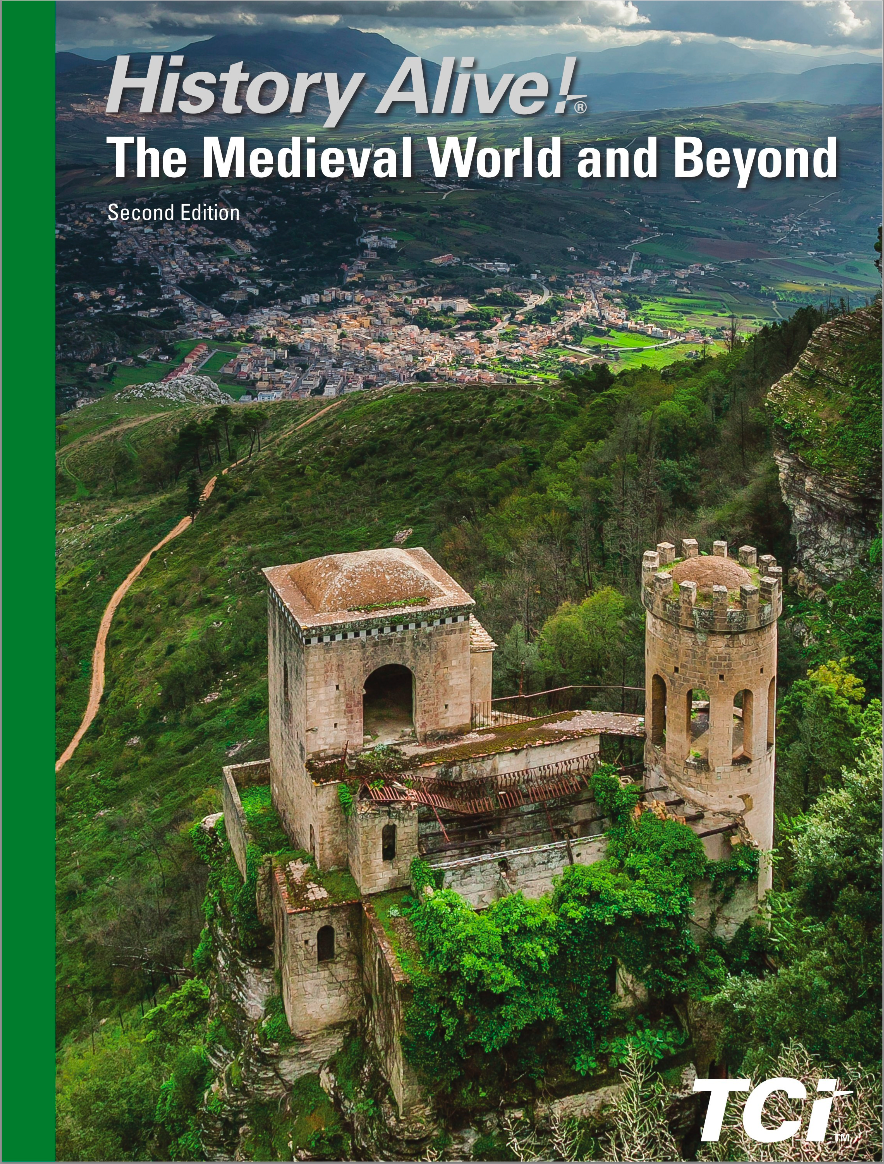
History Alive! The Medieval World and Beyond
Grade 7History0 chapters, 0 lessons
History Alive! The Medieval World and Beyond, published by Teachers' Curriculum Institute (TCI), is a Grade 7 history textbook that takes students on a broad survey of world civilizations from roughly 300 to 1500 CE. The curriculum covers medieval Europe, the rise and spread of Islam, South Asia, West African kingdoms, Imperial China, feudal Japan, and the civilizations of the Americas, giving students a genuinely global perspective on the medieval period. It concludes by examining the European Renaissance, Reformation, and the early transition into the modern age.
Chapters & Lessons
Frequently Asked Questions
- Is History Alive! The Medieval World and Beyond right for my seventh grader?
- History Alive! The Medieval World and Beyond is an excellent choice for seventh-grade world history. Its 10 chapters cover medieval Europe, Islam, South Asia, West Africa, Imperial China, medieval Japan, the Americas, the Renaissance, the Reformation, and the early modern transition—a genuinely global scope that matches most seventh-grade state standards. Teachers Curriculum Institute designed it around interactive learning: students use maps, primary sources, and comparative analysis rather than passive reading. It is widely used in California and other states. If your child's school uses this textbook, it is the right resource. Students who completed History Alive! The Ancient World in sixth grade will find the transition natural since this book picks up chronologically where that one ends.
- Which chapters in History Alive! The Medieval World and Beyond are hardest for seventh graders?
- Chapter 2 (Islam in Medieval Times) and Chapter 8 (The Medieval World, 1200-1490) are consistently the most challenging. Chapter 2 requires students to understand the Five Pillars, the spread of Islam, and the political fragmentation of the caliphate as interconnected phenomena—unfamiliar religious and political vocabulary creates barriers. Chapter 8 is a synthesis chapter that asks students to connect developments across multiple regions, which demands broader retention than individual chapter study typically builds. Chapter 9 (Europe's Renaissance and Reformation) is also demanding because students must track how economic, religious, and intellectual forces interact simultaneously across a century and a half. Chapter 3 (South Asia 300-1200) is content-dense with terminology unfamiliar to most American students.
- My child is struggling with medieval history—where should they start?
- Start with Chapter 1 (Europe During Medieval Times) because it is the most familiar starting point for US students—feudalism, knights, the Catholic Church, and the Crusades connect to prior knowledge from elementary school and popular culture. Once your child has the medieval European framework in mind, Chapter 2 (Islam) makes more sense because much of the Islamic empire's story unfolds in relation to Europe and Byzantium. From there, working through the non-European chapters (3 through 7) in order builds a comparative picture: by the time students reach Chapter 8's synthesis, they have frameworks for Africa, China, Japan, and the Americas that allow cross-regional comparison. Review the maps at the start of each chapter before reading the text.
- What should my child study after finishing History Alive! The Medieval World and Beyond?
- Eighth-grade US history is the standard next course in most school sequences. Students who have completed the Renaissance and Reformation chapters (9 and 10) are well prepared because those topics directly connect to the colonization of the Americas, which is often the starting point for eighth-grade US history. Pengi Social Studies Grade 8 picks up exactly at the Revolutionary Era, which follows logically from the European transformations covered in this book's final chapters. Students interested in going deeper on any region—Islamic civilization, Imperial China, or West Africa—will find additional textbook resources on Pengi that extend those specific chapters.
- How can Pengi help my child with History Alive! The Medieval World and Beyond?
- Pengi can help your child prepare for the interactive components that are central to this curriculum—socratic seminars, structured debates, and document-based questions. Before a class discussion on whether the Crusades were justified, Pengi can help your child develop evidence-based arguments from Chapter 1 and Chapter 2 perspectives. For the dense terminology chapters like Chapter 2 (Islam) or Chapter 3 (South Asia), Pengi can create glossaries, explain interconnections between terms, and generate practice questions that mirror what shows up on chapter tests. When your child needs to write a comparative essay across two chapters—say, comparing Imperial China and medieval Japan—Pengi can help structure the argument and identify relevant evidence.
Ready to start learning?
Jump into your first lesson for History Alive! The Medieval World and Beyond. Free, no account required.
Start Learning