
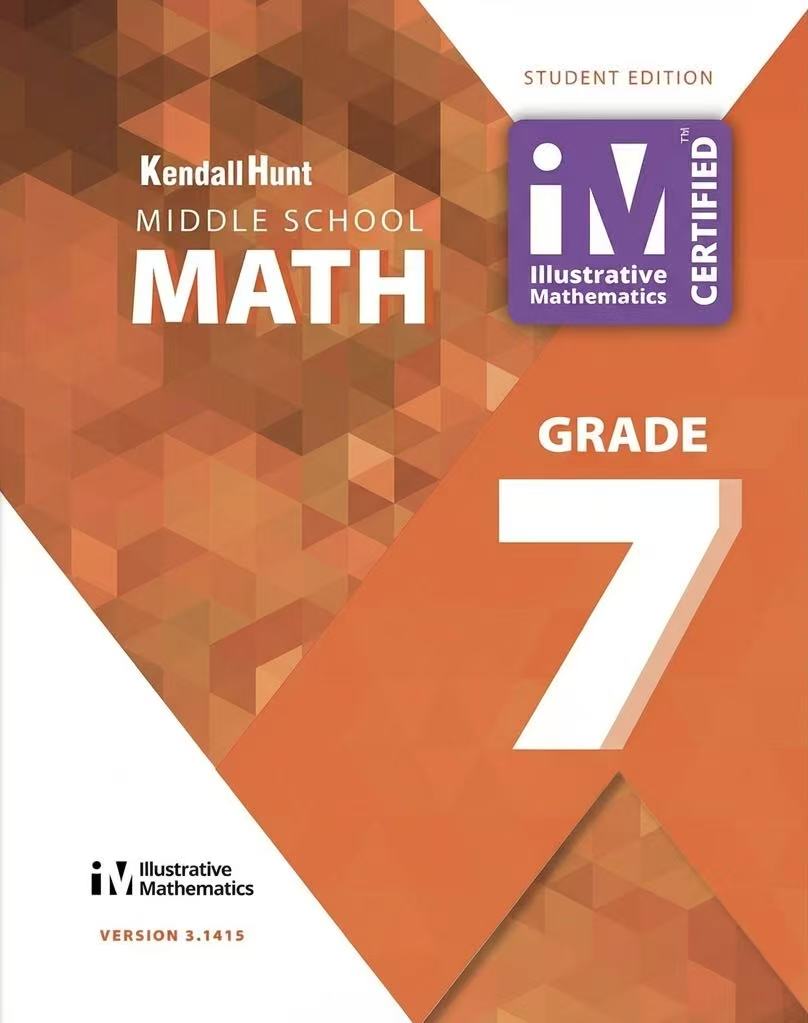
Illustrative Mathematics, Grade 7
Grade 7Math0 chapters, 0 lessons
Illustrative Mathematics Grade 7 is a comprehensive seventh-grade math curriculum that guides students through core middle school mathematics concepts with a focus on deep understanding and problem-solving. The course covers scale drawings, proportional relationships, percentages, circle measurements, rational number arithmetic, expressions, equations, and inequalities, as well as geometry topics including angles, triangles, and prisms. It also introduces students to foundational data and statistics concepts through units on probability and sampling.
Chapters & Lessons
Frequently Asked Questions
- Is Illustrative Mathematics Grade 7 the right math curriculum for my child?
- Illustrative Mathematics Grade 7 is an excellent choice for students who do best when they understand the reasoning behind math rather than just memorizing procedures. The curriculum takes a problem-solving-first approach — students explore scale drawings, proportional relationships, rational numbers, and geometry through real-world contexts before formalizing rules. It is widely used in US middle schools and aligns with Common Core standards. It works well for curious, discussion-oriented learners. If your child struggles with open-ended problems or needs more procedural practice repetition, supplementing with extra exercises is recommended.
- Which chapters or units in Illustrative Mathematics Grade 7 are the hardest for students?
- Chapter 5 (Rational Number Arithmetic) is where many students hit a wall, particularly Lesson 5 on solving equations with negative number coefficients like -1/2 x = 1/4. The jump from understanding signed numbers conceptually to manipulating them algebraically requires real mastery. Chapter 6 (Expressions, Equations, and Inequalities) builds directly on this and Lesson 3 on inequalities trips students up when they need to think about why a solution to 100 + 12n >= 500 has infinitely many answers. Chapter 8 (Probability and Sampling) can feel abstract, especially using mean absolute deviation to evaluate the reliability of sample estimates in Lesson 4.
- My child struggles with fractions and proportional reasoning — where should they begin?
- Start with Chapter 2 (Introducing Proportional Relationships), specifically Lesson 1 using tables and Lesson 2 using equations in the form y = kx. These lessons use very concrete, real-world contexts — rice servings, paint mixing — that make the constant of proportionality tangible. Lesson 3, which compares proportional to nonproportional relationships, is essential for building accurate intuition. Once your child can confidently identify whether a relationship is proportional from a table and write its equation, Chapter 4 (Proportional Relationships and Percentages) becomes accessible, and that foundation carries through to Chapter 5's rational number work.
- What should my child study after finishing Illustrative Mathematics Grade 7?
- After completing IM Grade 7, the natural progression is Illustrative Mathematics Grade 8 or a comparable 8th-grade math course, which covers linear equations, systems of equations, functions, and the Pythagorean theorem. The work your child did in Chapters 5 and 6 on rational number arithmetic and solving equations provides the exact foundation for 8th grade algebra. The statistics and sampling work in Chapter 8 feeds into the scatter plot and data analysis units in Grade 8. If your child performed strongly in Chapter 6 and the probability unit, they may be ready to begin an Algebra 1 course rather than following the standard Grade 8 sequence.
- How can Pengi help my child with Illustrative Mathematics Grade 7?
- Pengi is particularly helpful with the reasoning-heavy aspects of Illustrative Mathematics that can be hard to untangle from a textbook alone. If your child is stuck on Chapter 5 Lesson 5 — solving equations like -2/9t = -12 — Pengi can walk through the logic of using the reciprocal step by step and then generate similar practice problems. For Chapter 8's statistics work on mean absolute deviation and sampling, Pengi can explain what MAD actually tells you using relatable examples before applying the formula. Pengi can also serve as a Socratic partner, asking guiding questions that help your child develop the reasoning skills IM is designed to build rather than just providing answers.
Ready to start learning?
Jump into your first lesson for Illustrative Mathematics, Grade 7. Free, no account required.
Start Learning